U.S. Strategic Re-Engagement Amid Lukoil Sanctions and Implications for Asia
- 1. Executive Summary
- 2.1 Sanctions on Lukoil and the Force Majeure Declaration
- 2.2 Iraq’s Response: Formal Outreach to U.S. Energy Companies
- 3.1 Sanctions as a Tool to Reshape Middle Eastern Energy Dynamics
- 3.2 Ensuring Global Oil Market Stability
- 3.3 Strong Demand for U.S. Technical and Financial Capacity
- 4.1 Iraq’s Balancing Act Among the U.S., Iran, and Russia
- 4.2 Russia’s Pushback and China’s Opportunistic Entry
- 4.3 High Contractual and Operational Risks
- 5.1 Supply Disruptions and Oil Price Volatility
- 5.2 U.S. Operators Could Improve Long-Term Stability
- 5.3 U.S. Presence Links Middle Eastern Stability to Indo-Pacific Strategy
- 6.1 Heightened Political and Contractual Risk in Iraqi Projects
- 6.2 Increased Volatility in Middle Eastern Energy Supply
- 6.3 Reassessment of India-Related Energy and Industrial Portfolios
- 6.4 Strategic Opportunities for Co-Financing
1. Executive Summary
Following the intensification of U.S. sanctions on Russia in 2025, Iraq’s West Qurna-2 (WQ-2) oil field—one of the country’s largest producing assets—has emerged as a new focal point in global geopolitics. Lukoil, the Russian operator, declared force majeure after the sanctions, prompting the Iraqi government to freeze payments and crude allocations and to initiate discussions with several international oil companies, including U.S. majors, over a potential transfer of operational control.
This report examines:
- Whether the United States is actively seeking to acquire influence over Lukoil’s Iraqi assets
- How sanctions are reshaping the Middle Eastern energy landscape
- The downstream implications for Asian economies, particularly India
- Strategic considerations for international financial institutions
The core assessment is:
The U.S. is indeed leveraging Lukoil’s weakened position to expand its influence in Iraq’s upstream sector.
However, achieving full operational control is not guaranteed due to Iraq’s domestic political constraints, Iranian influence, Russian countermeasures, and rising Chinese interest.
The restructuring of WQ-2 will have multi-year consequences for global oil stability, geopolitical alignment, and investment strategies across emerging Asia.
2. Current Situation: A Weakening of Russia’s Position in Iraq
2.1 Sanctions on Lukoil and the Force Majeure Declaration
- In 2025, the U.S. placed Lukoil on its expanded sanctions list, restricting financing and international transactions.
- Lukoil subsequently declared force majeure at WQ-2, disrupting contractual operations.
- Iraq suspended related payments and crude lifting arrangements.
Result: Russia’s most important upstream asset in the Middle East has entered operational limbo.
2.2 Iraq’s Response: Formal Outreach to U.S. Energy Companies
- The Ministry of Oil formally invited American oil majors to consider assuming operatorship.
- Reports indicate ExxonMobil and other companies are in exploratory discussions.
- Chinese and Gulf state firms are simultaneously evaluating the opportunity.
Implication: Iraq seeks a technically capable, politically stable operator—criteria that U.S. firms are well-positioned to meet.
3. Is the United States Actively Targeting the Oilfield? — Evidence Indicates “Yes”
3.1 Sanctions as a Tool to Reshape Middle Eastern Energy Dynamics
Weakening Russia’s upstream footprint in Iraq aligns with U.S. strategic objectives:
- Reducing Moscow’s geopolitical influence in the region
- Reinforcing U.S. leadership in global energy security
- Stabilizing supplies to U.S. partners in Asia
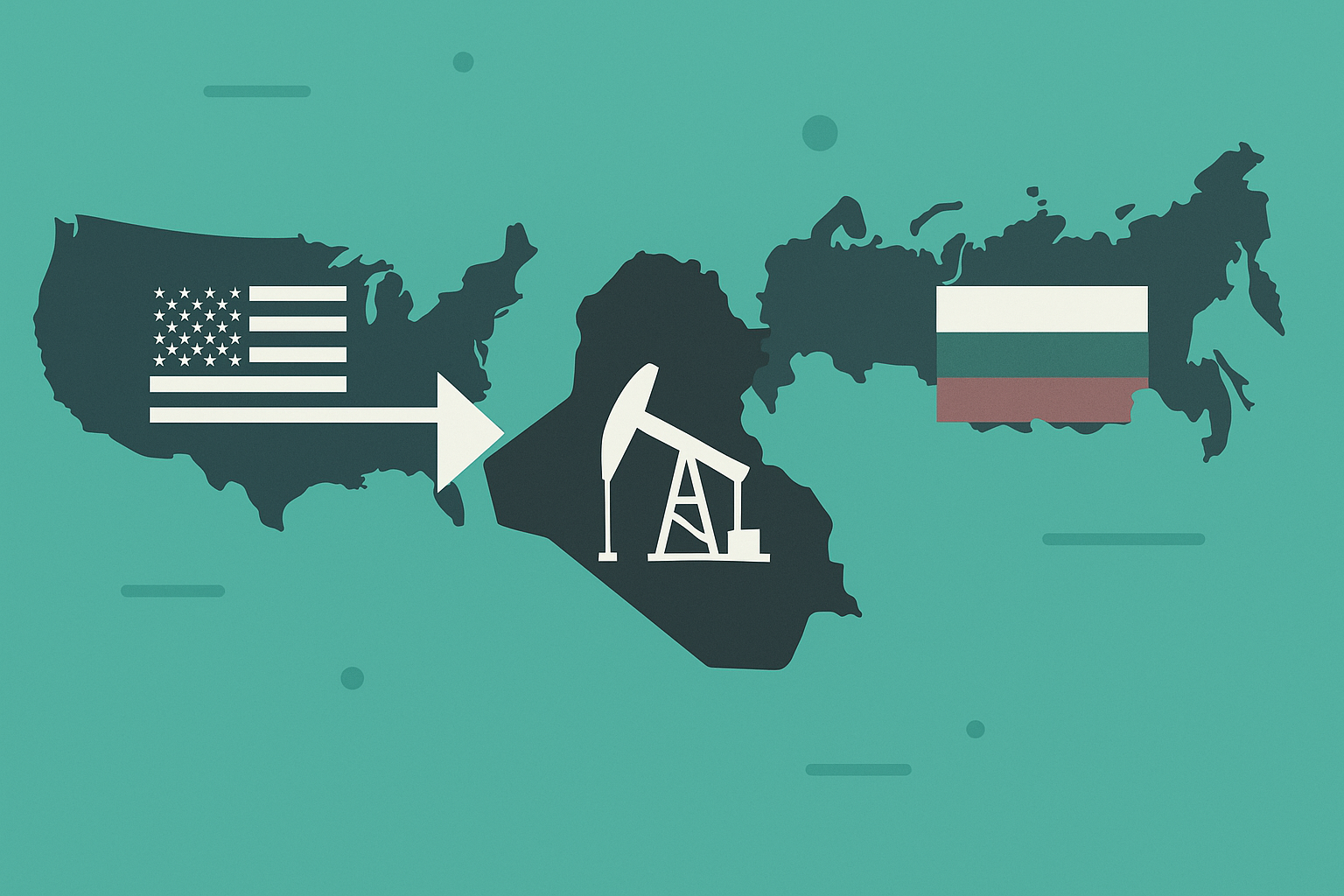
The sequence of events—sanctions → force majeure → Iraqi outreach to U.S. firms—suggests an intentional strategic window.
3.2 Ensuring Global Oil Market Stability
WQ-2 has scalable production potential exceeding 800,000 b/d. U.S. involvement would:
- Boost global supply stability
- Reduce volatility during geopolitical disruptions
- Strengthen energy resilience among Indo-Pacific partners
3.3 Strong Demand for U.S. Technical and Financial Capacity
Iraq urgently needs:
- long-term investment,
- operational reliability,
- enhanced recovery technologies.
U.S. oil companies are the most credible providers.
4. Why U.S. Control Is Not Guaranteed
4.1 Iraq’s Balancing Act Among the U.S., Iran, and Russia
Iraq’s security landscape is deeply intertwined with:
- Iran-aligned militias
- Russian diplomatic channels
- U.S. military and economic presence
A tilt toward U.S. operators could provoke political backlash and security risks.
4.2 Russia’s Pushback and China’s Opportunistic Entry
- Russia is seeking alternative arrangements to maintain its regional influence.
- China possesses financial depth, operational experience, and fewer political constraints.
Thus, competitive multipolar dynamics limit the U.S.’ ability to “take over” unilaterally.
4.3 High Contractual and Operational Risks
Iraq has a track record of revising upstream contracts, complicating long-term investment horizons for Western energy companies.
5. Spillover Effects on Asia — With a Focus on India
5.1 Supply Disruptions and Oil Price Volatility
If Lukoil’s exit triggers transitional supply issues:
- Asia-bound crude price benchmarks could become volatile
- India’s import bill would rise
- Inflation and current account dynamics would deteriorate
5.2 U.S. Operators Could Improve Long-Term Stability
A stable, well-capitalized operator improves:
- Production regularity
- Infrastructure maintenance
- Supply chain predictability
This supports energy security for India and ASEAN economies.
5.3 U.S. Presence Links Middle Eastern Stability to Indo-Pacific Strategy
Greater U.S. influence in Iraq strengthens:
- Indo-Pacific energy security architecture
- Strategic pressure on China
- U.S.–India alignment in broader geopolitical terms
India emerges as both a beneficiary and a strategic stakeholder.
6. Implications for International Financial Institutions (IFIs)
6.1 Heightened Political and Contractual Risk in Iraqi Projects
The transition from a sanctioned operator to new entrants increases risks in:
- upstream operations
- payment and lifting agreements
- infrastructure financing
IFIs should expect short-term instability.
6.2 Increased Volatility in Middle Eastern Energy Supply
Model assumptions must incorporate:
- price shocks
- transport disruptions
- sanctions-related payment constraints
Stress-testing for oil market disruptions becomes essential.
6.3 Reassessment of India-Related Energy and Industrial Portfolios
Since India relies heavily on discounted Russian oil:
- import costs may rise
- refinery margins may tighten
- INR volatility may increase
IFIs should adjust their India risk metrics accordingly.
6.4 Strategic Opportunities for Co-Financing
If U.S. or regional firms expand operations in Iraq, IFIs may gain opportunities in:
- field infrastructure
- pipelines and storage
- export terminals and supporting logistics
7. Conclusion: Lukoil Sanctions Mark a Structural Turning Point
The sanctions regime is catalyzing a reallocation of influence across the Middle Eastern energy sector.
- U.S. influence is expanding, though not uncontested
- Russia’s regional footprint is weakening
- China may seek strategic entry points
- Iraq strategically leverages multipolar competition
- Asia—especially India—faces both risks and opportunities
For international financial institutions, the priority is to:
- Integrate geopolitical instability into project assessment
- Update oil price and supply risk models
- Evaluate secondary effects on South Asian economies
- Seek collaborative opportunities in emerging energy infrastructure
The situation at West Qurna-2 is more than an operational reshuffle—
it represents a significant realignment in global energy geopolitics.