— Implications of President Putin’s Pledge of “Uninterrupted” Oil Supplies to India —
December 2025
1. Executive Summary
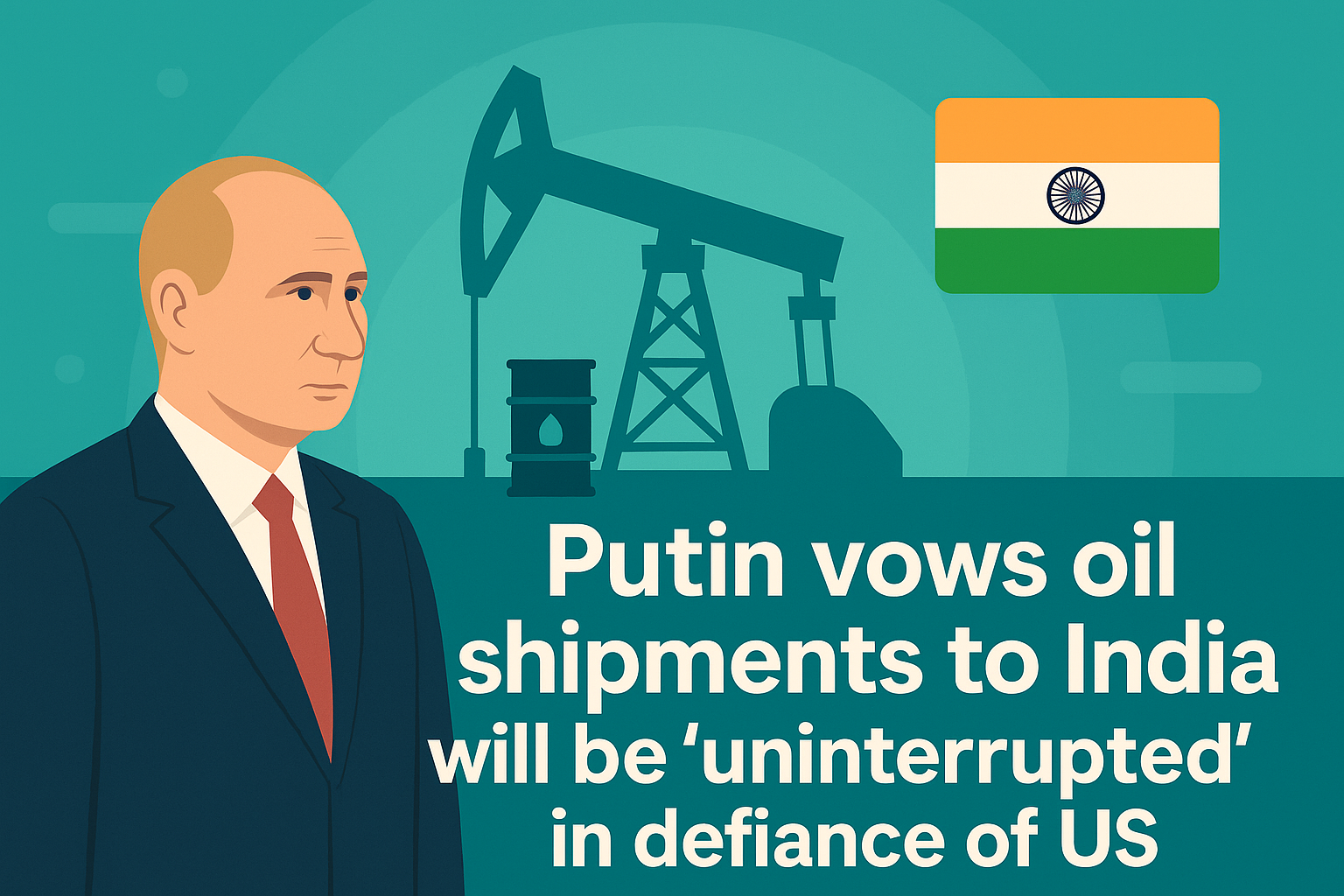
During his December 2025 visit to New Delhi, Russian President Vladimir Putin declared that Russia would ensure “uninterrupted” oil supplies to India, even as the United States increases tariff and sanctions pressure on New Delhi. The statement goes far beyond an energy assurance; it signals a strategic tightening of Russia–India relations and the emergence of a counter-axis to the US-led order, particularly in energy and security.
Moscow and New Delhi reaffirmed their goal of expanding bilateral trade to USD 100 billion by 2030, while broadening cooperation across energy, defence, security, nuclear power, and clean energy. For India, maintaining a robust relationship with Russia is a key instrument of its doctrine of strategic autonomy, especially at a time of friction with the US.
This development marks a significant phase in the geopoliticization of energy in the Global South, with direct implications for Japan and international financial institutions in terms of energy security, sanctions compliance, and emerging-market risk assessment.
2. Detailed Analysis: The Strategic Logic Behind the Russia–India Alignment
2.1 Russia’s Motivation: Countering Isolation Under Western Sanctions
Since the Ukraine invasion, Russia has redirected its energy exports from Europe to Asian markets. India has emerged as one of its largest buyers of discounted crude, creating structural interdependence.
Putin’s pledge of “uninterrupted” supplies serves two objectives:
- to secure India as a long-term strategic partner, and
- to demonstrate Moscow’s defiance of US sanctions pressure.
The message is both geopolitical and economic: Russia intends to remain relevant by anchoring itself in the Global South’s growth trajectories.
2.2 India’s Pursuit of Strategic Autonomy
Despite its deepening cooperation with the United States, India’s foreign policy remains fundamentally non-aligned and multi-vector. As the US imposes higher tariffs and political pressure on New Delhi, Russia has become a crucial balancing partner.
India’s motivations include:
- ensuring stable and low-cost energy supplies to sustain 7%+ GDP growth,
- enhancing bargaining power vis-à-vis Washington, and
- maintaining freedom of manoeuvre in a multipolar environment.
2.3 A 2030 Vision: Diversified Economic and Security Cooperation
The meetings produced commitments across multiple sectors:
- Long-term hydrocarbons supply
- Defence co-production and equipment procurement
- Civil nuclear cooperation and shipbuilding
- Clean energy, workforce mobility, and digital cooperation
This reflects Russia’s intent to reduce overreliance on China and India’s drive to diversify strategic partners, forming a mutually reinforcing partnership.
3. Implications for the International System: A Shift in Energy Geopolitics
3.1 A New Triangle: United States vs. Russia–India Dynamics
The pledge comes at a moment when US–India relations face trade and political friction. Russia is exploiting this window to regain influence.
For Washington, key concerns include:
- Erosion of sanctions effectiveness as Russian crude continues flowing through India;
- Reduced likelihood of India joining the Western containment architecture;
- The emergence of a Eurasian energy-security alignment involving Russia, India, and indirectly China.
This marks a weakening of the Western-centered regulatory regime governing energy flows.
3.2 Structural Shifts in Global Energy Markets
The Russia–India nexus accelerates several medium-term transformations:
- Permanent redirection of Russian crude to Asia
- Expansion of India as a global refining hub (re-exporting to Europe and beyond)
- Strengthening of energy security for China and India
- Declining leverage of G7 price-cap mechanisms
These shifts indicate a world where energy markets are increasingly shaped by geopolitical blocs rather than purely commercial logic.
4. Implications for Japan and JBIC
4.1 Changing Competitive Landscape in Asia’s Energy Sector
The deepening Russia–India partnership may:
- Increase Russian participation in India’s energy infrastructure
- Shift demand patterns for LNG and crude in the broader Indo-Pacific
- Strengthen India’s diversification away from Middle Eastern suppliers
For Japan and JBIC, understanding India’s evolving energy strategy is critical for planning long-term financing in renewables, LNG, and strategic infrastructure.
4.2 Heightened Compliance and Sanctions Complexity
As Russian-linked entities become more embedded in Indian projects, risks emerge in:
- sanctions circumvention,
- opacity in blended crude origins, and
- financial flows involving Russian intermediaries.
For project finance and export credit, enhanced due diligence will be indispensable:
- Verification of transaction counterparties
- Traceability of energy inputs and financial flows
- Assessment of secondary sanctions exposure
4.3 New Opportunities: Defence, Clean Energy, and Infrastructure
India seeks to diversify away from full dependence on Russian defence systems while continuing to co-produce equipment. This opens space for:
- Japanese technology partnerships (robots, electronics, dual-use systems)
- Green hydrogen, ammonia, storage technologies
- Port, logistics, and smart-city infrastructure
Japan’s strong reputation in quality and reliability positions it well — but strict compliance is required where Russian involvement overlaps.
5. Conclusion: Energy, Geopolitics, and Emerging-Market Strategy at a Turning Point
Putin’s statement is more than a diplomatic gesture — it reflects a reordering of global energy alignments and a strategic assertion by Russia and India in an increasingly multipolar world.
India is consolidating its status as a strategic-autonomy power, balancing relations with both the West and Russia. Russia is leveraging Asia’s growth to counteract Western isolation. The US is likely to respond with further trade, technology, or sanctions tightening.
For JBIC and other international financial institutions, the key tasks ahead include:
- monitoring the geopolitical fragmentation of energy markets,
- incorporating sanctions-compliance risk into all India-related energy financing,
- pursuing opportunities in clean energy and strategic infrastructure, and
- building investment strategies compatible with an emerging multipolar economic order.
The Russia–India axis is a leading indicator of the next phase of global energy geopolitics — one in which emerging markets are increasingly central actors shaping international stability and economic flows.