— From Crisis Narrative to Structural Reboot —
1. Executive Summary
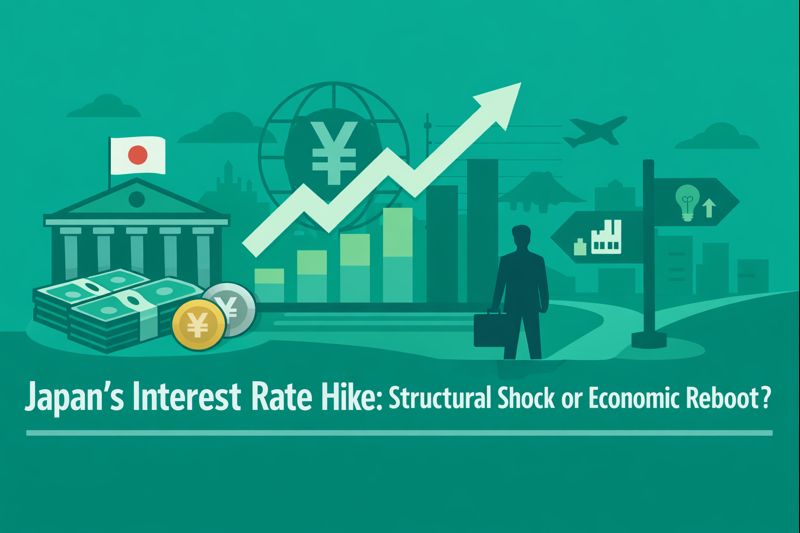
The Bank of Japan’s recent interest rate increase should not be interpreted as a cyclical policy adjustment, but rather as a structural inflection point signaling the return of fundamental economic discipline after decades of distortion.
The key conclusions of this report are as follows:
- A systemic financial crisis comparable to the Global Financial Crisis is unlikely.
- However, economic agents that depended on a zero-interest-rate regime will face growing stress over time.
- The shock is gradual, selective, and structural, not abrupt or system-wide.
- While short-term pain is unavoidable, medium- to long-term productivity and capital efficiency are likely to improve.
In short, this is not a collapse scenario, but a controlled normalization with delayed distributional effects.
2. Why This Rate Hike Is Structurally Different
For nearly three decades, Japan has operated in an economy where interest rates effectively did not exist:
- Capital costs were muted
- Low-return activities survived without exit
- Fiscal constraints remained largely invisible
This environment produced stability without vitality — an equilibrium where failure was rare, but growth was equally elusive.
The current rate increase disrupts this equilibrium.
It represents the return of economic gravity, rather than a tactical response to inflation alone.
3. Expected Shock: Type and Magnitude
3.1 Nature of the Shock
The anticipated shock has three defining characteristics:
- Gradual, not sudden
- Sector- and agent-specific, not uniform
- Non-systemic, unlikely to destabilize the financial system
It should therefore be understood as a structural adjustment shock, not a financial crisis.
3.2 Macroeconomic Magnitude (Economist’s Range)
Based on historical analogs and structural conditions:
- Real GDP growth:
Downward pressure of approximately 0.3–0.7 percentage points annually, spread over several years - Unemployment:
No sharp spike expected; increases likely to be localized and frictional - Corporate failures:
A gradual rise, concentrated among highly leveraged, low-margin firms
This contrasts sharply with the credit-contraction dynamics of Japan’s 1990s crisis.
4. Where the Shock Will Concentrate
4.1 Corporate Sector: The Return of Selection
Firms most exposed share common traits:
- Thin operating margins
- Heavy reliance on refinancing
- High sensitivity to interest costs
These entities survived under financial repression.
Rising rates reintroduce market-based selection, leading to:
- Restructuring and consolidation
- Reallocation of capital toward higher-productivity uses
This process is disruptive but economically constructive.
4.2 Households: Behavioral Adjustment, Not Collapse
Household impact is meaningful but not destabilizing:
- Variable-rate borrowers face gradual income pressure
- Consumption shifts from quantity to quality
- Investment decisions move from speculation to selection
This reflects economic maturation, not demand destruction.
4.3 Fiscal and Financial Policy: Constraints Become Visible
Higher rates imply:
- Rising refinancing costs for government debt
- Reduced reliance on central-bank profit remittances
- Increased necessity for policy prioritization
This does not imply fiscal insolvency, but rather a loss of policy discretion.
5. Currency and Yen Carry Trade Implications
Historically, the yen functioned as:
- A funding currency
- The backbone of global carry trades
With rate normalization:
- Carry profitability erodes gradually
- Abrupt unwinding remains unlikely due to persistent global rate differentials
Going forward, the yen will be valued less as a mechanical funding tool and more as a reflection of Japan’s economic structure and policy credibility.
6. Crisis or Rite of Passage?
From an economist’s perspective, the answer is clear.
This episode represents:
- An unavoidable adjustment
- A manageable transition
- A delayed correction of accumulated distortions
Avoiding normalization would have risked:
- Accelerating currency depreciation
- Persistent imported inflation
- Continued erosion of real wages
Such outcomes would constitute a far more destructive shock.
7. Conclusion
Japan is transitioning from an economy that avoided failure but also avoided growth, to one that permits:
- Capital discipline
- Economic exit
- Productive reallocation
The short-term adjustment will be uncomfortable.
But an economy where interest rates function, risk is priced, and capital is allocated rationally is more sustainable, transparent, and resilient.
Japan’s rate hike is not a crisis signal.
It is a quiet reboot of economic normalcy.