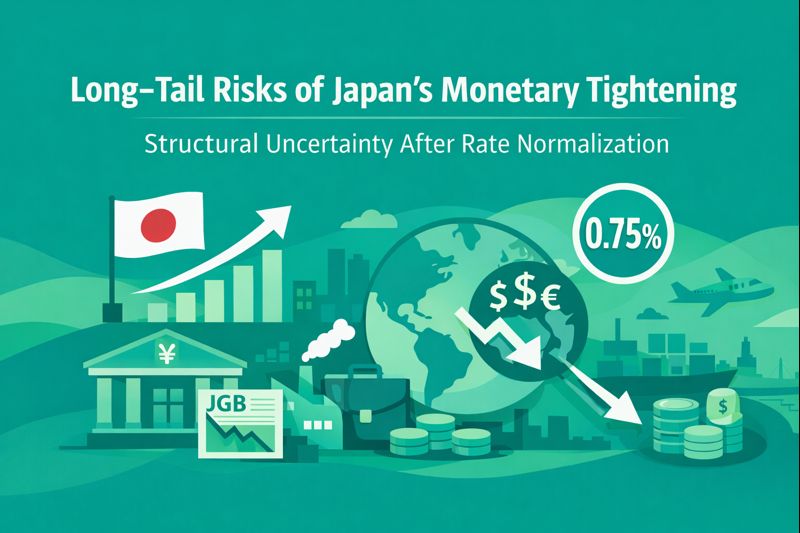
Structural Uncertainty Following the Bank of Japan’s Policy Rate Hike
- Abstract
- 1. Introduction: Monetary Tightening as a Regime Shift
- 2. Long-Tail Risk I: Non-Linear Confidence Effects in the Government Bond Market
- 3. Long-Tail Risk II: Gradual Weakening of Regional Financial Intermediation
- 4. Long-Tail Risk III: Delayed Corporate Credit Events
- 5. Long-Tail Risk IV: Structural Change in the International Role of the Yen
- 6. Long-Tail Risk V: Policy Entrapment and Reduced Macroeconomic Flexibility
- 7. Conclusion: Monetary Normalization and Uncertain Equilibria
Abstract
The Bank of Japan’s decision to raise the policy interest rate to 0.75 percent marks a significant departure from Japan’s prolonged ultra-low interest rate regime. While the absolute level of the policy rate remains modest by international standards, this paper argues that the primary risks do not stem from near-term macroeconomic tightening effects, but from long-tail risks—low-probability, high-impact outcomes that materialize with long lags through structural, institutional, and expectation-based channels.
This study examines five such long-tail risks: (i) non-linear shifts in government bond market confidence, (ii) gradual erosion of regional financial intermediation, (iii) delayed corporate credit events, (iv) changes in the international role of the yen, and (v) policy entrapment through reduced macroeconomic policy space. The paper concludes that Japan’s monetary normalization is best understood as a regime transition with uncertain equilibrium outcomes rather than a conventional interest rate adjustment.
1. Introduction: Monetary Tightening as a Regime Shift
From a conventional macroeconomic perspective, a policy rate of 0.75 percent is unlikely to impose significant contractionary pressure on aggregate demand. However, in the Japanese context, the economic relevance of the rate hike lies not in its magnitude, but in its symbolic and structural implications.
Japan’s economy has operated under near-zero or negative interest rates for almost three decades. During this period, ultra-low rates became embedded in private sector balance sheets, financial intermediation models, fiscal sustainability assumptions, and market expectations. As a result, the recent rate hike should be interpreted as a regime shift—a transition away from a deeply entrenched monetary environment—rather than a marginal policy adjustment.
Long-tail risks arise precisely because such regime transitions alter behavioral norms and institutional constraints in ways that standard short-horizon macroeconomic models fail to capture.
2. Long-Tail Risk I: Non-Linear Confidence Effects in the Government Bond Market
2.1 Analytical Background
Japanese government bonds (JGBs) have long been perceived as quasi-risk-free assets, supported by three structural pillars: domestic ownership, yen denomination, and large-scale central bank purchases. Monetary tightening weakens the third pillar by reintroducing price volatility and restoring market-based price discovery.
2.2 Long-Tail Dynamics
Under normal conditions, modest increases in yields do not threaten fiscal sustainability. However, long-tail risk emerges when market narratives shift discontinuously. A change in collective beliefs—such as doubts regarding the permanence of central bank support—can raise term premia independently of fundamentals.
Crucially, such confidence effects are non-linear: they may remain dormant for extended periods before materializing abruptly, with potentially outsized effects on yields, liquidity, and fiscal financing conditions.
3. Long-Tail Risk II: Gradual Weakening of Regional Financial Intermediation
3.1 Mechanism
Regional banks and credit cooperatives play a critical role in Japan’s local economies. Their balance sheets are heavily exposed to long-duration government bonds and local real estate lending—both sensitive to interest rate normalization.
3.2 Long-Tail Characteristics
Rather than triggering acute financial distress, monetary tightening is more likely to induce behavioral adjustments: increased risk aversion, stricter lending standards, and reduced support for new or innovative projects. These effects accumulate slowly and are rarely visible in headline financial stability indicators.
Over time, reduced credit availability can depress regional investment, entrepreneurship, and labor mobility, leading to a persistent decline in potential growth—an outcome that is difficult to reverse once established.
4. Long-Tail Risk III: Delayed Corporate Credit Events
4.1 Intertemporal Nature of Corporate Risk
Many Japanese firms entered the tightening phase with ample liquidity and long-maturity, low-cost debt. Consequently, immediate distress is unlikely. However, corporate vulnerability is inherently intertemporal, emerging at refinancing points, investment renewal stages, or during restructuring of overseas operations.
4.2 Macroeconomic Implications
A key long-tail risk is the appearance of rising corporate failures during periods of apparent macroeconomic stability. Such timing mismatches can complicate policy interpretation and undermine confidence in economic management, particularly if financial stress appears disconnected from cyclical indicators.
5. Long-Tail Risk IV: Structural Change in the International Role of the Yen
5.1 Yen as a Funding Currency
For decades, the yen has served as a low-cost funding currency in global financial markets. Sustained monetary tightening challenges this role by narrowing interest differentials and increasing exchange rate volatility.
5.2 Global Spillovers
While the effects may be muted in normal times, during global stress episodes a revaluation of yen funding conditions could amplify capital outflows from emerging markets and contribute to synchronized financial tightening. In this sense, Japan’s monetary policy may function as a global risk amplifier, even if domestic conditions remain stable.
6. Long-Tail Risk V: Policy Entrapment and Reduced Macroeconomic Flexibility
6.1 Conceptual Framework
Policy entrapment refers to a situation in which the range of feasible policy responses narrows due to structural constraints. As interest rates rise, fiscal sensitivity to debt servicing costs increases, while financial institutions become more exposed to bond price fluctuations.
6.2 Long-Term Consequences
This dynamic may limit the authorities’ ability to respond decisively to future shocks—either through further tightening or aggressive easing. Over time, markets may incorporate this reduced flexibility into risk assessments, raising sovereign and financial risk premia even in the absence of immediate stress.
7. Conclusion: Monetary Normalization and Uncertain Equilibria
The central insight of this analysis is that the long-tail risks associated with Japan’s monetary tightening are structural rather than cyclical. They arise from changes in expectations, institutional behavior, and policy constraints that unfold over extended horizons.
The critical question for Bank of Japan is therefore not whether normalization has been achieved, but whether the post-normalization economy converges to a stable and growth-supportive equilibrium. Addressing long-tail risks requires policy coordination, transparent communication, and analytical frameworks that extend beyond short-term macroeconomic stabilization.
References (indicative)
- Gennaioli, N., Shleifer, A., & Vishny, R. (2018). A Crisis of Beliefs.
- Borio, C. (2014). The financial cycle and macroeconomics. BIS Quarterly Review.
- Krugman, P. (1998). It’s Baaack: Japan’s Slump and the Return of the Liquidity Trap.