A Structural Analysis of Indian and African Labor Inflows within a Managed Globalization Framework
Executive Summary
The recent economic development of the United Arab Emirates (UAE)—particularly Dubai—cannot be adequately understood through a conventional free-market or migration narrative. Instead, it reflects a highly engineered labor and residency regime, designed to maximize growth while minimizing sovereign social risk.
At the core of this regime lies the Kafala system. Far from being a peripheral or residual institution, Kafala has functioned as a macroeconomic control mechanism: enabling the UAE to absorb massive inflows of foreign labor and human capital without transforming itself into a permanent immigration state.
This report argues that:
- The Kafala system was instrumental in enabling rapid capital accumulation, urban development, and infrastructure expansion.
- Indian and African labor inflows were not accidental but structurally aligned with this system.
- As the UAE’s economy upgraded, the system was not abolished but strategically differentiated by skill level and economic function.
1. Structural Premises of the UAE Growth Model
The UAE’s development trajectory rests on several non-standard premises:
- A small national population with limited labor supply
- An explicit rejection of the Western “immigration + welfare” state model
- A growth strategy centered on logistics, finance, tourism, real estate, and re-export hubs
- A political economy that prioritizes state stability over labor integration
Under these constraints, conventional migration regimes would have imposed unsustainable fiscal and social costs. The Kafala system emerged as an institutional response to this structural problem.
2. The Economic Function of the Kafala System
From an economic—not ethical—perspective, the Kafala system operates as a risk-externalization mechanism.
Core Functional Characteristics
- Residency rights are tied to employment or sponsorship
- Unemployment risk is borne by the worker, not the state
- Social security obligations remain minimal at the sovereign level
- Labor supply can expand and contract with economic cycles
In macroeconomic terms, this allowed the UAE to:
- Maintain high growth without structural unemployment
- Avoid fiscal pressure from welfare systems
- Rapidly scale large infrastructure and real-estate projects
- Preserve political and social stability despite extreme demographic imbalance
In effect, labor became a variable input rather than a permanent social constituency.
3. Indian Labor Inflows: Scale and Structural Fit
3.1 Quantitative Alignment with Labor-Intensive Growth
Indian nationals constitute the largest expatriate group in the UAE. This dominance reflects not only population size but structural compatibility:
- Wage expectations aligned with UAE labor demand
- Strong remittance incentives
- Deep migrant networks reducing hiring friction
- Cultural normalization of temporary overseas employment
Under the Kafala system, Indian workers supplied the backbone of:
- Construction and infrastructure
- Transportation and logistics
- Hospitality and urban services
Critically, the system ensured circulation without settlement, preserving the UAE’s non-immigration design.
3.2 Qualitative Shift: White-Collar Differentiation
In recent years, Indian labor inflows have bifurcated:
- Low- and mid-skill workers remain under traditional sponsorship
- Professionals, entrepreneurs, and specialists increasingly access self-sponsored or long-term residency schemes
This differentiation reflects a deliberate policy shift:
Residency rights are increasingly allocated by economic value, not nationality.
4. African Labor Inflows: Beyond Manual Labor
African migration to the UAE is often misunderstood as purely labor-driven. In reality, it reflects Dubai’s emergence as a commercial and financial gateway to Africa.
4.1 Dubai as Africa’s External Commercial Hub
African nationals increasingly participate in:
- Trade intermediation and re-export businesses
- Logistics and shipping services
- Hospitality, tourism, and aviation
- Small-scale entrepreneurship linked to African markets
These flows are connected not only to labor demand, but to trade architecture and capital circulation between Africa, the Gulf, and Asia.
4.2 The Kafala System as an Entry Filter
In this context, Kafala functions less as a labor constraint and more as a boundary-management tool:
- It anchors residency to economic activity
- It limits informal settlement
- It allows sector-specific allocation of manpower
- It protects urban infrastructure from uncontrolled demographic pressure
Thus, for African inflows, Kafala acts as a regulatory gate, not merely a labor device.
5. Institutional Fatigue and Policy Adaptation
As the UAE economy advanced toward finance, technology, and innovation, the original
Kafala framework began to generate friction:
- Reduced labor mobility for high-skill professionals
- Weak incentives for long-term human capital accumulation
- Reputational tensions with ESG and global governance norms
The policy response has been adaptation rather than abolition:
- Long-term residency visas
- Self-sponsorship mechanisms
- Freelance and entrepreneur visas
- Expanded family residency rights for skilled workers
The result is a dual-track system:
- Managed, sponsor-based labor for labor-intensive sectors
- Liberalized, individual-based residency for high-value human capital
6. Conclusion: The UAE Model Reconsidered
The Kafala system has functioned across different stages of UAE development as:
- A growth accelerator during rapid urbanization
- A stabilization mechanism that externalized social risk
- A platform for institutional differentiation in a mature economy
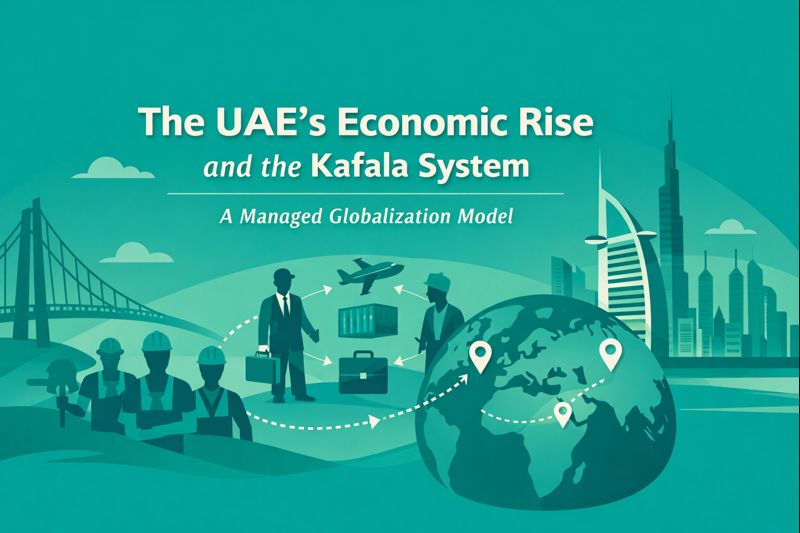
The defining feature of the UAE is not globalization itself, but controlled globalization—the deliberate engineering of openness without full social integration.
From this perspective, the Kafala system is best understood not as a relic, but as a governance technology, continuously recalibrated to match the UAE’s evolving economic structure.
In that sense, the UAE is not a passive participant in global labor markets; it is one of the few states that has successfully designed and operated globalization as a managed system rather than an uncontrollable force.