— A Critical-Point Analysis of Arctic Great-Power Competition —
- Executive Summary
- 1. Analytical Premise: Is Greenland a Strategic “Win”?
- 2. Russia’s Response: Maximizing Tension While Avoiding War
- 3. China’s Response: Denial of Defeat Through Time and Structure
- 4. The United States’ Hidden Burden: A Two-Front Cost Structure
- 5. Strategic Paradox: Visibility of Dominance Accelerates Competition
- 6. Why the United States Rationally Chooses Engagement Over Ownership
- Conclusion
Executive Summary
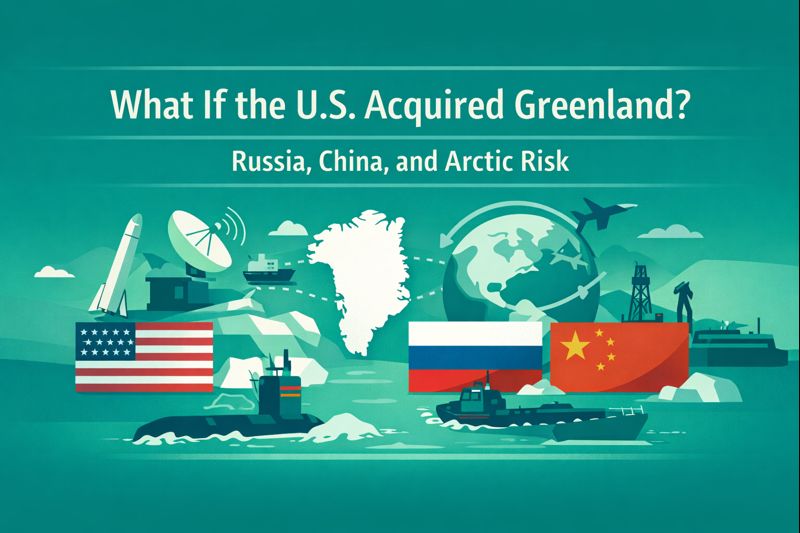
If the United States were to acquire Greenland, or establish a form of de facto exclusive control equivalent to ownership, neither Russia nor China would remain passive.
However, their responses would be non-kinetic, asymmetric, and long-term, rather than direct military confrontation.
This report analyzes:
- Russia’s rapid military-centric response
- China’s time-extended institutional and economic counterstrategy
- The dual-front strategic costs imposed on the United States
and explains why, from an economic perspective, “ownership” represents a suboptimal equilibrium compared with deep strategic engagement.
1. Analytical Premise: Is Greenland a Strategic “Win”?
At first glance, U.S. acquisition of Greenland appears to deliver a decisive strategic advantage:
- Control of a critical Arctic node
- Enhanced military depth vis-à-vis Russia
- Preemptive exclusion of Chinese influence
Yet economic analysis requires incorporating endogenous responses.
The relevant metric is not unilateral gain, but expected net benefit after adversarial adaptation.
Greenland is therefore not a static asset problem, but a strategic interaction problem under conditions of great-power rivalry.
2. Russia’s Response: Maximizing Tension While Avoiding War
For Russia, the Arctic is not peripheral; it is existential:
- The backbone of nuclear deterrence
- A primary energy export corridor
- The shortest strategic axis toward North America
Likely Russian Actions
- Immediate expansion of Arctic air bases, radar networks, and missile infrastructure
- Persistent deployment of nuclear submarines and long-range bombers
- Legal and operational efforts to assert de facto control over Arctic sea routes
Russia would interpret U.S. ownership of Greenland as the completion of strategic encirclement.
At the same time, nuclear deterrence imposes a ceiling on escalation.
The result is a familiar but dangerous equilibrium: maximum tension, minimum direct conflict.
The Arctic would shift into a state of permanent high alert with low kinetic probability, increasing systemic risk without crossing the threshold of war.
3. China’s Response: Denial of Defeat Through Time and Structure
China’s reaction would differ fundamentally in character.
For China, the Arctic is not primarily a military theater, but a:
- Commercial corridor
- Scientific domain
- Institutional and data-driven frontier
Likely Chinese Countermeasures
- Reinforcement of the “Near-Arctic State” doctrine
- Expansion of Arctic research, satellite observation, and climate-data control
- Deepened Arctic cooperation with Russia, particularly in LNG and shipping
- Diversified influence-building across Canada, Iceland, and Nordic states
China’s strategic logic is explicit:
A loss at one node does not constitute defeat if the system as a whole remains contestable.
From this perspective, Greenland’s loss is tactical, not strategic.
Competition shifts from territory to standards, institutions, and long-term embedded presence.
4. The United States’ Hidden Burden: A Two-Front Cost Structure
The most critical implication of Greenland acquisition lies not in adversaries’ reactions alone, but in U.S. cost exposure.
The Dual-Front Reality
- Arctic front: heightened Russian military pressure
- Global front: intensified Chinese economic and institutional pushback
This structure increases:
- Defense expenditures
- Alliance management costs
- Diplomatic and escalation-control burdens
Economically, the problem is clear:
The acquisition cost is one-off, but the management cost is perpetual.
From a balance-sheet perspective, Greenland becomes a high-maintenance asset with rising operating expenses.
5. Strategic Paradox: Visibility of Dominance Accelerates Competition
The core paradox of Greenland acquisition is this:
By making strategic dominance visible, the United States would accelerate the competitive response cycle.
- Relative advantage becomes explicit
- Adversaries lose incentives to wait
- Countermeasures become front-loaded
The Arctic would therefore transform:
- From a latent cooperative space
- Into a permanently contested surveillance and deterrence zone
Deterrence improves, but systemic volatility increases.
6. Why the United States Rationally Chooses Engagement Over Ownership
Observed U.S. policy reflects this calculus.
Rather than sovereign acquisition, the United States has favored:
- Expanded military basing
- Infrastructure investment
- Political and security cooperation
- Persistent strategic presence
This model—engagement dominance—achieves key objectives while:
- Avoiding immediate Russian escalation
- Preventing China from framing a definitive loss
- Preserving allied sovereignty and alliance cohesion
It represents the lowest-cost equilibrium under strategic competition.
Conclusion
If the United States were to acquire Greenland:
- Russia would militarize the Arctic more aggressively
- China would intensify institutional and economic counterpressure
- The Arctic would become a permanently high-tension theater
Such an outcome would not represent decisive victory, but rather the externalization of strategic competition costs into a visible, permanent form.
From an economist’s standpoint, the conclusion is unambiguous:
Greenland is too heavy an asset to own outright,
yet too valuable not to shape through deep engagement.
This asymmetry explains why U.S. rhetoric may express ambition,
but U.S. strategy remains deliberately restrained.