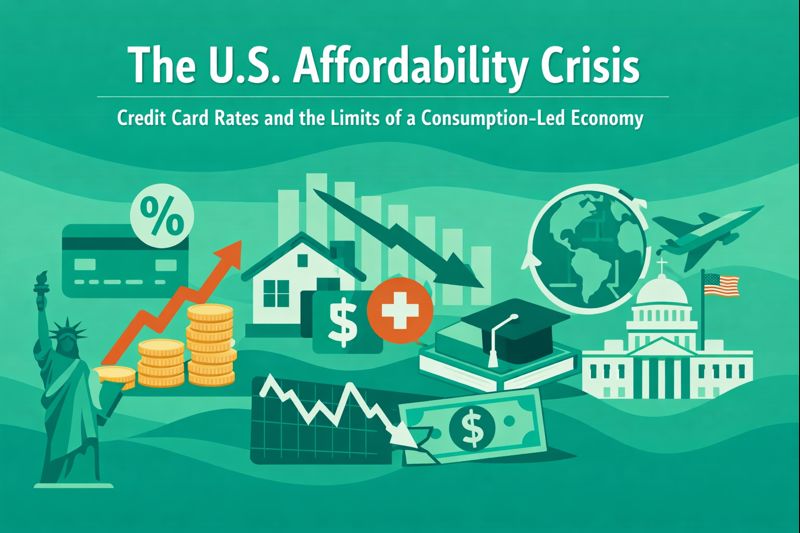
- The Affordability Crisis and the Structural Limits of a Consumption-Led Economy
- 1. Introduction: Why “Affordability” Has Become a Central Economic Issue
- 2. Credit Card Interest Rates as a De Facto Shadow Tightening
- 3. The Strain on the Consumption-Led Growth Model
- 4. Financial Stability Implications: Slow-Burn Credit Risk
- 5. Political Economy: Why Market Adjustment Alone Is No Longer Viable
- 6. Global Spillovers: Why This Is Not a Domestic Issue
- 7. Conclusion: The Core Challenge Facing the U.S. Economy
The Affordability Crisis and the Structural Limits of a Consumption-Led Economy
1. Introduction: Why “Affordability” Has Become a Central Economic Issue
As of 2025–2026, the U.S. economy appears resilient on the surface. Employment remains solid, headline GDP growth is positive, and a near-term recession has been avoided. Yet beneath these aggregates lies a growing structural imbalance: the rising unsustainability of household living costs.
The renewed political focus on “affordability,” particularly credit card interest rates, should not be dismissed as mere election rhetoric. It reflects a deeper concern that the mechanisms sustaining U.S. consumption—historically the engine of global growth—are increasingly dependent on high-cost consumer credit. This dynamic raises questions about the durability of the U.S. economic model in a prolonged high-interest-rate environment.
2. Credit Card Interest Rates as a De Facto Shadow Tightening
From a policy standpoint, monetary tightening is formally conducted by the Federal Reserve Board. However, for households, the effective financial conditions are increasingly dictated not by policy rates but by credit card APRs exceeding 20–30%.
This divergence has created a form of unintended, persistent monetary tightening:
- Policy rates may stabilize or decline expectations may build,
- Yet household borrowing costs remain punitive and slow to adjust.
As a result, the economy enters an uncomfortable equilibrium:
- Consumption does not collapse,
- Household balance sheets do not heal,
- Credit stress accumulates gradually rather than explosively.
This is not a crisis dynamic; it is a structural erosion dynamic.
3. The Strain on the Consumption-Led Growth Model
The strength of the U.S. economy has long rested on household consumption, accounting for roughly 70% of GDP. Historically, this consumption was supported by:
- Real wage growth,
- Asset price appreciation (housing and equities),
- Expanding access to credit at manageable cost.
Today, the composition has shifted:
- Real wages struggle to outpace cumulative cost increases,
- High interest rates suppress asset-driven wealth effects,
- Consumption is increasingly maintained through revolving, high-interest debt.
This transformation matters. Credit-financed consumption can sustain demand temporarily, but it reduces future flexibility. Over time, it lowers the economy’s resilience to shocks and compresses potential growth.
4. Financial Stability Implications: Slow-Burn Credit Risk
From a financial system perspective, elevated credit card rates do not immediately trigger systemic stress. Delinquency rates rise slowly; defaults are contained; institutions appear profitable.
However, risks accumulate in less visible ways:
- Deterioration in the quality of consumer ABS,
- Pressure on regional banks and non-bank lenders,
- Gradual tightening of credit availability for marginal borrowers.
This creates a feedback loop: tighter credit conditions weaken consumption, which in turn reinforces economic deceleration—without a clear trigger event.
5. Political Economy: Why Market Adjustment Alone Is No Longer Viable
The political salience of credit card rates reflects more than voter dissatisfaction. It signals that market-based adjustment mechanisms are losing social legitimacy.
If left unaddressed:
- Household frustration increasingly targets financial institutions,
- Pressure builds for blunt, populist regulatory interventions,
- The probability of abrupt, poorly calibrated policy action rises.
In this context, early discussion of interest rate caps or fee regulation can be interpreted as an attempt to preempt more disruptive forms of intervention later.
6. Global Spillovers: Why This Is Not a Domestic Issue
The U.S. economy has historically served as a stabilizing anchor for global demand and financial markets. That role is becoming less reliable.
A structurally constrained U.S. consumer implies:
- Slower global trade momentum,
- Higher volatility in dollar funding markets,
- Increased sensitivity of emerging markets to U.S. policy signals.
Crucially, uncertainty now stems not only from monetary policy, but from the interaction of household stress, political intervention, and geopolitical assertiveness.
7. Conclusion: The Core Challenge Facing the U.S. Economy
The fundamental challenge confronting the U.S. economy is neither excessive tightening nor insufficient growth per se. It is the growing tension between:
- A credit-dependent consumption model,
- And the political and social limits of that dependence.
Credit card interest rates have become the most visible symptom of this tension. If left unresolved, the U.S. risks evolving into an economy that avoids crisis yet struggles to restore long-term dynamism.
For international financial institutions, the key implication is clear:
risk assessments must move beyond cyclical assumptions and incorporate the possibility that the quality—not just the pace—of U.S. economic recovery is changing.