Sanctions, Energy, and the Rise of an Asymmetric Non-Western Economic Network
- 1. Introduction: Understanding the Nature of the Trilateral Relationship
- 2. Venezuela: Resource Wealth Without Market Power
- 3. China: The Dominant Creditor and Strategic Risk Manager
- 4. Russia: A Tactical Partner and Sanctions Practitioner
- 5. The Structural Power Balance: Cooperation Without Equality
- 6. Implications for Global Finance and Sanctions Policy
- 7. Conclusion: Not an Anti-U.S. Alliance, but a Sanctions-Driven Equilibrium
1. Introduction: Understanding the Nature of the Trilateral Relationship
The relationship among China, Russia, and Venezuela is frequently framed as an “anti-U.S. alliance.”
This interpretation is analytically misleading.
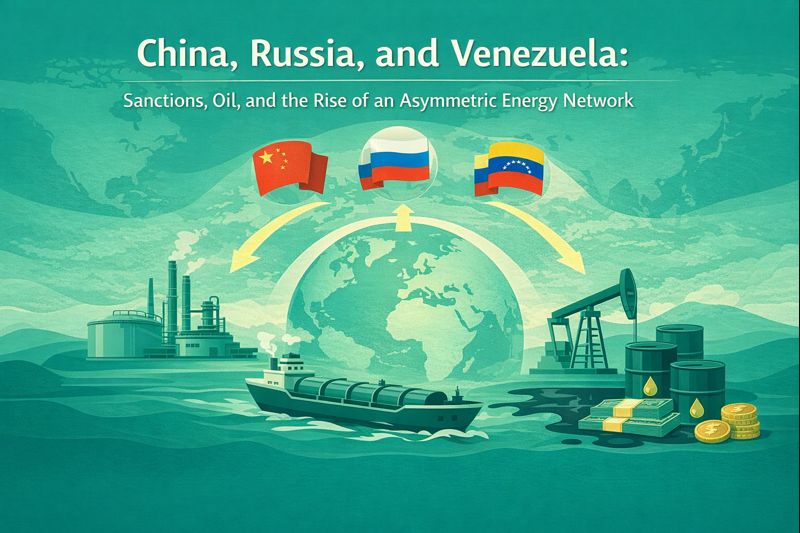
In reality, the trilateral relationship is neither an ideological bloc nor a formal alliance. It is best understood as a sanctions-adaptive economic network, built around energy flows, financial constraints, and asymmetric bargaining power.
At its core lies a pragmatic objective shared by all three countries: loss minimization under external pressure, rather than long-term economic integration.
2. Venezuela: Resource Wealth Without Market Power
Venezuela possesses the world’s largest proven oil reserves, yet it lacks the ability to monetize them independently due to:
- Severe deterioration of production capacity
- Collapse of refining and transport infrastructure
- Broad U.S. sanctions restricting access to global markets and finance
As a result, Venezuela has become structurally dependent on resource-backed arrangements, in which oil substitutes for cash.
This dependence places the country in a weak negotiating position, forcing it to accept unfavorable pricing, opaque logistics, and creditor-driven terms—particularly vis-à-vis China and, to a lesser extent, Russia.
3. China: The Dominant Creditor and Strategic Risk Manager
China’s role is central and fundamentally financial in nature.
Through policy banks and state institutions, China extended large-scale loans to Venezuela under oil-for-loans structures, securing repayment in crude oil rather than cash. Crucially, China has behaved not as a political benefactor, but as a disciplined creditor.
When Venezuelan output declined:
- New lending was effectively halted
- Repayment schedules were extended rather than forgiven
- Exposure was managed to minimize losses while preserving optionality
For China, Venezuela is not a short-term profit center. It is a long-duration geopolitical asset, whose value depends on future recovery or sanctions relief. China’s strategy is patient, transactional, and risk-aware.
4. Russia: A Tactical Partner and Sanctions Practitioner
Russia’s role differs materially from China’s.
Through state-linked energy firms and intermediaries, Russia has:
- Provided logistical and trading support
- Shared operational know-how for sanctions circumvention
- Offered political backing to the Venezuelan government
For Russia, Venezuela has functioned less as a commercial opportunity and more as a testing ground for sanctions survival mechanisms. These capabilities—relabeling cargoes, ship-to-ship transfers, opaque trading chains—have since been scaled and refined following Russia’s own sanctions after the Ukraine war.
In this sense, Russia acts as a tactical enabler, complementing China’s financial dominance.
5. The Structural Power Balance: Cooperation Without Equality
Although the three countries are often grouped together, their relationship is highly asymmetric:
- China
- Controls capital, market access, and refining capacity
- Holds the strongest bargaining position
- Russia
- Contributes sanctions expertise and geopolitical leverage
- Plays a secondary, complementary role
- Venezuela
- Supplies resources but lacks alternatives
- Bears the greatest economic and political costs
This is not solidarity among equals. It is a hierarchical, interest-driven arrangement, sustained by constraints rather than shared values.
6. Implications for Global Finance and Sanctions Policy
The trilateral relationship highlights a broader transformation in the function of sanctions.
Sanctions no longer fully halt economic activity. Instead, they:
- Distort pricing mechanisms
- Reduce transparency
- Concentrate market power in the hands of a few buyers
As a result:
- Sanctioned countries sell assets at a discount
- Large non-Western players gain structural leverage
- The global financial system becomes more fragmented and opaque
This represents a shift from sanctions as a blocking tool to sanctions as a restructuring force.
7. Conclusion: Not an Anti-U.S. Alliance, but a Sanctions-Driven Equilibrium
The relationship among China, Russia, and Venezuela should not be interpreted as a cohesive geopolitical front.
It is better understood as:
A flexible, asymmetric equilibrium formed under sanctions pressure,
in which each participant seeks to minimize losses rather than maximize integration.
China emerges as the most powerful and patient actor.
Russia functions as an operational partner.
Venezuela remains structurally dependent.
Importantly, this arrangement is not permanent. Any significant change—sanctions relief, regime change, or shifts in global energy markets—would rapidly reshape the relationship.
For international financial institutions, the key lesson is clear:
these dynamics must be assessed through the lenses of credit risk, resource control, and sanctions resilience, not ideology.