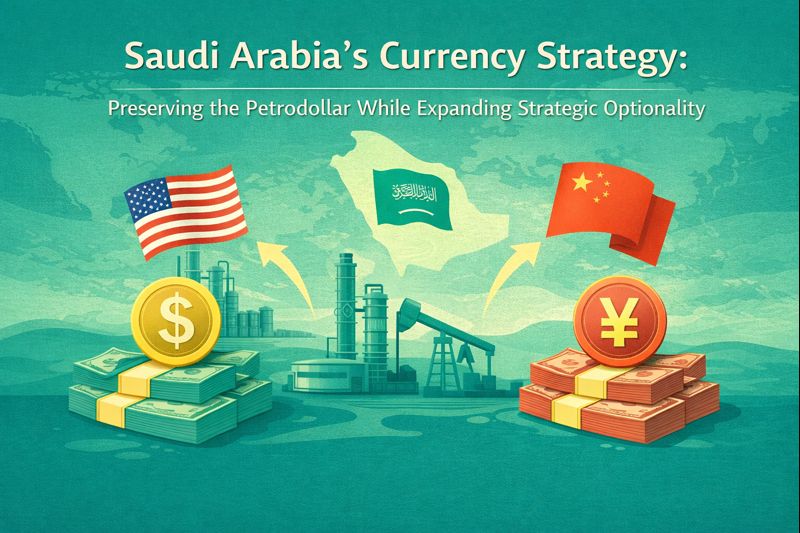
ーPreserving the Petrodollar While Expanding Strategic Optionalityー
- 1. Introduction: Why Saudi Arabia Matters to the Global Monetary Order
- 2. The First Pillar: The Dollar System Remains Irreplaceable
- 3. The Second Pillar: The Renminbi as a Strategic Instrument, Not a Substitute
- 4. Why Renminbi Use Will Remain Limited
- 5. The True Strategy: Hedging and Bargaining Power
- 6. Implications for the Petrodollar System
- 7. Conclusion: Saudi Arabia as a Custodian of Order, Not a Challenger
1. Introduction: Why Saudi Arabia Matters to the Global Monetary Order
Saudi Arabia is not merely the world’s leading oil exporter; it is a cornerstone of the petrodollar system itself.
As such, Saudi Arabia’s currency strategy offers a uniquely clear lens through which to observe the evolving relationship between energy markets, monetary power, and geopolitics.
Recent commentary often frames the issue in binary terms:
Is Saudi Arabia abandoning the dollar in favor of the renminbi?
This framing is misleading. The reality is more nuanced. Saudi policy reflects neither de-dollarization nor currency realignment, but rather a calibrated expansion of strategic choice.
2. The First Pillar: The Dollar System Remains Irreplaceable
At the core of Saudi monetary policy lies the Saudi riyal’s peg to the U.S. dollar.
This arrangement remains economically and politically rational for several reasons:
- Oil revenues and fiscal income are overwhelmingly dollar-denominated
- The peg anchors inflation expectations and financial stability
- Access to deep, liquid global capital markets remains essential
Most importantly, the financial ecosystem of the United States—particularly the U.S. Treasury market—continues to provide a scale, safety, and liquidity profile that no alternative currency system can replicate.
For Saudi Arabia, the dollar is not simply a transaction medium; it functions as a balance-sheet stabilizer for the state itself. Abandoning it would introduce macroeconomic volatility inconsistent with Saudi development ambitions.
3. The Second Pillar: The Renminbi as a Strategic Instrument, Not a Substitute
At the same time, Saudi Arabia has openly discussed the possibility of settling certain oil transactions with China in renminbi. This should not be interpreted as a challenge to the dollar’s primacy.
China is Saudi Arabia’s largest oil customer and a critical long-term demand anchor. Riyadh’s strategic priority is therefore demand security, not currency symbolism.
In this context, the renminbi functions as:
- A transactional tool within the China–Saudi economic corridor
- A lever to deepen Chinese downstream investment (refining, petrochemicals)
- A bargaining instrument to secure long-term offtake and industrial cooperation
Saudi Arabia’s underlying objective is not to sell oil in renminbi, but to ensure China continues to buy Saudi oil for decades.
4. Why Renminbi Use Will Remain Limited
Despite growing bilateral trade, structural constraints prevent the renminbi from assuming a broader role in Saudi reserves or oil revenues:
- Capital controls limit free conversion and capital mobility
- Safe, large-scale renminbi-denominated investment vehicles are scarce
- Monetary credibility remains closely tied to China’s domestic policy priorities
For a hydrocarbon exporter managing large, volatile revenue streams, currency choice is inseparable from security, liquidity, and geopolitical alignment. On these dimensions, the renminbi cannot yet compete with the dollar.
As a result, renminbi use is likely to remain bilateral, selective, and transactional, rather than systemic.
5. The True Strategy: Hedging and Bargaining Power
Saudi Arabia’s currency policy can be summarized succinctly:
Preserve the dollar-based system while ensuring alternatives are feasible.
This approach delivers multiple benefits simultaneously:
- Maintains financial and macroeconomic stability
- Strengthens negotiating leverage with both Washington and Beijing
- Provides insurance against sanctions or geopolitical shocks
- Enhances strategic autonomy without provoking systemic disruption
Crucially, the value lies not in how much oil is settled in non-dollar currencies, but in demonstrating that such settlement is possible.
6. Implications for the Petrodollar System
Saudi behavior does not signal the collapse of the petrodollar. Instead, it reflects an evolution in its character:
- The dollar remains dominant in oil pricing and reserves
- Limited, case-specific non-dollar settlement expands
- Dollar primacy shifts from exclusivity to centrality
In other words, the global system is moving toward functional currency diversification, not wholesale de-dollarization.
7. Conclusion: Saudi Arabia as a Custodian of Order, Not a Challenger
Saudi Arabia is not seeking to overturn the existing monetary order. It is exploiting it intelligently—while preparing for uncertainty.
- The dollar remains the foundation
- The renminbi is a strategic option
- Currency is a means, not an end
This disciplined pragmatism explains why Saudi Arabia continues to function not merely as an energy supplier, but as a sophisticated actor within the international monetary system.
The future of the global currency order will not be decided by dramatic ruptures, but by incremental adjustments of power, preference, and optionality—and Saudi Arabia sits at the center of that process.