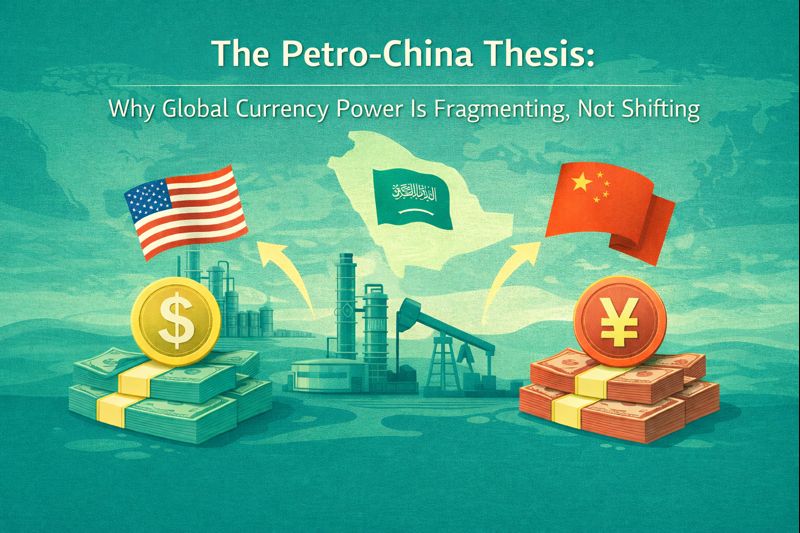
Why the World Is Not Experiencing Currency Hegemony Shift, but Functional Fragmentation
- 1. Framing the Question: Why “Petro-China” Is Widely Misunderstood
- 2. The Enduring Strength of the Petrodollar System
- 3. Why Petro-China Cannot Become a True Substitute
- 4. Where Petro-China Does Work: Limited but Real Domains
- 5. Saudi Arabia’s Currency Strategy as the Revealing Case Study
- 6. The Monetary Order Emerging Toward 2026: Functional Decomposition
- 7. The Japanese Yen: A Quiet Beneficiary of Fragmentation
- 8. Conclusion: Petro-China as Adaptation, Not Regime Change
1. Framing the Question: Why “Petro-China” Is Widely Misunderstood
In recent years, the concept of Petro-China (or Petro-Yuan) has often been presented as evidence that the U.S. dollar–based global order is nearing collapse.
This narrative suggests a linear transition:
Petrodollar → Yuan-based oil trade → End of dollar hegemony
From an economist’s perspective, this framing is analytically flawed.
What is unfolding toward 2026 is not a replacement of one hegemonic currency by another, but a structural reconfiguration in which monetary functions are increasingly separated by use case and economic sphere.
Petro-China should therefore be understood not as a new system, but as a symptom of adaptation within the existing one.
2. The Enduring Strength of the Petrodollar System
To evaluate Petro-China properly, it is essential to restate what the petrodollar actually is.
The petrodollar is not simply the fact that oil is priced in dollars.
It is a three-pillar system:
- Oil trade is predominantly settled in U.S. dollars
- Oil exporters recycle surplus dollars into U.S. financial markets
- The United States can sustain large current-account deficits while maintaining monetary dominance
This system is reinforced by:
- Unmatched depth and liquidity of U.S. capital markets
- The role of U.S. Treasuries as the global risk-free asset
- A global security architecture underpinning energy trade routes
As a result, the petrodollar is not merely a currency convention—it is an institutional ecosystem.
3. Why Petro-China Cannot Become a True Substitute
China is the world’s largest marginal buyer of crude oil and has clear incentives to expand renminbi settlement.
Yet the renminbi cannot replace the dollar as the foundation of global energy finance for structural reasons.
(1) Constraints on Reserve-Currency Function
- Capital controls remain in place
- Large-scale, freely investable RMB safe assets are limited
- Crisis-time credibility as a global store of value is unproven
For oil exporters, the core question is not how they are paid—but where and how they can safely park the proceeds. On this dimension, the dollar remains unrivaled.
(2) The Security–Currency Link
Energy trade is inseparable from security arrangements.
Major exporters such as Saudi Arabia continue to rely on U.S.-led security guarantees. China cannot yet offer a comparable framework.
Currency choice, therefore, is not a purely economic decision.
4. Where Petro-China Does Work: Limited but Real Domains
The Petro-China concept is not fictional. It is context-specific.
It functions most effectively when:
- Trade is bilateral with China
- Counterparties face sanctions or seek sanctions resilience
(e.g., Russia, Iran, Venezuela) - RMB receipts are recycled directly into Chinese goods, services, or investments
In these cases, the renminbi acts as an internal settlement currency within the China-centric economic sphere, not as a global reserve medium.
This distinction is critical.
5. Saudi Arabia’s Currency Strategy as the Revealing Case Study
Saudi Arabia’s behavior provides the clearest empirical evidence against simplistic Petro-China narratives.
Saudi policy combines:
- Continued dollar pricing of oil
- Maintenance of the riyal’s dollar peg
- Tactical openness to RMB settlement for China-specific transactions
This reflects a deliberate strategy:
Preserve the existing order while expanding bargaining power within it.
For Saudi Arabia, Petro-China is not a monetary revolution—it is a negotiating instrument.
6. The Monetary Order Emerging Toward 2026: Functional Decomposition
By 2026, the global monetary system is best described as functionally decomposed rather than hegemonically replaced.
| Function | Dominant Currency |
|---|---|
| Reserves & safe assets | U.S. dollar |
| Global finance & capital markets | U.S. dollar |
| China-focused energy trade | Renminbi (partial) |
| Sanctions-resilient transactions | Renminbi / local currencies |
| Crisis-time risk aversion | U.S. dollar, yen |
This is not de-dollarization.
It is currency specialization.
7. The Japanese Yen: A Quiet Beneficiary of Fragmentation
Within this structure, Japan occupies a distinctive position.
- Large net external asset position
- Low politicization of its currency
- Strong tendency for capital repatriation during global stress
The yen is neither a growth currency nor a hegemonic one.
Its role is subtler:
A systemic shock absorber in periods of global instability
As fragmentation increases, this function gains relative value.
8. Conclusion: Petro-China as Adaptation, Not Regime Change
The central conclusion is clear:
Petro-China does not signal the end of dollar dominance.
It signals the transition from dollar exclusivity to dollar centrality.
The global order toward 2026 will be:
- More complex
- More fragmented
- But not fundamentally chaotic
The key analytical mistake is to frame the future as a contest between currencies.
The correct question is:
Which currency is used for which function, under which political and institutional constraints?
That functional perspective—not narratives of sudden hegemony collapse—provides the most reliable guide for policymakers, financial institutions, and investors navigating the next phase of the international monetary system.