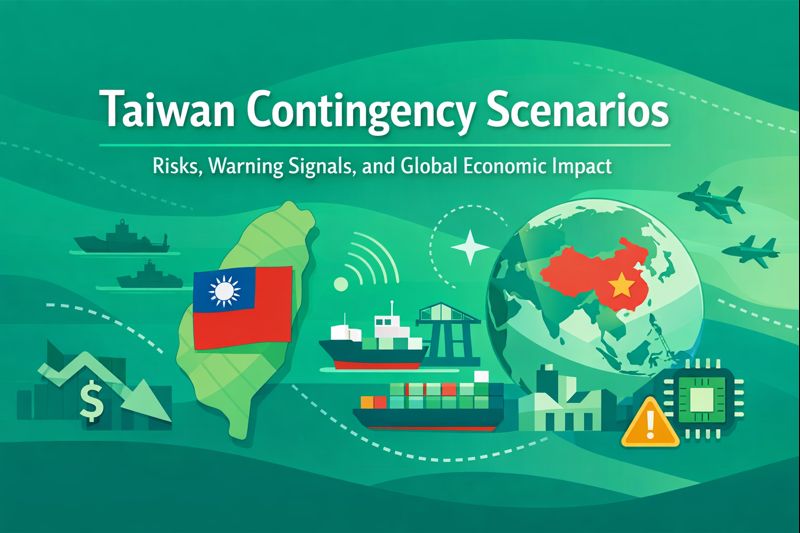
— Why a “Sudden War” Is Unlikely, but a “Quiet Crisis” Is Already Underway —
Executive Summary
A Taiwan contingency is not a single, binary event. It is best understood as a multi-stage process, shaped by rational state behavior rather than emotional nationalism.
The Chinese leadership’s overriding objective is not war itself, but political control at the lowest possible cost and risk.
For Beijing, the worst outcome is a prolonged conflict with uncertain victory and external military intervention. The preferred outcome is the accumulation of faits accomplis without crossing the formal threshold of war.
Accordingly, a Taiwan contingency is most likely to unfold through four escalating patterns:
- Expansion of gray-zone pressure
- Quasi-blockade and economic coercion
- Limited military confrontation
- Full-scale invasion (last resort, low probability)
This report analyzes each scenario and identifies early warning signals across political, military, economic, financial, and informational domains, allowing decision-makers to assess where the situation lies along the escalation spectrum.
1. Four Plausible Patterns of a Taiwan Contingency
Pattern I: Gray-Zone Encroachment (Most Likely, Already Ongoing)
Overview
China incrementally constrains Taiwan’s autonomy without triggering a formal armed conflict.
Typical measures include:
- Persistent incursions into Taiwan’s ADIZ
- Maritime pressure by coast guard and maritime militia
- Cyber operations and information warfare
- Diplomatic isolation through pressure on third countries
Strategic Logic
- Avoids crossing the legal threshold of war
- Complicates alliance responses by exploiting ambiguity
- Shifts risk perceptions of firms, insurers, and investors before governments react
Economic Meaning
This phase constitutes a de facto contingency in slow motion.
The objective is not immediate disruption, but the normalization of chronic uncertainty around Taiwan.
Pattern II: Quasi-Blockade and Economic Containment (Most Critical Scenario)
Overview
Rather than invasion, China uses law enforcement, inspections, and military exercises to control access to Taiwan.
Possible actions:
- Intensified inspection of Taiwan-bound vessels
- Near-permanent military exercises in key sea lanes
- Pressure on air routes and undersea cables
- Signaling of trade and financial restrictions
Strategic Logic
- Maintains the claim that “this is not a war”
- Weakens Taiwan economically from within
- Forces global stakeholders to pressure Taiwan for stability
Implications for Japan and the Global Economy
- Taiwan Strait disruption directly affects energy flows, semiconductors, and logistics
- Insurance premia, freight rates, and FX volatility move before official conflict recognition
This scenario offers Beijing the highest leverage-to-risk ratio.
Pattern III: Limited Military Confrontation
Overview
China conducts narrowly scoped military actions, often around peripheral islands.
Examples:
- Seizure of outlying islands (e.g., Kinmen or Matsu)
- Missile or drone strikes as coercive signaling
- Rapid escalation followed by calls for de-escalation
Strategic Logic
- Demonstrates resolve to domestic audiences
- Tests U.S. and Japanese red lines
- Preserves escalation dominance while avoiding total war
Market Consequences
- Simultaneous risk-off across equities, FX, and credit
- Supply-chain diversification shifts from “planned” to “forced”
Pattern IV: Full-Scale Invasion (Low Probability, Highest Risk)
Overview
A direct amphibious assault on Taiwan proper.
Why This Is Unlikely
- Amphibious operations carry extreme operational uncertainty
- Failure or stalemate would threaten regime stability
- U.S. and Japanese military intervention risks are maximized
For Chinese leadership—particularly Xi Jinping—
an unwinnable war equates to existential political risk.
2. Where the Warning Signs Appear First
1) Political and Legal Signals (Earliest, Often Ignored)
- Increased emphasis on “Taiwan as an internal matter”
- Expanded application of national security and mobilization laws
- Noticeable hardening of language toward the U.S. and Japan
These signals matter before markets react.
2) Military and Paramilitary Signals
- “Joint operations” exercises becoming routine rather than episodic
- Logistical and missile force activity exceeding training norms
- Surge in coast guard and maritime militia deployments
Normalization is the danger signal.
3) Trade and Economic Signals (Operationally Critical)
- Tighter customs and licensing procedures for Taiwan trade
- Rising marine insurance and reinsurance costs
- Sudden restrictions on specific commodities or components
Corporations usually sense these changes first.
4) Financial Market Signals (Lagging but Powerful)
- Volatility in TWD and CNH
- Abnormal movements in semiconductor and shipping equities
- Flight to gold, U.S. Treasuries, and USD
At this point, the situation has entered a pre-crisis phase.
5) Information and Cognitive Warfare
- Rapid increase in narratives claiming:
- “Taiwan’s economy is unsustainable”
- “The U.S. will not intervene”
- Coordinated amplification across Chinese-language platforms
This phase aims to inject fear before physical disruption.
Conclusion: A Taiwan Contingency Is a Process, Not an Event
The central analytical mistake is treating a Taiwan contingency as a sudden outbreak of war.
In reality, it unfolds along a continuum:
Gray-zone pressure → Economic coercion → Quasi-blockade → Limited conflict → (Only if unavoidable) invasion
The most pressing risk in the mid-2020s is not tanks landing on Taiwan’s beaches, but the entrenchment of a “war-like environment without war”.
For governments, firms, and investors, the key question is not if war has begun, but:
Which stage of the process are we already in?
As of 2026, the most plausible and dangerous phase is the quasi-blockade / economic containment stage—
a form of conflict that reshapes supply chains, capital flows, and strategic planning long before a single shot is fired.
In that sense, a Taiwan contingency is already influencing global economic behavior—
not as a military shock, but as a systemic geopolitical risk embedded in everyday decision-making.