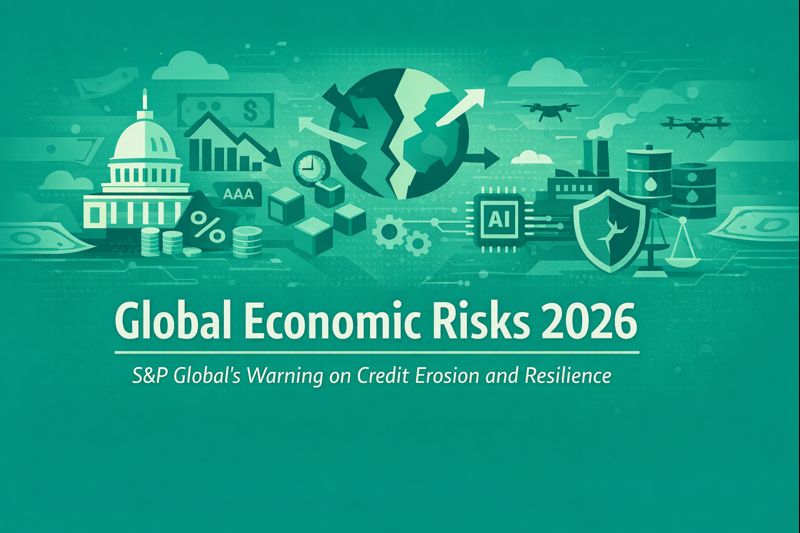
ーFrom the Age of Credit to the Age of Resilience ー
Executive Summary: What S&P Is Really Warning About
The core risk is not collapse, but erosion:
a gradual weakening of credit quality, policy credibility, and institutional resilience beneath a surface of apparent macroeconomic stability.
Growth continues. Financial systems remain operational.
Yet the margin for error is shrinking, and shocks that would once have been absorbed are increasingly likely to propagate into credit events.
- I. The Macro Backdrop: Stable, but Structurally Fragile
- II. Credit Cycles: The Problem Is Not Leverage, but Concentration
- III. Financial Systems: Stability Without Slack
- IV. Geopolitics and Markets: Chronic Risk, Not Acute Shock
- V. Climate, Resources, and AI: Risks Already on the Balance Sheet
- Conclusion: The Real Risk of 2026
I. The Macro Backdrop: Stable, but Structurally Fragile
S&P’s base case for 2026 does not assume a global recession.
However, the post-tightening global economy exhibits three defining weaknesses:
- Growth that is uneven and narrowly concentrated
- Inflation that has moderated, but with persistent supply-side constraints
- Interest rates that remain structurally higher, embedding elevated credit costs
In this environment, risk does not come from volatility itself, but from reduced shock absorption capacity.
Small disturbances—geopolitical, policy-driven, or sector-specific—can more easily translate into defaults, downgrades, or liquidity stress.
This is the macro condition S&P is most concerned about: a calm surface over thinner ice.
II. Credit Cycles: The Problem Is Not Leverage, but Concentration
The defining credit risk of 2026 is not system-wide excess, but localized accumulation.
Key features include:
- High leverage clustered in specific sectors and issuers
- Capital flowing disproportionately into AI, energy transition, and infrastructure themes
- Risk pricing that remains optimistic despite tighter financial conditions
S&P’s implicit warning is clear:
the next credit events will be explainable, contained, and therefore underestimated—until they are not.
This is not a 2008-style crisis.
It is a 2026-style credit deterioration, incremental and cumulative.
III. Financial Systems: Stability Without Slack
Banking systems enter 2026 with:
- Strong capital ratios
- Improved liquidity buffers
- Better stress-testing frameworks
Yet S&P highlights a different vulnerability: the erosion of regulatory and policy discipline.
Risks arise from:
- Weakened supervisory rigor
- Political influence over financial regulation
- Legacy assets originated during ultra-low-rate periods
This does not point to a banking collapse, but to a system that becomes less forgiving under stress.
In other words, stability persists—but without redundancy.
IV. Geopolitics and Markets: Chronic Risk, Not Acute Shock
Unlike political risk consultancies, S&P treats geopolitics primarily as a credit modifier, not a market shock generator.
Persistent factors include:
- Prolonged conflicts without resolution
- Normalization of trade frictions and tariffs
- Episodic sanctions and export controls
The economic consequence is not sustained volatility, but a permanently higher cost of capital.
Geopolitics in 2026 quietly compresses credit quality by:
- Raising operating costs
- Increasing funding uncertainty
- Shortening investment horizons
Markets have not fully priced this persistence.
V. Climate, Resources, and AI: Risks Already on the Balance Sheet
A critical distinction in S&P’s analysis is that climate risk, resource constraints, and AI are not treated as future issues.
They are already embedded in credit fundamentals:
- Physical climate risk is altering asset valuations
- Resource bottlenecks (notably power and copper) constrain growth potential
- AI investment cycles show signs of over-concentration and delayed monetization
In 2026, technology is less a growth accelerator than a credit differentiator.
Strong balance sheets gain optionality; weak ones face amplified downside.
Conclusion: The Real Risk of 2026
S&P Global’s perspective can be summarized succinctly:
The global economy in 2026 will not break—but it will bend more easily.
- Crises will be localized
- Defaults will be rationalized
- Recoveries will be slower and more selective
The key variable is no longer growth or inflation, but the remaining stock of trust—in institutions, policy frameworks, and balance sheets.
2026 is therefore not a year for maximizing returns.
It is a year in which success depends on avoiding irreversible mistakes.
In the age of resilience, the winners are not the most aggressive, but the most robust.