ーJapan’s Vulnerability as a State Anchored to U.S. Institutionsー
- Executive Summary
- 1. Japan’s Starting Point: A Nation That Bet on Institutions
- 2. Primary Risk: The Qualitative Transformation of U.S. Treasuries
- 3. Secondary Risk: The Hollowing-Out of the Yen’s Safe-Haven Role
- 4. Tertiary Risk: The Global Normalization of Politicized Monetary Policy
- 5. Quaternary Risk: Forced Policy Synchronization with the United States
- 6. The Worst-Case Configuration: Loss of All Safe Anchors
- Conclusion: Japan’s Strategic Challenge Is a Collapse of Assumptions
Executive Summary
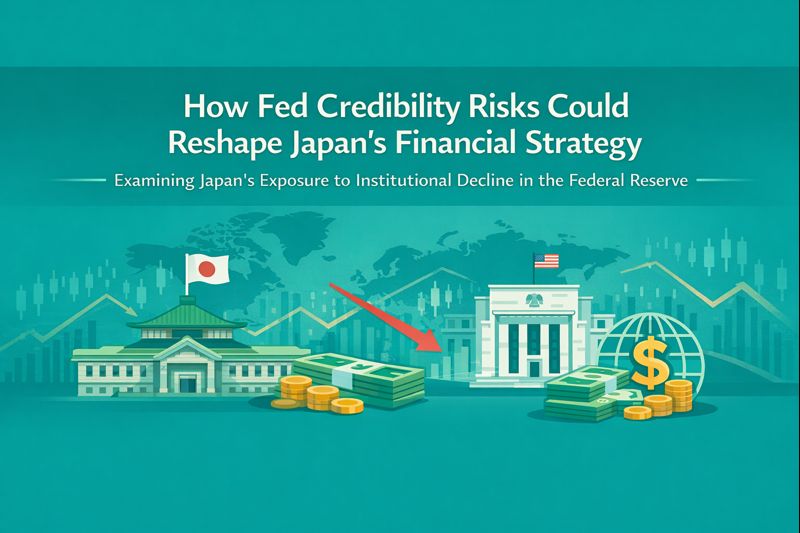
Recent developments surrounding the Federal Reserve Board (FRB), most notably the criminal investigation involving Chair Jerome Powell, should not be interpreted as a purely domestic political issue in the United States. For Japan, these events represent an endogenous structural risk—one that directly affects monetary stability, external assets, and national economic security.
Japan is:
- One of the world’s largest net external asset holders
- Among the largest foreign holders of U.S. Treasuries
- Deeply embedded in the dollar-centric international monetary system
As a result, any deterioration in U.S. institutional credibility—especially the independence of the central bank—has first-order implications for Japan’s financial foundations. This report examines the scenarios Japan must critically monitor and the structural vulnerabilities they expose.
1. Japan’s Starting Point: A Nation That Bet on Institutions
Japan’s post-war financial strategy has been internally consistent and rational.
- Foreign exchange reserves concentrated in U.S. dollars
- U.S. Treasuries treated as the ultimate safe asset
- Exchange-rate stability implicitly anchored to U.S. institutional reliability
This framework rests on a single, often unstated assumption:
U.S. institutions—especially the Federal Reserve—are insulated from political pressure.
For Japan, FRB independence has not been a philosophical ideal; it has been the practical justification for allocating national wealth.
2. Primary Risk: The Qualitative Transformation of U.S. Treasuries
If the perception takes hold that the FRB is politically vulnerable, U.S. Treasuries undergo a fundamental reclassification.
- Previous status:
Institutionally risk-free assets - Emerging status:
Assets with embedded political risk
This is not a question of yields or mark-to-market losses.
For Japan, the risk lies in a qualitative degradation of reserve assets.
Once U.S. Treasuries are no longer viewed as institutionally neutral, Japan’s reserve strategy loses its theoretical anchor—regardless of short-term price stability.
3. Secondary Risk: The Hollowing-Out of the Yen’s Safe-Haven Role
Traditionally, global stress follows a familiar pattern:
- Dollar instability → Yen appreciation
However, current conditions challenge this mechanism.
- The yen is constrained by prolonged monetary accommodation
- Bank of Japan faces limited policy flexibility amid inflation and fiscal concerns
If confidence in the dollar weakens while the yen lacks institutional credibility as an alternative, Japan faces a new scenario:
- The dollar becomes unstable
- The yen fails to function as a credible refuge
This is not standard currency depreciation.
It is the risk of the yen becoming structurally non-selectable in global portfolios.
4. Tertiary Risk: The Global Normalization of Politicized Monetary Policy
Should the United States normalize:
- Electoral pressure on interest-rate decisions
- Direct or indirect intimidation of central bank leadership
Such behavior will not remain isolated. It will become implicitly permissible globally.
For Japan, this creates acute pressure:
- The relative independence of the Bank of Japan becomes harder to defend
- Domestic political arguments emerge questioning restraint
- Fiscal-monetary boundaries risk blurring once again
Japan has historical experience with politically driven monetary policy.
This is not a theoretical risk—it is a known failure mode.
5. Quaternary Risk: Forced Policy Synchronization with the United States
If U.S. monetary policy becomes increasingly aligned with political calendars rather than macroeconomic conditions, Japan may face pressure to follow suit.
- Policy decisions justified by “global coordination”
- Actions driven by U.S. timing rather than domestic conditions
The danger here is not policy error per se, but policy opacity.
- Decisions become difficult to explain
- Accountability becomes diffuse
- Course correction becomes politically costly
This represents institutional fatigue rather than a single mistake.
6. The Worst-Case Configuration: Loss of All Safe Anchors
The most severe scenario for Japan is the simultaneous occurrence of:
- Declining FRB independence
- Erosion of the institutional premium on U.S. Treasuries
- Relative weakening of the yen’s safe-haven status
In such a configuration, Japan loses both:
- A stable reserve asset
- A credible domestic currency anchor
This is not a market shock.
It is a balance-sheet problem at the level of the state.
Conclusion: Japan’s Strategic Challenge Is a Collapse of Assumptions
The central risk for Japan is not U.S. recession, dollar volatility, or temporary financial stress.
It is the erosion of a foundational assumption:
That U.S. institutions are structurally insulated from politics.
Japan’s external reserves, exchange-rate policy, financial stability framework, and economic security strategy have all been built on that assumption.
What is now required is not crisis management, but intellectual and institutional preparation for a world in which that assumption no longer holds.
The question Japan must confront is no longer hypothetical:
Will Japan continue to bet on institutional exceptionalism,
or will it redesign its financial strategy to price institutional risk itself?
That decision point has already arrived.