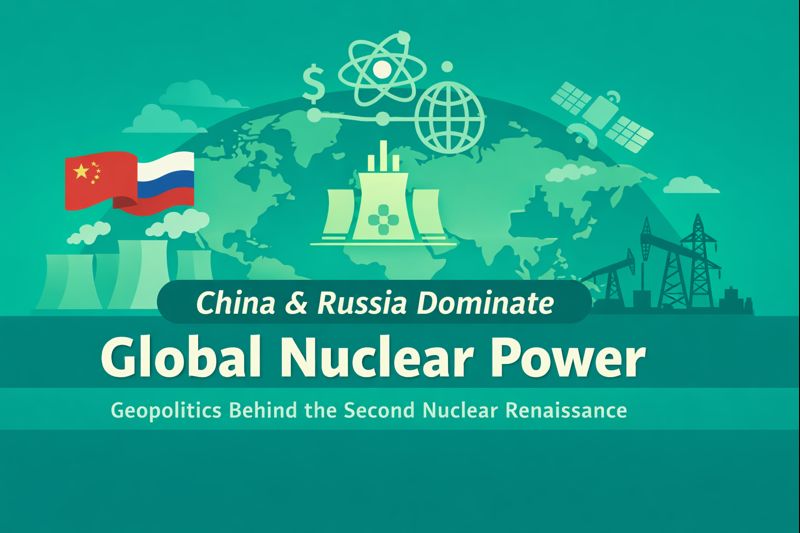
China–Russia Dominance and the True Nature of the “Second Nuclear Renaissance”
- Executive Summary
- Chapter 1: Nuclear Power as Strategic Infrastructure, Not Energy Equipment
- Chapter 2: The Chinese Model — State-Capitalist, Fully Integrated Control
- Chapter 3: The Russian Model — Lock-In Through Nuclear Diplomacy
- Chapter 4: Why the West Exited the Nuclear Construction Market
- Chapter 5: AI as the Catalyst for the Second Nuclear Renaissance
- Chapter 6: Japan’s Realistic Position in the New Nuclear Order
- Conclusion: Nuclear Power Has Returned as an Instrument of Power
Executive Summary
The global nuclear power industry has entered an irreversible structural transition in the mid-2020s.
The fact that roughly 90% of newly constructed nuclear reactors worldwide are led by China and Russia is not the outcome of cost competitiveness alone. It reflects a more fundamental shift: nuclear power has re-emerged as a strategic instrument for long-term geopolitical influence, rather than merely a source of electricity or a decarbonization tool.
This report examines:
- Why China and Russia have come to dominate nuclear construction
- Why Europe, the United States, and Japan fell out of the market
- How AI-driven electricity demand has altered the strategic value of nuclear power
- What a realistic and economically rational strategy looks like for Japan
Chapter 1: Nuclear Power as Strategic Infrastructure, Not Energy Equipment
Nuclear power differs fundamentally from other energy sources such as solar or wind.
A nuclear plant entails:
- Design and construction
- Fuel fabrication and supply
- Operation and maintenance
- Spent fuel management
- Decommissioning
Taken together, these create interdependencies lasting 60–100 years.
Therefore, adopting nuclear power is not an energy choice—it is effectively:
A decision to embed long-term institutional, technological, human-capital, and diplomatic dependence on the supplier country.
Only states that understand this strategic nature can successfully leverage nuclear power internationally.
Chapter 2: The Chinese Model — State-Capitalist, Fully Integrated Control
2.1 Vertically Integrated National System
China has fully embedded nuclear power into national industrial strategy:
- Reactor design: domestically developed models (e.g., Hualong One)
- Construction: state-owned heavy engineering firms
- Operation: national power utilities
- Finance: policy banks
- Regulation: centralized state oversight
This full-stack, state-controlled model cannot be replicated within Western systems that rely on market discipline, regulatory separation, and private capital.
2.2 Rational Choice for Emerging Economies
For emerging economies, the key decision criteria are not:
- Maximum theoretical safety margins
- Lengthy social consensus processes
Instead, priorities are:
- Manageable upfront investment
- Political negotiability
- Turnkey provision of capital, technology, and expertise
China is uniquely positioned to meet all three simultaneously. Nuclear exports thus function as a high-value extension of China’s overseas strategic influence, well beyond conventional infrastructure diplomacy.
Chapter 3: The Russian Model — Lock-In Through Nuclear Diplomacy
Russia’s nuclear strategy is export-oriented rather than domestic-demand driven.
Through its state nuclear corporation Rosatom, Russia offers comprehensive packages including:
- Reactor design
- Construction
- Fuel supply
- Operations support
- Financing
Once construction begins:
- Projects cannot be abandoned
- Alternative suppliers are scarce or nonexistent
- Fuel dependence persists for decades
This makes nuclear exports an exceptionally powerful tool:
A mechanism for sustaining geopolitical influence without military force.
Even under sanctions, recipient countries are structurally compelled to maintain cooperation.
Chapter 4: Why the West Exited the Nuclear Construction Market
The Fukushima Daiichi accident was a catalyst, but not the root cause.
The deeper issue lies in institutional exhaustion within Western governance models:
- Fragmentation between regulators, operators, and financiers
- Full risk transfer to private capital
- Escalating litigation exposure
- Prolonged and uncertain local consent processes
As a result, nuclear power became:
Socially indispensable yet financially unviable.
Markets rationally withdrew, leaving a vacuum filled by state-driven actors.
Chapter 5: AI as the Catalyst for the Second Nuclear Renaissance
5.1 Structural Shift in Electricity Demand
AI and hyperscale data centers require:
- Continuous, 24/7 power supply
- Extremely high energy density
- Near-zero tolerance for outages
Renewables alone cannot satisfy these requirements.
Consequently, nuclear power is being redefined—not as a climate solution, but as:
Foundational infrastructure for computational capacity.
5.2 Small Modular Reactors as a Pragmatic Solution
The United States’ renewed focus is not on traditional large-scale reactors, but on SMRs:
- Modular construction
- Reduced construction timelines
- Lower upfront capital requirements
- Standardization and scalability
Public involvement—exemplified by entities such as the Tennessee Valley Authority—represents a partial return to state participation, narrowing the structural gap with China’s model.
Chapter 6: Japan’s Realistic Position in the New Nuclear Order
Japan is unlikely to reclaim leadership in full-scale reactor exports.
However, this does not imply strategic irrelevance.
The emerging reality is:
- Complete reactor systems: dominated by China and Russia
- Critical components, control systems, advanced materials: Japan remains indispensable
Japan’s rational strategy is therefore:
To abandon end-product competition and instead dominate irreplaceable core technologies.
Deep integration into U.S.-led SMR supply chains offers Japan the highest strategic return with manageable political and financial risk.
Conclusion: Nuclear Power Has Returned as an Instrument of Power
In the early 21st century, nuclear energy was framed around climate policy and safety concerns.
That framing is no longer sufficient.
Today, nuclear power has re-emerged as:
Long-duration infrastructure through which states bind other states.
China and Russia understand this clearly.
The United States is returning to realism under pressure from AI-driven demand.
Japan’s opportunity lies not in leadership symbolism, but in structural indispensability.
Over the next two decades, nuclear policy will not be energy policy.
It will be national strategy in its most concrete form.