Wrote By:Global Economist 2025/11
1. Overview: The Critical Node of Energy Security
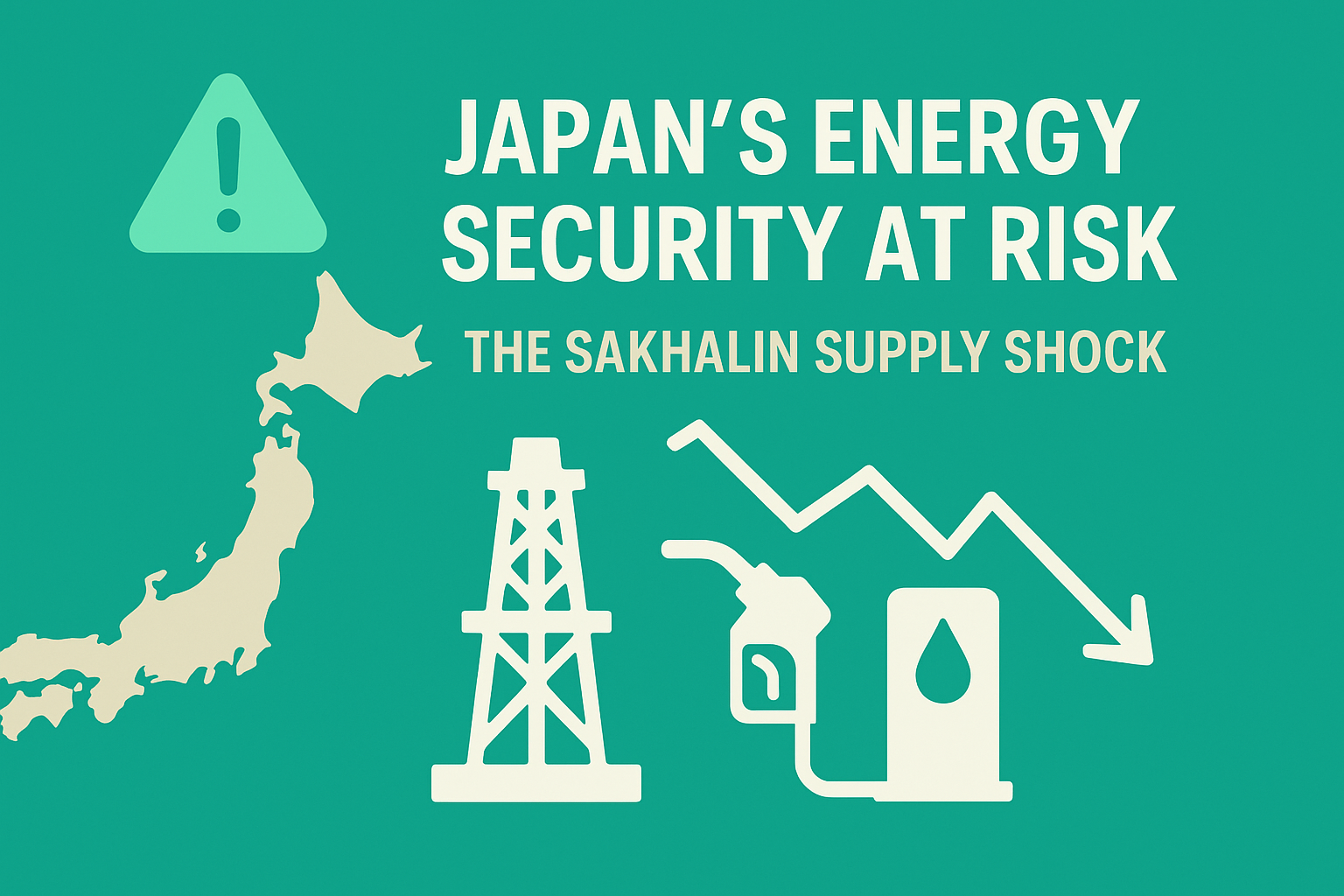
Sakhalin‑2 (LNG) and Sakhalin‑1 (crude oil) have long served as geographically proximate and stable Russian supply sources for Japan, accounting for roughly 3% of total energy imports. Although modest in volume, these projects offer a rare combination of proximity, cost efficiency, and winter supply stability. A full disruption—whether due to sanctions or geopolitical escalation—would reverberate through Japan’s energy prices, exchange rate, industrial cost structures, and monetary policy.
2. Short‑Term Impacts (1–6 months): Inflationary Shock and Currency Pressure
(1) Import Prices and Trade Balance
Loss of Sakhalin crude and LNG would force Japan to source from the Middle East, Australia, or the U.S., leading to higher freight and spot premiums:
- LNG: +$2–4 per MMBtu
- Crude oil: +$5–10 per barrel above Brent benchmark
This implies an additional ¥2–3 trillion in annual import costs, worsening the current‑account balance by 0.3–0.5% of GDP. The inflation pass‑through to consumer prices would lift CPI by +0.4–0.7 percentage points.
(2) Energy Tariffs and Consumer Costs
Utilities such as TEPCO, Chubu Electric, and Toho Gas rely on long‑term Sakhalin LNG contracts. Replacement via the spot market would push electricity and gas prices up 5–8%, risking winter power shortages and renewed pressure to restart nuclear reactors.
(3) Financial Market Repercussions
Rising import prices and headline inflation would intensify pressure on the Bank of Japan to normalize policy. Long‑term yields could rise 20–30 bps, and the yen could temporarily weaken to ¥155 per dollar. Nominal GDP might edge up via price effects, but real growth would decelerate.
3. Medium‑Term Impacts (6 months–2 years): Industrial Costs and Competitiveness
(1) Structural Cost Increase
Energy‑intensive industries—petrochemicals, metals, paper, and logistics—would face 5–10% higher production costs. Northern regions such as Hokkaido and Tohoku, more reliant on Sakhalin energy, would be disproportionately affected.
(2) Exchange Rate and Export Competitiveness
A weaker yen supports exporters temporarily but erodes real income through imported inflation. Manufacturing giants gain windfalls from FX translation, yet domestic SMEs see profit margins compressed.
(3) Policy and Public Finance Response
Government countermeasures would likely include:
- Greater Middle East reliance
- Expanded LNG contracts with Australia and the U.S.
- Diversification via renewables and nuclear restarts
JBIC would align by financing alternative LNG procurement, renewable expansion, and fuel‑storage infrastructure, potentially unlocking trillions of yen in new investments.
4. Long‑Term Impacts (2+ years): Geopolitics and Structural Transition
(1) End of Russia Dependency
A Sakhalin cutoff would redraw Japan’s energy map. Cooperation with Russia in the Far East and Arctic corridors would freeze, replaced by diversification toward India, ASEAN, the Middle East, and Africa.
(2) Persistent Energy Cost Inflation
As Japan loses bargaining power in the Asian LNG market, sustained high electricity and gas prices could trigger industrial hollowing‑out as manufacturers relocate abroad.
(3) Macro‑Level Effects
- Real GDP growth: −0.5 to −0.8 pp
- Trade balance: −¥2–3 trillion annually
- CPI: +1.0 pp
- Fiscal cost: +¥0.5–1 trillion (energy subsidies, fuel stockpiles)
5. Policy and JBIC Recommendations
- Accelerate Alternative Supply Financing: Expand JBIC guarantees for LNG and oil contracts with Australia, India, Vietnam, and the UAE.
- Diversify the Energy Portfolio: Redirect policy finance toward renewables, nuclear, hydrogen, and ammonia projects.
- Enhance Hedging and Risk Management: Utilize multi‑currency (INR/JPY, USD/JPY) and commodity‑linked hedges to stabilize import costs.
- Support Regional Resilience: Establish special lending programs for Hokkaido and Tohoku to strengthen local storage, transport, and renewable facilities.
6. Conclusion: The Geopolitics of Energy and Japan’s Strategic Choice
A disruption of Sakhalin supply, though small in volume, would eliminate Japan’s closest and most cost‑effective energy corridor. Its consequences—spanning prices, currency, industrial policy, and financial stability—would be profound. Japan’s challenge is not merely replacing Russian volumes but adapting to a permanently higher‑cost energy world. JBIC and policy finance must therefore evolve from crisis stabilizers to long‑term architects of energy resilience.