Wrote By:Global Economist Date:2025/12
1. Introduction
The United Arab Emirates (UAE) stands not only as a resource-based economy but also as a strategic nexus linking Asia, Africa, and Europe through energy, logistics, and diplomacy.
This report provides a comprehensive analysis of the UAE’s geopolitical advantages under five core pillars — location, infrastructure, diplomacy, diversification, and risk — and identifies how these advantages translate into practical opportunities for trade, finance, and investment, particularly from a JBIC (Japan Bank for International Cooperation) perspective.
2. The Structural Foundations of UAE’s Geopolitical Advantage
2.1 Strategic Geographic Position
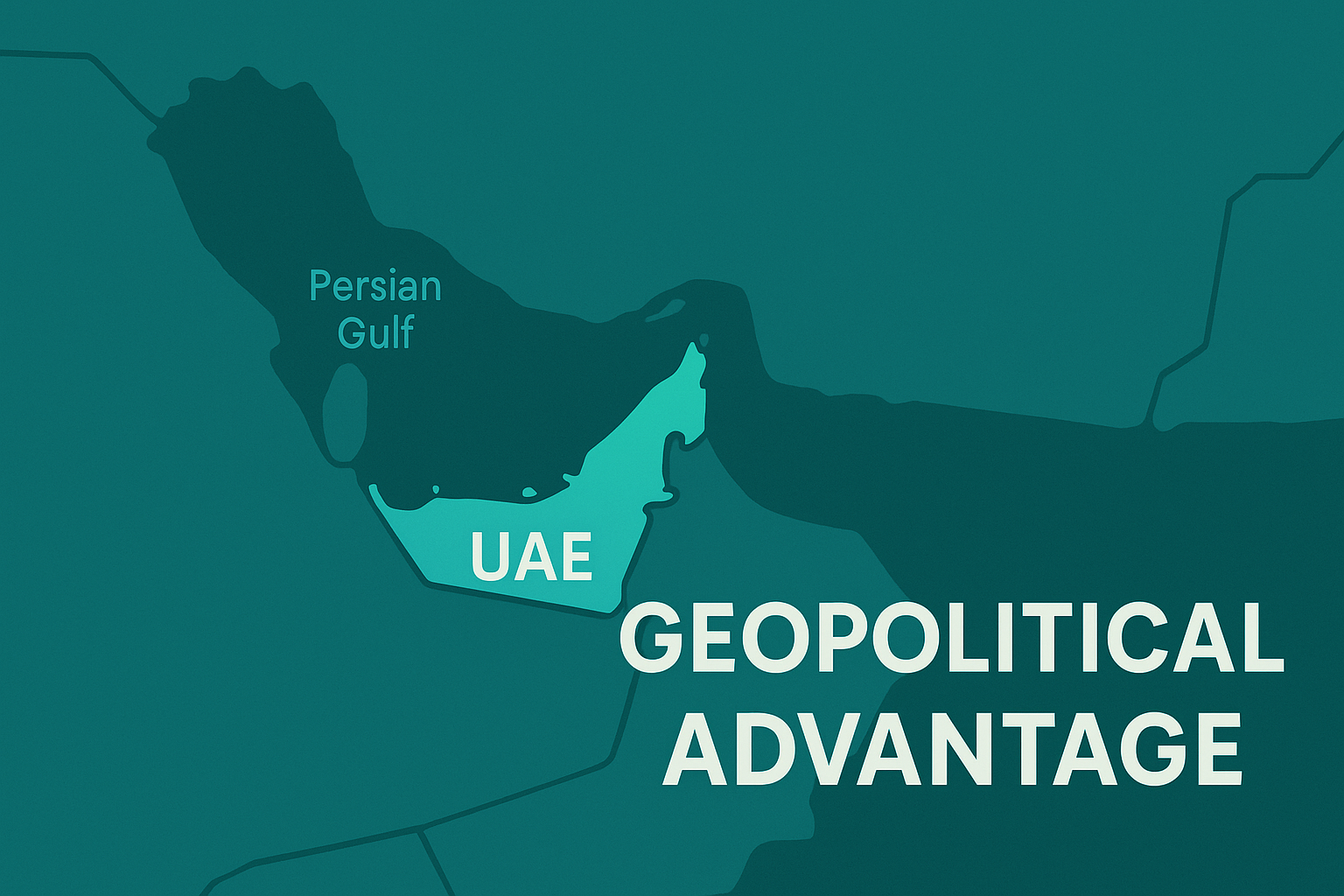
- The UAE occupies a central position between the Persian Gulf and the Gulf of Oman, commanding maritime routes that connect Europe, Africa, and Asia.
- Its proximity to critical maritime chokepoints such as the Strait of Hormuz and Bab el-Mandeb makes it indispensable to global energy flows.
- The Port of Fujairah, located on the Gulf of Oman, allows oil exports to bypass the Strait of Hormuz — a vital hedging measure against regional instability.
The UAE’s geographic location enables it to act as a natural hub for logistics, energy export, and crisis-contingency shipping.
2.2 Infrastructure and Hub Functionality
- The UAE has developed world-class infrastructure including Jebel Ali Port, Dubai International Airport, and numerous Free Trade Zones (FTZs) such as DMCC and JAFZA.
- These zones facilitate re-export, storage, and transshipment of goods across MENA, Africa, and South Asia.
- The UAE’s advanced logistics and trade ecosystem has allowed it to emerge as a “service hub” complementing its traditional energy exports.
In the energy, commodity, and aviation sectors, the UAE functions as a “geo-economic hinge” of the 21st century.
2.3 Multi-Vector Diplomacy and Balanced Foreign Policy
- The UAE maintains strong ties with the United States and Western allies, while also deepening relations with Russia, China, India, and Africa.
- Through this multi-vector diplomacy, the UAE acts as a neutral mediator and connector between conflicting global blocs.
- Initiatives such as the Abraham Accords and growing engagement in Africa showcase the UAE’s ambition to become a regional stabilizer and diplomatic broker.
Its pragmatic neutrality enhances its attractiveness as a platform for global finance, logistics, and multilateral cooperation.
2.4 Economic Diversification and Strategic Transformation
- The UAE has strategically shifted from hydrocarbon dependence toward knowledge-based, technology-driven, and green industries.
- Investments in renewable energy, hydrogen, AI, logistics, tourism, and financial services support its “Vision 2031” diversification plan.
- As a result, foreign investment and multinational presence in the UAE have surged, transforming its geopolitical strength into a sustainable economic advantage.
The UAE’s diversification makes it not merely an oil exporter, but a future-ready innovation hub for the greater Middle East.
3. Why UAE’s Geopolitical Advantage Matters for Global Business
| Advantage | Strategic Implication | Business Opportunity |
|---|---|---|
| Geographic Hub | Central between Asia, Africa, and Europe | Ideal logistics base for regional export, resource distribution, and trade optimization |
| Infrastructure + Free Zones | Efficient ports, flexible tax and trade regimes | Resource and commodity trading, energy re-export, and supply-chain clustering |
| Diplomatic Stability | Neutral mediator amid global tensions | Reliable base for financial and multilateral operations |
| Economic Diversification | Expanding green and digital sectors | Investment in renewables, water, data centers, and mobility tech |
| Resilience & Connectivity | Redundant supply routes bypassing chokepoints | Supply-chain risk mitigation and alternative routing strategies |
For Japan and JBIC-related initiatives, UAE’s geopolitical position offers a “gateway” to Africa, MENA, and South Asia — vital for energy security and economic diplomacy.
4. Risk Landscape and Structural Constraints
While its strategic position offers great promise, the UAE’s geopolitical advantage also entails complex vulnerabilities:
- Regional Conflict Risk – Proximity to volatile chokepoints (Strait of Hormuz, Red Sea, Bab el-Mandeb) exposes UAE shipping to potential disruptions.
- Governance & Transparency Gaps – Free zones attract global business but sometimes lack ownership transparency, creating compliance risks.
- Resource Dependence – Despite diversification, global oil price volatility and decarbonization trends remain structural risks.
- Geopolitical Balancing Challenge – Managing relationships among the US, China, Russia, Iran, and regional powers demands constant strategic calibration.
UAE’s strength lies in balance — but this very balancing act remains its greatest long-term test.
5. Implications for Investors and Policy Institutions (e.g., JBIC)
5.1 Field Observation Priorities
- Visit Jebel Ali Port and Fujairah Terminal to assess logistics capacity and export routes.
- Review Free Zone regulatory frameworks, ownership rules, and foreign equity caps.
- Evaluate renewable-energy and hydrogen projects supported by the UAE’s national strategy.
- Conduct geopolitical risk briefings with local think tanks and maritime experts.
5.2 Due Diligence Enhancements
- Integrate geoeconomic factors into risk-assessment models — route diversification, maritime security, and legal transparency.
- Require disclosure of ultimate beneficial ownership (UBO) for UAE-based partners.
- Use dual-route or redundant logistics planning to offset chokepoint exposure.
5.3 Strategic Partnership Approach
- Pursue joint infrastructure and green-energy financing frameworks with UAE sovereign entities (e.g., ADNOC, Masdar, ADIA).
- Develop co-investment vehicles for Africa and South Asia using UAE as a capital and logistics base.
- Strengthen policy dialogue on ESG governance, export-control compliance, and sanctions alignment.
6. Conclusion
The UAE’s geopolitical advantage is defined by five interlocking dimensions — location, infrastructure, diplomacy, diversification, and resilience.
As a logistics and energy hub bridging continents, the UAE has evolved from a resource state into a strategic intermediary between the Global North and South.
For Japan and JBIC, this advantage translates into tangible leverage:
- energy security through stable Gulf access,
- investment expansion into MENA and Africa,
- and diversification of global supply chains through a politically stable gateway.
In essence, the UAE is no longer merely “in the Middle East” — it is the Middle East’s strategic hinge, balancing global power flows and offering a secure, adaptive platform for future-oriented investment.
(Prepared for policy and investment planning purposes. Sources: Carnegie Endowment, BNP Paribas Research, MEI-NUS, Al Jazeera Centre for Studies, TNI, ORF Online, UAE MoFA, Vision 2031.)