— From Airport Chaos to Systemic Distrust in a Divided America —
① Overview
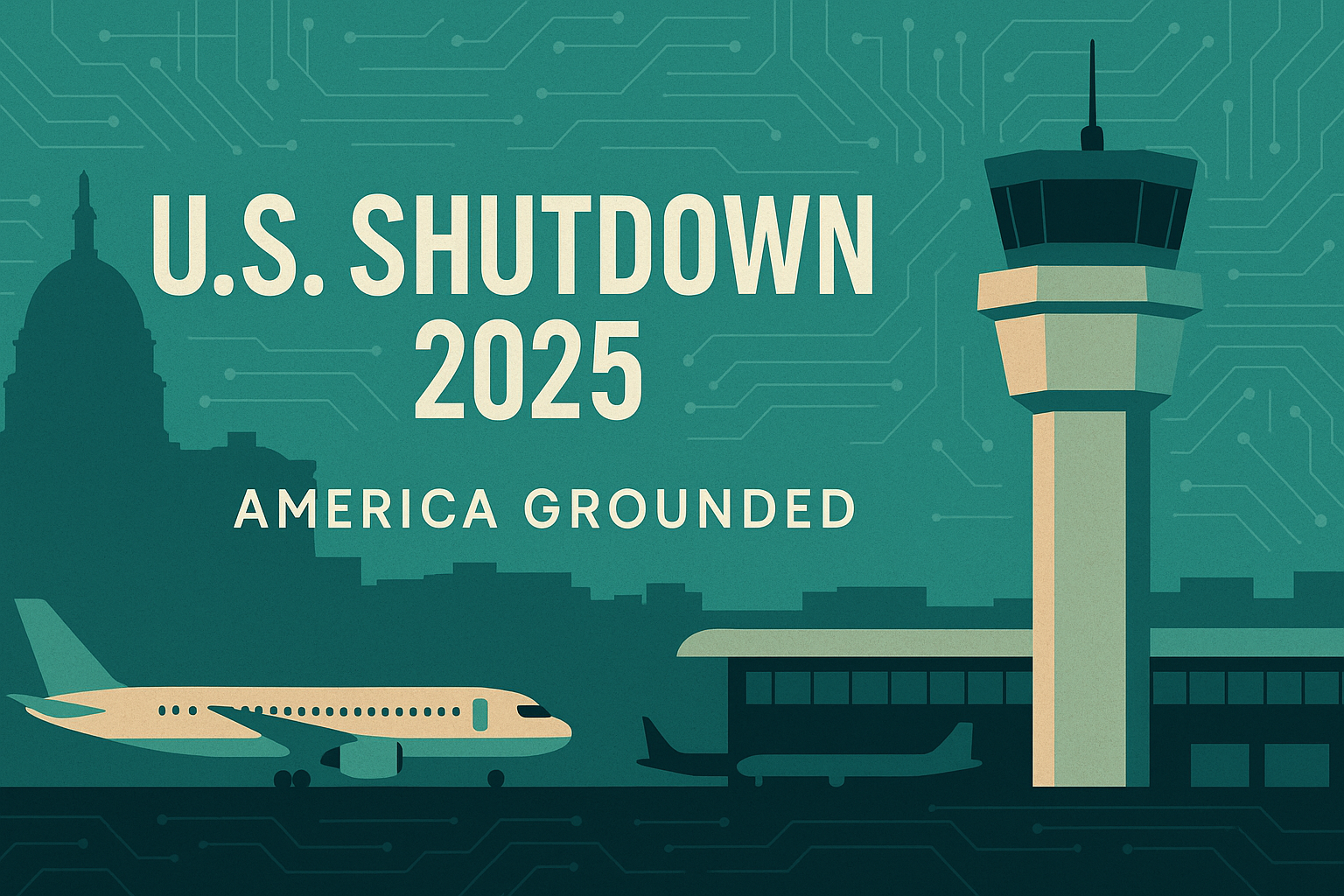
The prolonged U.S. federal government shutdown of late 2025 has evolved beyond an administrative impasse — it has become a test of institutional resilience and public trust.
Grounded flights, unpaid federal workers, and suspended public services are not only disrupting daily life but also fueling a collective sense of insecurity.
While the situation has not escalated into open violence or civil conflict, the erosion of confidence in governance and the fragmentation of social stability suggest the system is approaching a dangerous threshold.
② Background and Current Conditions: The Limits of Institutional Endurance
Failure to pass a federal budget forced hundreds of thousands of civil servants into furloughs or unpaid work.
At the Federal Aviation Administration (FAA) and the Transportation Security Administration (TSA), staff shortages and fatigue have led to major operational slowdowns.
Over 10% of flights have been reduced at key airports, and delays and cancellations have reached decade-high levels (AP, The Guardian, Nov 2025).
Meanwhile, the shutdown has halted food-aid programs, court operations, and housing support — directly affecting vulnerable populations.
The public is now facing not just financial uncertainty but an existential question:
“What happens when the government itself stops functioning?”
This psychological rupture is deepening the political divide, with both major parties blaming each other for administrative paralysis.
③ Social Impact: The Chain Reaction from Airports to the Public Mind
What began as a budget standoff has cascaded into a logistical and emotional breakdown.
At airports, last-minute cancellations and delays have multiplied the administrative burden on ground crews, air-traffic controllers, and customer-service staff.
The result is a loop of fatigue and dysfunction — staff shortages cause operational stress, which in turn leads to more cancellations and even greater stress.
For millions of Americans, the shutdown is no longer an abstract policy debate; it is a tangible disruption of daily life.
“Government doesn’t pay me, but still taxes me.”
This sentiment captures the growing cognitive dissonance that fuels distrust toward federal authority — an emotional precursor to deeper social unrest.
④ Economic and Geopolitical Repercussions: The Fragility of U.S. Credibility
Economists estimate that each week of shutdown costs the U.S. economy billions of dollars in lost productivity, tourism, and consumption (The Guardian, Oct 2025).
Defense contractors, infrastructure developers, and technology suppliers face project delays as federal payments and approvals are frozen.
Internationally, the episode has revived the question of “U.S. reliability” as a governing and financial anchor.
The dollar remains strong, but confidence in U.S. policy predictability is eroding.
Allies and investors are now forced to consider “institutional risk” as a structural element of dealing with Washington — a profound shift in global perception.
⑤ Risk Scenarios
| Scenario | Description | Probability | Social Impact |
|---|---|---|---|
| A: Quick Resolution | Temporary bipartisan deal restores funding within weeks | 40% | Short-term recovery; lingering distrust |
| B: Chronic Dysfunction | Repeated shutdowns and rolling administrative paralysis | 45% | Nationwide disillusionment, sporadic protests, economic stagnation |
| C: Civil Unrest | Localized riots or violent protests driven by systemic distrust | 15% | Regional instability, possible deployment of National Guard |
Scenario B — chronic political dysfunction — appears most likely.
In this path, the U.S. experiences a slow institutional decay rather than a sudden collapse.
If Scenario C emerges, potential flashpoints would include Washington D.C., Atlanta, and Chicago, where federal employment and social inequality converge.
⑥ Conclusions and Policy Implications
- Reinforce Institutional Resilience
Emergency mechanisms — such as interim pay for essential staff and automated budget rollovers — should be formalized to prevent total administrative paralysis. - Protect Operational Sustainability
In aviation, logistics, and transport, pre-emptive staffing buffers and AI-based scheduling could mitigate future shutdown disruptions. - Rebuild Public Trust through Communication
The government and media must provide consistent, transparent messaging to reassure citizens that essential functions continue. - Implications for Businesses and Investors
Companies and financial institutions must treat “U.S. governance instability” as a variable in their strategic risk models.
Sectors most exposed include aviation, defense, logistics, and digital infrastructure.
Final Analysis
This government shutdown symbolizes more than a partisan stalemate — it reveals the structural fatigue of 21st-century democracy in its most visible form.
When the machinery of governance falters, everyday disruptions become existential threats to social cohesion.
The airport chaos is a metaphor: a nation grounded by its own procedural gridlock.
Whether the United States transforms this crisis into institutional renewal — or descends into a spiral of distrust and dysfunction — will depend on decisions made in the coming weeks.
The world is watching, not only the outcome of a political standoff, but the endurance of a democratic superpower under internal strain.