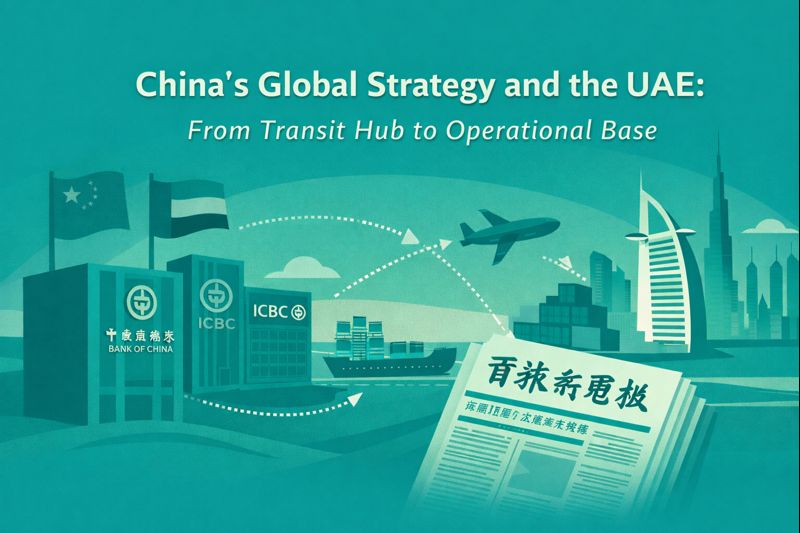
The Economic Meaning of “Permanent Presence” in DIFC and Major Airports
- Executive Summary
- 1. Why “Banks + Newspapers” Matter Economically
- 2. DIFC as China’s Institutional “Work Platform”
- 3. Chinese Media in Airports: A Signal of Decision Density
- 4. Implications for the Belt and Road Initiative (BRI)
- 5. The UAE’s Strategy: Leverage, Not Alignment
- 6. Economic Interpretation: What Is Actually Happening
- Conclusion
Executive Summary
The permanent presence of Chinese banks in DIFC and the systematic placement of Chinese-language newspapers in major UAE airports are not incidental observations. Together, they signal a structural shift in China’s external economic strategy—from transit-based globalization to resident, operational globalization.
For the United Arab Emirates, this development does not represent geopolitical alignment or dependency. Instead, it reflects the UAE’s emergence as a neutral, institutionally reliable operating base where Chinese, Western, and regional capital can coexist under a shared rule-based framework.
This report argues that:
- China now treats the UAE as an offshore operational hub, not merely a logistics waypoint.
- The combination of banks and native-language media marks the transition from episodic engagement to continuous decision-making on site.
- The UAE has successfully positioned itself as a systemic enabler, not a participant in any single bloc.
What is unfolding is not geopolitical expansion, but institutional convergence.
1. Why “Banks + Newspapers” Matter Economically
In economic systems, two elements define whether activity is transient or embedded:
- Banks provide capital access, settlement, and risk management.
- Native-language media provide information continuity, cognitive comfort, and decision autonomy.
During early or peripheral engagement, firms rely on:
- Correspondent banking
- English-language information
- Headquarters-based decision-making
However, once an economy requires:
- Permanent staff with local authority
- Project-level financial autonomy
- Continuous monitoring and execution
both banking infrastructure and native-language information environments become indispensable.
Their simultaneous presence indicates that:
Economic actors are no longer passing through—they are operating from within.
2. DIFC as China’s Institutional “Work Platform”
The Dubai International Financial Centre plays a critical role in this transformation.
From China’s perspective, DIFC offers:
- English common-law–based courts and arbitration
- Full foreign ownership and regulatory predictability
- Co-location with US and European financial institutions
The establishment of institutions such as Bank of China and ICBC within DIFC is therefore not symbolic.
It signals that China views DIFC as:
A legally interoperable offshore platform that complements China’s domestic capital controls while remaining integrated with Western financial systems.
In effect, the UAE is being used as a functional alternative to traditional offshore centers, with lower political risk and higher operational neutrality.
3. Chinese Media in Airports: A Signal of Decision Density
Major hub airports—particularly Dubai International Airport—are not passive transit spaces. They are zones where:
- Regional executives rotate
- Long-haul project teams regroup
- Strategic decisions are often made between movements
The permanent availability of Chinese-language newspapers in these spaces suggests that:
- Chinese business travelers are a core, recurring user group
- The UAE expects ongoing, not episodic, Chinese decision-making activity
- Information access is being localized to reduce friction and dependency on external sources
This reflects a shift from “visitor accommodation” to resident user infrastructure.
4. Implications for the Belt and Road Initiative (BRI)
China’s Belt and Road Initiative has evolved beyond its initial phase:
- Phase 1: Infrastructure construction and policy-bank lending
- Phase 2: Operational management, financial integration, and information localization
The UAE’s role belongs squarely to Phase 2.
Crucially:
- The UAE is not a debt-dependent recipient
- It does not rely on Chinese financing
- It supplies services—logistics, finance, legal infrastructure—to Chinese firms
Thus, the UAE is not a BRI endpoint but a:
Platform that re-connects BRI flows into global markets under stable institutional conditions.
5. The UAE’s Strategy: Leverage, Not Alignment
A key insight is what this development does not represent.
The UAE is not:
- Aligning politically with China
- Substituting Chinese capital for Western capital
- Becoming part of a Chinese economic sphere
Instead, the UAE is executing a consistent strategy:
Maximize hub utilization by accommodating all major capital systems without committing to any single one.
Chinese banks operate under the same regulatory architecture as Western banks.
Chinese media presence reflects demand, not preferential treatment.
This symmetry is the source of the UAE’s leverage.
6. Economic Interpretation: What Is Actually Happening
From an economist’s standpoint, the observed pattern indicates:
- China’s global economic activity has moved from “routing through” the UAE to “being administered from” the UAE
- The UAE’s institutional quality has reached a threshold where continuous Chinese operations are viable without political or legal compromise
- Capital, personnel, and decision-making are now temporarily resident but structurally repeatable
This is not empire-building.
It is operational optimization under institutional constraints.
Conclusion
The presence of Chinese banks in DIFC and Chinese-language newspapers in UAE airports demonstrates that:
China has found a place where it can operate globally without exiting the Western legal-financial system—and that place is the UAE.
At the same time, it proves that:
The UAE has engineered an institutional environment capable of absorbing competing global capital systems without surrendering autonomy.
This relationship is neither dependency nor dominance.
It is a precise equilibrium of mutual utility.
The UAE is not China’s forward base.
But it has become one of the few places where China can operate as if it had one—without actually owning it.
That is the true significance of what you observed.