— Is U.S. Hegemony Retreating, or Being Redesigned? —
- Executive Summary
- Chapter 1: Intellectual Origins — The Economicization of the Monroe Doctrine
- Chapter 2: States as Investment Vehicles
- Chapter 3: Geopolitical Reconfiguration Under Donroe-ism
- Chapter 4: Economic Implications — The Shrinking of Global Public Goods
- Chapter 5: Final Assessment — Isolationism or Reengineered Hegemony?
- Conclusion: What the Donroe Doctrine Really Is
Executive Summary
The foreign-policy worldview of Donald Trump is often described as isolationist or inward-looking.
From an economic perspective, however, this interpretation is incomplete.
What is commonly labeled the “Donroe Doctrine” (Trump’s modernized Monroe Doctrine) represents not a withdrawal from global leadership, but a recalibration of hegemonic costs. Its defining features are:
- Measuring international engagement by cost and return, not values
- Recasting alliances and interventions from public goods into contractual arrangements
- Making spheres of influence explicit rather than implicit
In this sense, Trump’s approach is best understood as conditional hegemony, not isolationism.
Chapter 1: Intellectual Origins — The Economicization of the Monroe Doctrine
The original Monroe Doctrine, articulated in the early 19th century by James Monroe, was based on reciprocal non-interference:
- Europe should stay out of the Western Hemisphere
- The United States would avoid European internal affairs
Its goal was stability through mutual restraint.
Trump’s reinterpretation does not revive this doctrine nostalgically. Instead, it modernizes it by shifting the organizing principle:
- From geography → cost–benefit boundaries
- From ideological leadership → financially sustainable dominance
- From implicit obligations → explicit, conditional engagement
“Donroe-ism,” therefore, is not a revival but an economic transformation of Monroe-era logic.
Chapter 2: States as Investment Vehicles
The central analytical key to Trump’s foreign policy is his treatment of states and alliances as investment cases.
1. Alliances Are Not Free Assets
Trump’s pressure on NATO defense spending and cost-sharing for overseas U.S. forces did not signal abandonment.
Rather, it downgraded alliances from perpetual public goods to renewable contracts.
2. Intervention Must Pass an ROI Test
- Military engagement must generate visible U.S. benefits
- Open-ended conflicts without domestic justification are rejected
The United States thus moves from being the global policeman to a selective stakeholder.
Chapter 3: Geopolitical Reconfiguration Under Donroe-ism
1. The Western Hemisphere: Reasserted Exclusivity
Hardline policies toward Venezuela, Cuba, and Nicaragua are not democracy-promotion strategies.
They are containment measures designed to block Chinese and Russian penetration into the U.S. strategic backyard.
This is classical power politics, not ideological activism.
2. Europe: Forced Strategic Autonomy
Trump did not abandon Europe; he withdrew automatic guarantees.
The result has been:
- Increased European defense spending
- Renewed debate over strategic autonomy
In effect, the U.S. transferred responsibility rather than severing ties.
3. Middle East and Peripheral Regions: Transactional Engagement
In these regions, engagement depends on:
- Energy interests
- Security cooperation
- Deal feasibility
Normative alignment is secondary. Morality is not a precondition.
Chapter 4: Economic Implications — The Shrinking of Global Public Goods
1. End of Free U.S. Order Provision
Trump’s approach reduces America’s willingness to supply:
- Free trade leadership
- Security guarantees
- Monetary and maritime stability
As a result:
- States invest more in self-reliance
- Global order becomes fragmented and regionalized
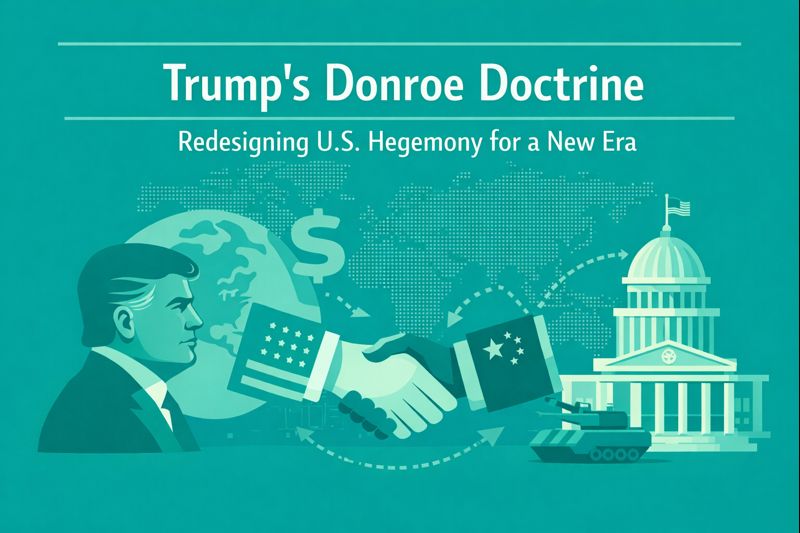
2. The Message to China
Contrary to popular belief, Donroe-ism is not purely confrontational.
Its implicit message is:
“Do not manage the entire world.
Manage your own sphere of influence.”
This is less a call for conflict than a proposal for hegemonic segmentation.
Chapter 5: Final Assessment — Isolationism or Reengineered Hegemony?
The conclusion is unambiguous.
Trump is not an isolationist.
He is a critic of high-cost hegemony.
- Engagement is selective
- Alliances are conditional
- Responsibilities are shared
While rhetorically blunt, this approach reflects a realistic response to fiscal, political, and social constraints within the United States.
Conclusion: What the Donroe Doctrine Really Is
The essence of the Donroe Doctrine can be summarized in one sentence:
“To preserve hegemony, limit how hegemony is used.”
This is not the end of U.S. dominance.
It is a redefinition of how dominance is exercised.
The world is shifting:
- From ideology-driven integration
- Toward management through transactions and spheres of influence
Trump’s doctrine is not an anomaly, but an early signal of this structural transition.