Date: October 18, 2025
Sources: Al Jazeera, Reuters, Washington Post
Category: Geopolitics / Infrastructure / Post-Conflict Strategy
1. Overview
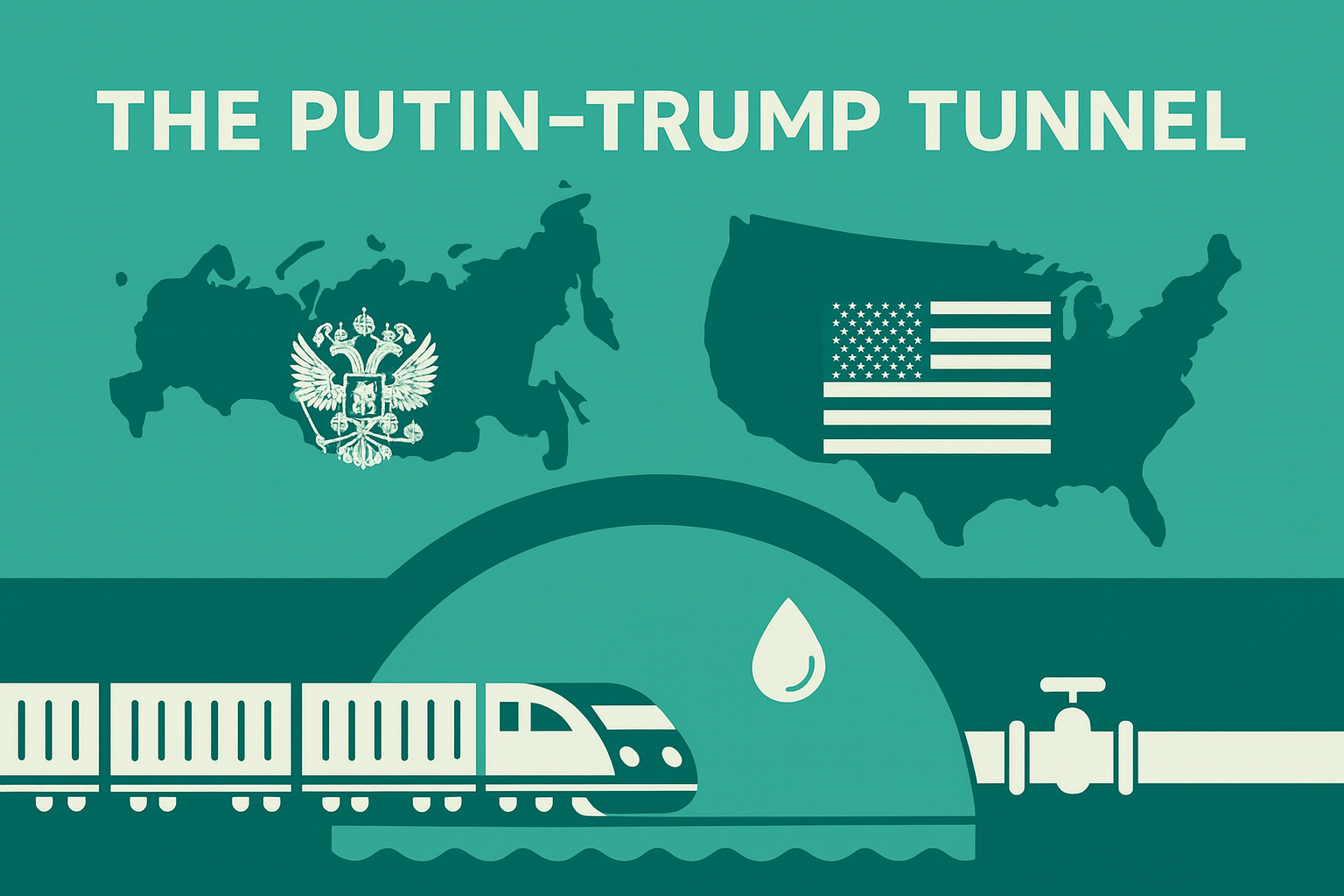
Russian Presidential Envoy Kirill Dmitriev (CEO of the Russian Direct Investment Fund – RDIF) has unveiled a proposal to build an undersea rail-freight tunnel linking Russia and the U.S. across the Bering Strait.
The envisioned tunnel—about 70 miles (112 km) long—would connect Chukotka (USSR Far East) and Alaska, with an estimated cost between USD 8 and 10 billion. Dmitriev suggested potential participation by The Boring Company (Elon Musk).
As of now, no official U.S. government endorsement exists, and feasibility remains highly uncertain.
2. Strategic Intentions of Both Sides
2.1 Russia’s Calculus
- Symbolic Diplomacy: The Kremlin aims to demonstrate willingness for re-engagement with Washington after years of hostility over Ukraine. The “bridge under the sea” serves as a physical metaphor for reconnecting Russia and the West.
- Arctic Strategy and Resource Access: The Far East and Arctic are central to Moscow’s long-term resource agenda (gas, nickel, rare metals). A land-freight route to North America would underscore Russia’s global energy relevance and diversify logistics beyond Europe.
- Sanctions Evasion and Narrative Shift: By proposing U.S. cooperation, Moscow seeks to soften the isolation narrative, presenting Russia as an indispensable Arctic partner rather than a sanctioned pariah.
- Negotiation Leverage over Ukraine: The timing—amid growing speculation about a U.S.–Russia backchannel cease-fire—suggests a calculated diplomatic card to reframe the post-war negotiation landscape.
2.2 Trump Administration’s Calculus
- Domestic Political Appeal: For President Trump, the “tunnel of peace” offers a high-visibility symbol of statesmanship and an opportunity to showcase himself as a global deal-maker ahead of the 2026 mid-terms.
- Arctic and Alaskan Interests: The project aligns with Trump’s resource-centric Arctic policy and could anchor U.S. economic activity in Alaska while projecting influence into the Northern Sea Route region.
- Leverage in Cease-Fire Talks: By entertaining Moscow’s proposal, Washington can probe for concessions in Eastern Ukraine or Crimea, offering symbolic cooperation in exchange for measurable de-escalation.
3. Link to Cease-Fire and Ukraine Dynamics
The tunnel proposal functions less as an engineering blueprint and more as a peace-signaling instrument in the context of war fatigue and sanctions strain.
Russian envoys framed it as a “joint economic corridor for the post-war era,” positioning Moscow as proactive in peacebuilding.
Conversely, the Trump White House could use the narrative to justify selective engagement with Russia—“building a tunnel, not a wall”—as diplomatic cover for gradual sanction relief or arms-control discussions.
No formal cease-fire has been reached, but the proposal’s timing—within days of reports of informal U.S.–Russia communications—strongly implies a pre-negotiation gesture rather than pure infrastructure planning.
4. Feasibility and Key Risks
4.1 Technical / Environmental
- The Bering Strait is shallow (max depth ≈ 55 m) but lies within the Arctic Circle, characterized by permafrost, ice drift, and seismic risk.
- Required infrastructure (rail links, ports, power) on both the Russian and Alaskan sides is minimal or non-existent.
- Previous feasibility studies estimate costs exceeding USD 60–70 billion—far higher than Dmitriev’s claim.
- Freight-volume justification remains weak; maritime shipping remains cheaper and scalable.
4.2 Political / Institutional
- U.S. Congressional approval and security clearance would be mandatory—both unlikely under current sanctions.
- The project would face restrictions under U.S. sanctions law, export controls, and environmental statutes.
- Arctic environmental and indigenous-rights concerns could delay or derail construction.
- Any association with a quid pro quo in cease-fire talks may trigger political backlash domestically in both countries.
5. Implications for Global Finance and JBIC-Type Institutions
- The “tunnel” should be interpreted as a geopolitical signal, not an immediate investment opportunity.
- Nonetheless, it reveals a potential pivot in Arctic governance and renewed discussion of trans-polar corridors that could reshape resource and logistics routes by the 2030s.
- For development and export-finance institutions:
- Scenario Inclusion: Integrate U.S.–Russia symbolic rapprochement as a long-term variable in Arctic and North Pacific infrastructure outlooks.
- Risk Profiling: Continue to price high regulatory and sanctions risk; assume any project financing would require multilateral exemption frameworks.
- Strategic Monitoring: Track Arctic energy corridors, cross-border rail feasibility, and emerging dual-use (civil–military) infrastructure developments.
6. Key Indicators to Monitor
| Dimension | Indicator | Early Signal of Shift |
|---|---|---|
| Diplomatic | Any formal U.S.–Russia MOU on infrastructure or sanctions relief | Would suggest incipient cease-fire architecture |
| Technical | Arctic infrastructure investments in Chukotka / Alaska | Suggests pre-engineering coordination |
| Economic | Russian Sovereign Fund capital reallocations toward Arctic corridors | Proxy for Moscow’s intent to operationalize |
| Environmental | Indigenous or NGO responses to Bering projects | Measures social license to operate |
7. Conclusion
The Putin–Trump Tunnel is best read as political theatre with strategic undertones.
Its physical construction is improbable in the near term, yet its rhetorical deployment underscores a shift: from confrontation toward a symbolic dialogue channel linking two sanctioned, fatigued superpowers.
For policymakers and financial institutions, the key is not whether the tunnel will be built, but why it was proposed now—as a test balloon for post-war normalization and as a signal that economic connectivity may once again become a bargaining chip in great-power diplomacy.