– From Resource Partnership to Capital Alliance: The Next Phase of Sino-Russian “Strategic Dependence” –
(Geopolitical Research / Economist Analysis)
1. Introduction
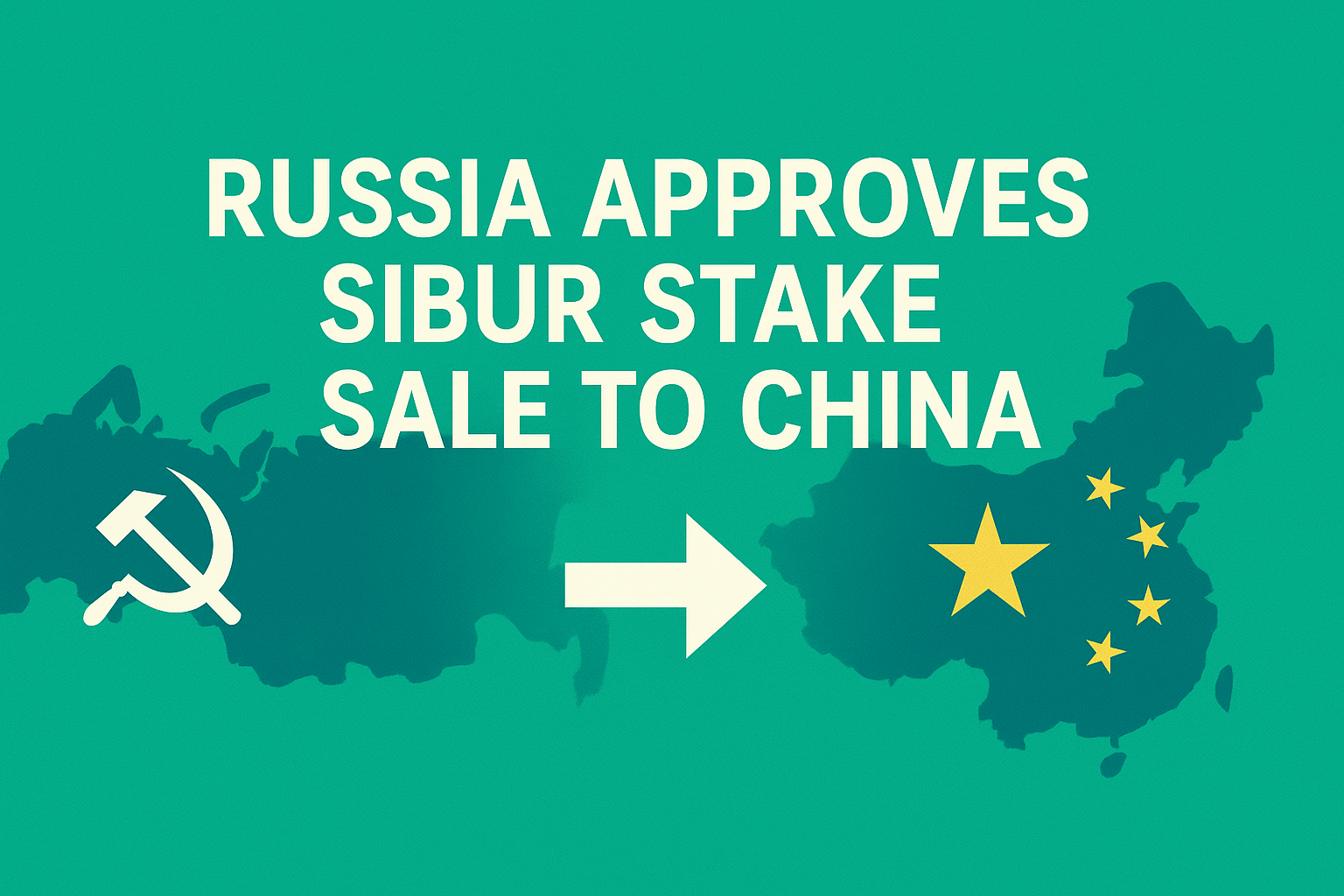
On October 17, 2025, the Russian government, by presidential decree, formally approved the acquisition of an 8.5% stake in SIBUR Holding PJSC, Russia’s largest petrochemical company, by the Hong Kong subsidiary of China Petroleum & Chemical Corporation (Sinopec).
This event is far more than a simple capital transaction. It marks a strategic realignment across energy, chemicals, and finance—a symbol of Russia’s structural integration into the “Chinese capital sphere” amid ongoing U.S. and European sanctions.
2. Structure of the Transaction: From Cyprus to Hong Kong — and State Approval
The approved share transfer is structured as a sale from SIBUR’s Cypriot subsidiary (SOIHL Cyprus Investment Limited) to Sinopec’s Hong Kong entity (SOIHL Hong Kong Holding Limited).
In effect, this represents a three-tier flow — offshore capital → Chinese corporate entity → Russian strategic asset — a transaction that could not occur without direct Kremlin authorization.
President Putin’s personal approval underscores that SIBUR is viewed not merely as a private company, but as part of Russia’s strategic infrastructure.
This structure simultaneously achieves a geo-economic design intended to:
- Circumvent Western sanctions (via the Cyprus–Hong Kong route);
- Transition toward renminbi-ruble settlement;
- Institutionalize Chinese dependence in technology and catalyst supply chains.
3. Sinopec’s Strategy: Securing Dual Leverage in Resources and Petrochemicals
For Sinopec, SIBUR is not just an investment target—it is a gateway to Russia’s petrochemical supply chain, which has been left vacuumed by Western sanctions.
Building on its initial 10% investment in 2015, this renewed approval enables three key strategic advantages:
- Raw-material control – Long-term fixation of naphtha and LPG supply from Siberia and the Urals, securing Asia-bound export routes.
- Technology–market bridge – Substitution of high-performance resins and synthetic rubbers that remain scarce in China with SIBUR-made materials.
- Financial circuit formation – RMB-denominated capital transactions reduce exposure to U.S.-dollar-based settlement risk.
Through this, China evolves from a resource importer into an integrated partner, combining capital, technology, and currency leverage in one framework.
4. Russia’s Strategy: De-Dollarization and Economic Sovereignty Redefined
Russia’s intent is explicit:
- Replace dependence on closed Western markets with access to Chinese capital and demand.
- Shift the chemical and energy sectors into the “RMB zone,” escaping the dollar-euro settlement regime.
- Secure long-term capital support and technology transfer by designating Sinopec and Chinese state funds as “strategic shareholders.”
State approval of a high-value corporate transaction such as SIBUR’s reflects the fusion of economic sovereignty and national security.
In essence, Moscow has entered a “second stage” of state capitalism, where corporate capital policy is an extension of foreign and security policy.
5. Geopolitical Implications: The Rise of a Sino-Russian Capital Alliance
The SIBUR case marks not mere bilateral cooperation but the emergence of a “Capital Alliance” between Moscow and Beijing.
- Russia contributes natural resources and transport infrastructure.
- China contributes financial capital, technology, and payment networks.
Together, these components lend tangible form to an alternative economic bloc that challenges the G7-led order.
If this model spreads, Central Asia, the Middle East, and Africa may gravitate toward the Sino-Russian template—potentially shifting JBIC-supported or Japan-backed projects into competition with China-financed ventures.
6. Implications for Japan and JBIC: The Quiet “Geoeconomic Drift”
Japanese corporations engaged in chemical, materials, and infrastructure projects across Russia and Eurasia may find themselves indirectly competing through Chinese capital intermediation.
Key areas of concern include:
- Supply-chain redesign risk – SIBUR’s resins and chemical materials may be redirected toward Chinese-controlled routes, reducing availability for Japanese importers.
- Capital and settlement pressure – RMB-denominated financing and Hong Kong-based channels may marginalize yen- or dollar-settled operations.
- Political realignment risk – If Russia’s petrochemical sector becomes embedded in a Sino-Russian industrial bloc, Japanese or JBIC-supported ventures could be reclassified as “third-party participants.”
Accordingly, JBIC and Japanese firms must diversify investment structures (to avoid overreliance on Sino-Russian capital) and re-route financial and logistics networks before this alignment becomes irreversible.
7. Conclusion: SIBUR’s Approval Marks the Opening Chapter of a “Silent Economic Bloc”
President Putin’s approval of the SIBUR share transfer transcends corporate boundaries—it signifies state-to-state capital integration and the emergence of a new Cold-War-style economic bloc.
If this trajectory consolidates:
- Western sanctions will shift focus from market access denial to capital order fragmentation;
- Energy dominance will evolve from volume competition to ownership and capital control.
The SIBUR decree is merely the first chapter in this transition.
Yet the deepening of Sino-Russian collaboration it embodies may reshape Asia’s investment landscape beyond 2026.
For Japan, the essential task will be to maintain “intelligent engagement at strategic distance”—participating where beneficial, but without entanglement.
References
- TASS (Oct 17 2025), “Putin authorizes Sinopec’s company to buy stake in SIBUR from its Cypriot subsidiary.”
- Interfax (Oct 17 2025), “Putin permits Sinopec’s Hong Kong subsidiary to buy SIBUR shares.”
- Reuters Archive (Sep 8 2015), “Sinopec to acquire stake in Russia’s SIBUR.”