An Analytical Report by an Economist on the Macroeconomic and Geopolitical Implications of a US–Russia Intercontinental Corridor
1. Executive Summary
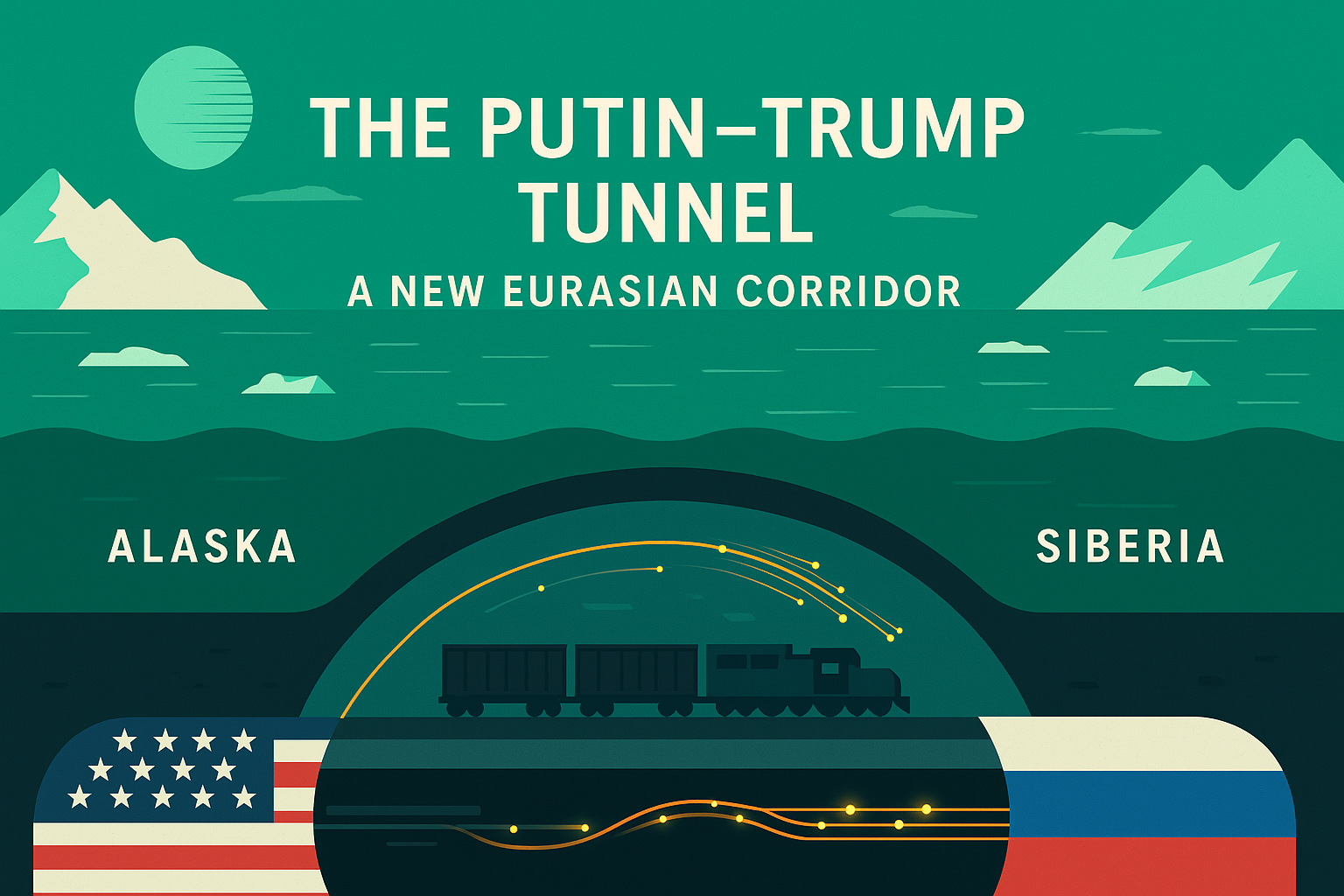
The proposed “Putin–Trump Tunnel” — a hypothetical intercontinental link connecting Alaska and Russia’s Chukotka region beneath the Bering Strait — symbolizes far more than engineering ambition.
It represents a geoeconomic reordering: the potential to realign supply chains, reshape energy corridors, and challenge post-Cold War alliances.
Yet, beneath its promise of global integration lies an intricate web of political volatility, environmental fragility, and fiscal uncertainty.
This report examines the project’s strategic upside, macroeconomic feasibility, and systemic risks, arguing that while the initiative could usher in a new era of Eurasian–American connectivity, its realization would demand an unprecedented level of multilateral trust and governance innovation.
2. Strategic and Geoeconomic Rationale
2.1 A Eurasian–American Economic Corridor
If realized, the tunnel would form the physical backbone of a new Arctic Silk Road, connecting North America’s resource base with Asia’s manufacturing core via Russia’s Far East.
Key potential outcomes include:
- Diversification of Energy Routes: A direct gas, hydrogen, and rare-metal corridor could reduce dependency on unstable Middle Eastern routes.
- Trade Efficiency: Shorter maritime and overland transit times could cut shipping distances between East Asia and the US East Coast by up to 30%.
- Arctic Development Synergy: Linking Alaska’s LNG and Canada’s critical minerals with Russian Arctic ports (e.g., Murmansk, Vladivostok) could spawn a new industrial belt across the circumpolar region.
2.2 Symbolism of Integration
The tunnel would be a geopolitical statement — transforming the world’s last Cold War frontier into a symbol of post-ideological connectivity.
In a fragmented world economy, such a gesture could stabilize investor sentiment and foster a sense of “civilizational détente.”
3. Macroeconomic Implications
3.1 Global Infrastructure Multiplier
Based on analogs like the Suez Canal expansion and the China–Pakistan Economic Corridor,
a $1 trillion investment could yield a multiplier of 1.8–2.2x, generating an estimated $1.8–2.2 trillion in cumulative GDP impact over 15 years, distributed as follows:
| Region | Estimated GDP Impact (15-year cumulative) | Key Drivers |
|---|---|---|
| United States | $600–700 billion | Energy exports, Arctic logistics, construction employment |
| Russia | $400–500 billion | Infrastructure modernization, Arctic resource monetization |
| Japan & Canada | $150–200 billion | Port construction, shipbuilding, hydrogen supply chain |
| Global Spillover | $500–700 billion | Trade facilitation, technology diffusion, logistics efficiency |
3.2 Financial Viability and Risk Pricing
- Construction Cost Estimate: $900 billion–$1.1 trillion
- Break-even Time Horizon: ~35–40 years under optimistic trade volume assumptions
- Private Sector Appetite: Weak, given sanction regimes and credit risk premiums (sovereign + 350bps for Russia exposure).
- Likely Financing Model: Sovereign Wealth + Multilateral Development Bank co-financing (possibly led by BRICS Bank, AIIB, and JBIC).
Without political normalization, capital costs would be prohibitively high — yielding a negative real NPV under current risk conditions.
4. Systemic Risks and Constraints
4.1 Political and Alliance Fracture
The greatest risk is geopolitical misalignment rather than engineering failure.
A US–Russia rapprochement could fragment NATO cohesion and trigger strategic uncertainty in Europe and East Asia.
- Europe: Perceives US–Russia cooperation as betrayal of its collective defense architecture.
- Asia: Japan and South Korea would reassess the reliability of the US security umbrella.
- China: Could interpret the corridor as an encirclement attempt, intensifying Sino-Russian bargaining tension.
4.2 Economic Fragility
- Debt Sustainability: Neither Russia nor the US federal system currently supports such fiscal commitments without extraordinary political consensus.
- Sanctions Drag: SWIFT restrictions and export controls limit material sourcing and cross-border payments.
- Environmental Externalities: Thawing permafrost and methane leakage could impose social cost of carbon exceeding $100 billion.
4.3 Technological and Security Vulnerabilities
- The tunnel’s digital infrastructure (AI logistics, autonomous freight systems) would become a cybersecurity flashpoint — a dual-use system vulnerable to espionage and sabotage.
- Strategic analysts foresee the emergence of a “Cold Tunnel Paradox”: the very infrastructure meant to unite civilizations could serve as a new front of hybrid warfare.
5. Environmental and Ethical Dimensions
5.1 Arctic Ecological Fragility
- The Arctic ecosystem is a global carbon sink; even minor disruptions to its thermal balance risk feedback acceleration of climate change.
- Large-scale construction could release up to 5 gigatons of CO₂-equivalent via permafrost melt — nullifying decades of global decarbonization progress.
5.2 Indigenous and Cultural Considerations
Chukchi and Inuit populations face existential challenges: migration pressure, resource exploitation, and cultural dilution.
Without a strict social–environmental governance charter, the project risks becoming a “neo-colonial corridor” under industrial disguise.
6. Policy Recommendations
- Multilateral Governance Mechanism:
Establish a Bering Strait Development Authority (BSDA) with equal voting rights for the US, Russia, Japan, Canada, and the UN Arctic Council. - Green Infrastructure Mandate:
Require full carbon offset via renewable energy integration — hydrogen-powered freight, geothermal tunneling systems, and Arctic carbon credits. - De-dollarized Financing Structure:
Explore neutral digital settlement mechanisms (e.g., SDR-basket stablecoin) to circumvent sanction-related financial friction. - Strategic Transparency Clause:
Mandate data sharing on freight, energy, and digital traffic under international supervision to prevent military misuse.
7. Conclusion: Between Vision and Volatility
The Putin–Trump Tunnel, if realized, could redefine 21st-century globalization by physically bridging the American and Eurasian continents.
Its symbolic power — connecting two historical adversaries — might outlast its economic returns.
Yet, without robust governance and ecological safeguards, it risks becoming the most expensive geopolitical fracture line ever constructed.
The project embodies both the promise of integration and the peril of illusion.
Its success would not be measured in concrete or steel, but in the world’s capacity to transcend ideology — to build not merely a tunnel, but a corridor of trust.