Implications of Allowing NVIDIA H200 Sales to China under a 25% Fee Framework
- 1. Executive Summary
- 2. Policy Background: From Embargo to Controlled Export
- 3. U.S. Strategic Intent: A Three-Layer Framework
- 4. China’s Strategic Intent: Accelerate AI While Buying Time
- 5. Industry Impact: Redefining the Global AI Supply Chain
- 6. Investment Outlook
- 7. Conclusion: From “Decoupling” to a System of Managed Competition
1. Executive Summary
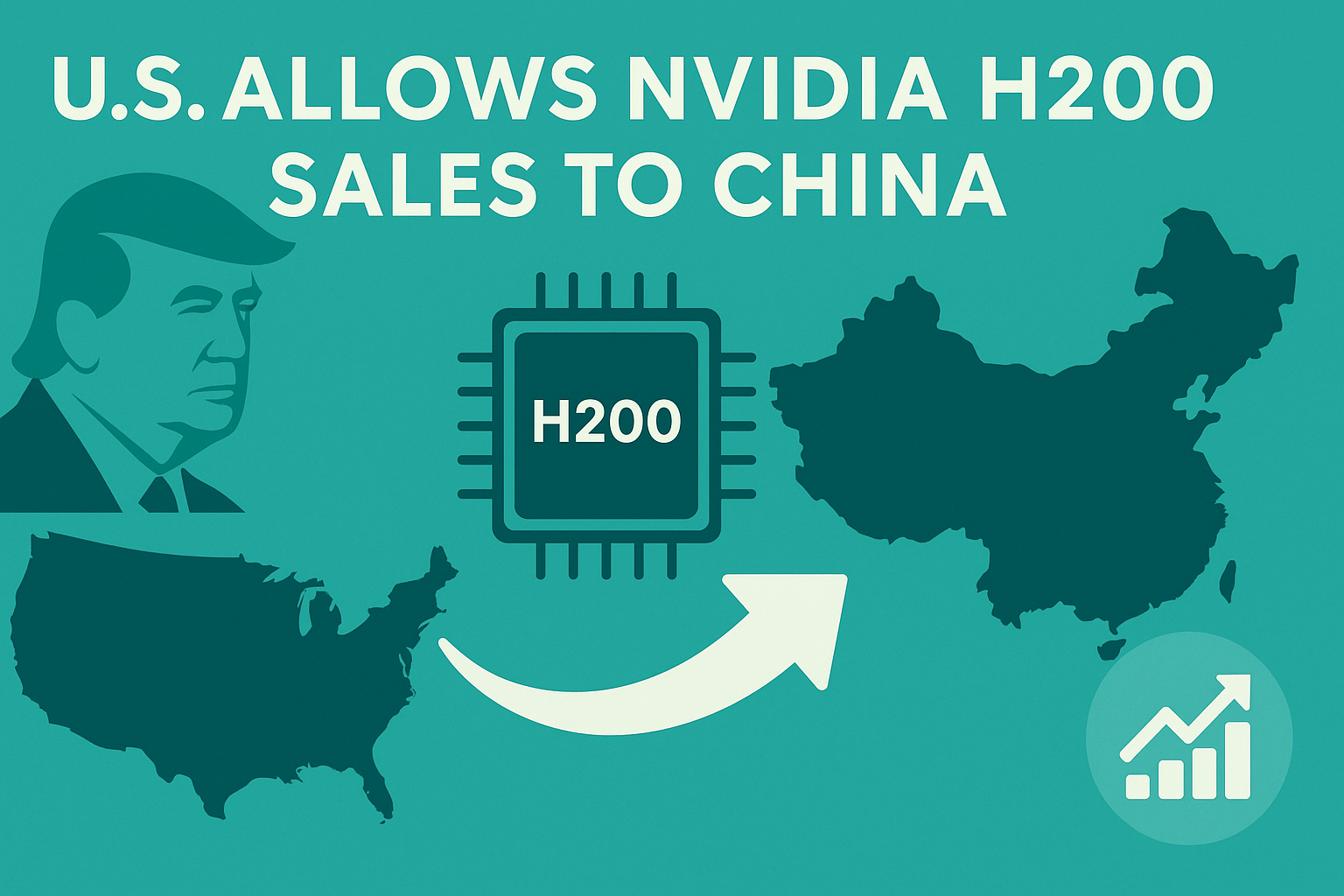
In December 2025, the Trump administration announced that it would allow NVIDIA to sell H200 AI chips to China, subject to a 25% federal fee and review by the U.S. Department of Commerce.
This marks a fundamental shift from the existing policy of strict export denial toward China and introduces a new paradigm of “controlled access combined with monetization.”
This report argues the following:
- The U.S. is transforming AI semiconductors into a controlled but monetizable strategic asset.
Prohibition is being replaced by regulated sales with embedded financial extraction. - China will use H200—likely a performance-restricted variant—to close short-term capability gaps and buy time for domestic GPU development.
- AI infrastructure investment in both countries will accelerate, while NVIDIA remains dominant in the near term.
However, China’s domestic GPU players may strengthen in the longer term. - The policy signals a transition from “decoupling” to a new stage of “managed technological competition.”
Our investment stance:
- NVIDIA: Outperform
- U.S. semiconductor equipment/materials: Positive
- Chinese AI cloud operators: Neutral → Improving
- Chinese domestic GPU manufacturers: Long-term positive
2. Policy Background: From Embargo to Controlled Export
For several years, the U.S. policy framework classified advanced GPUs (H100/H200 class) as high-risk dual-use technologies and prohibited their export to China.
The December announcement represents a dramatic deviation from that approach:
- Export prohibition → Conditional approval
- No monetization → Introduction of a 25% fee (“AI tariff”)
- Static restrictions → Dynamic, adjustable policy lever for negotiations
This effectively transforms U.S. export controls into a tool that blends
national security, revenue generation, and geopolitical leverage
into a single integrated mechanism.
3. U.S. Strategic Intent: A Three-Layer Framework
3.1 Intent #1: Convert AI chips into a new strategic revenue source
The 25% fee functions as a de facto AI semiconductor tariff.
Given the estimated USD 40–50bn annual size of China’s AI chip market, the U.S. gains:
- A substantial new federal revenue stream
- A mechanism that places fiscal burden on Chinese customers, not U.S. companies
- A policy model that can later be expanded to AMD, Intel, and others
3.2 Intent #2: Maintain unambiguous technological superiority
The U.S. will not allow China to receive full-performance H200s.
Performance-restricted variants are expected.
This ensures:
- U.S. military AI and advanced model training remain years ahead
- China cannot close the gap in critical compute-intensive applications
- Washington retains full control of the “performance dial”
3.3 Intent #3: Turn AI semiconductors into a geopolitical bargaining chip
By controlling access—and the ability to tighten, loosen, or monetize that access—the U.S. gains negotiating leverage across trade, defense, and technology domains.
This model aligns closely with the Trump administration’s deal-making style:
“Allow access, but only on U.S. terms.”
4. China’s Strategic Intent: Accelerate AI While Buying Time
4.1 Intent #1: Resolve GPU shortages and restart stalled AI development
H100/H200 bans had created severe constraints in China’s LLM training pipeline.
Allowing access (even to a restricted version) will:
- Reactivate multi-billion-dollar AI infrastructure investments
- Boost training efficiency 2–3x compared to China’s interim alternatives
- Revitalize innovation at Baidu, Alibaba, Tencent, and ByteDance
4.2 Intent #2: Secure “development time” for domestic GPU programs
China’s long-term objective is full localization.
Yet bottlenecks remain:
- SMIC fabrication constraints (7nm)
- EDA software dependency
- Huawei Ascend 910B still trails NVIDIA in efficiency and scalability
H200 imports provide crucial breathing room for domestic GPU maturation.
4.3 Intent #3: Claim a political and diplomatic win
Domestically, Beijing can frame this as:
- A victory in breaking U.S. technological containment
- Proof that China remains indispensable to global semiconductor demand
- Evidence that major U.S. corporations cannot ignore the Chinese market
5. Industry Impact: Redefining the Global AI Supply Chain
5.1 NVIDIA: Strong near-term beneficiary, mid-term competitive pressures
- China remains an essential demand pillar
- Most of the 25% fee burden will fall on Chinese customers
- Global GPU shortages will intensify as Chinese buyers return
Over time, however, accelerated Chinese GPU development could emerge as a structural competitor.
5.2 Chinese AI cloud and data center operators
Expect significant improvements:
- Higher compute efficiency
- Faster model iterations
- Increased utilization of existing AI clusters
This should alleviate the constraints seen through 2024–2025.
5.3 U.S. and Japanese semiconductor equipment/materials manufacturers
Increased H200 production and global demand expansion will benefit:
- TSMC
- ASML
- Tokyo Electron, SCREEN, DISCO
- Memory suppliers and advanced packaging firms
5.4 Chinese domestic GPU ecosystem
Paradoxically, conditional access to H200 strengthens Beijing’s resolve to accelerate domestic alternatives.
Huawei, Biren, and others may see increased government support and expanded market share in the medium term.
6. Investment Outlook
| Sector | Rating | Rationale |
|---|---|---|
| NVIDIA | Outperform | Access to China + monetized controlled export framework |
| U.S. equipment/materials | Positive | Stronger AI capex cycle |
| Chinese AI cloud | Neutral → Improving | GPU bottlenecks eased |
| Chinese domestic GPUs | Long-term positive | Policy support + urgency to localize |
7. Conclusion: From “Decoupling” to a System of Managed Competition
The H200 policy marks a structural turning point in U.S.–China technology relations.
Old paradigm:
- Ban
- Blockade
- Total decoupling
New paradigm:
- Controlled access
- Monetization
- Adjustable leverage
- Strategic competition within a managed framework
The U.S. secures:
- Control
- Technical leadership
- Revenue
- Negotiation power
China gains:
- Compute capacity
- AI acceleration
- Time for localization
- Domestic political credit
This decision signals the emergence of a new AI geopolitical equilibrium:
“Compete fiercely—yet transact when strategically beneficial.”
AI supremacy will no longer be defined solely by hardware bans,
but by the sophistication with which each side manages dependency, autonomy, and leverage.