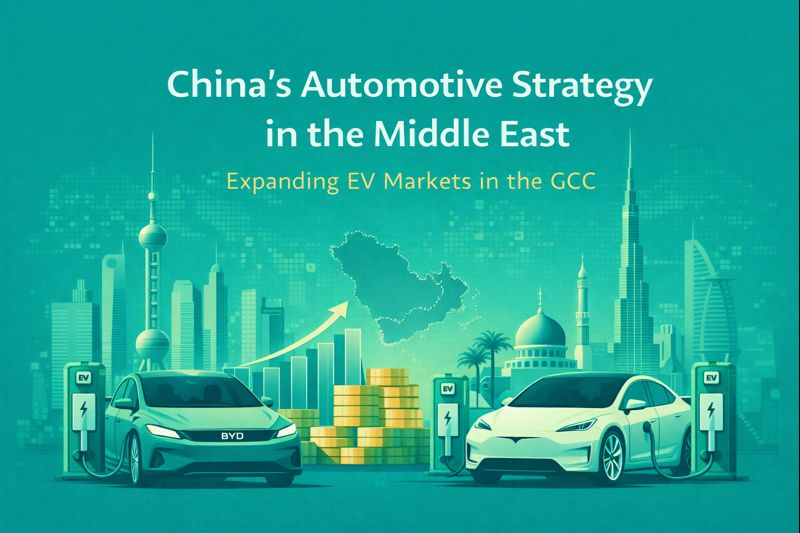
Why the GCC Is Becoming a Core Battlefield for Chinese EV and NEV Makers
- Executive Summary
- 1. Strategic Conclusion: The Middle East Is No Longer a Peripheral Market
- 2. Market Conditions: Low Penetration, High Growth Optionality
- 3. The Four Pillars of China’s Middle East Auto Strategy
- 4. Evidence of Structural Traction
- 5. Competitive Implications: A Shift in the Battlefield
- 6. Risk Assessment: Where the Strategy Could Falter
- 7. Forward Outlook (1–3 Years)
- Conclusion: A Structural, Not Cyclical, Expansion
Executive Summary
China’s automotive expansion in the Middle East—particularly across the GCC, with United Arab Emirates and Saudi Arabia at the center—should not be interpreted as opportunistic export diversification.
It represents a deliberate, structurally rational strategy that aligns Chinese industrial strengths with Middle Eastern demand, policy direction, and distribution realities.
The region offers Chinese manufacturers a rare combination of high purchasing power, rapid EV policy adoption, brand openness, and relatively low political trade barriers—conditions that are increasingly absent in Europe and North America.
1. Strategic Conclusion: The Middle East Is No Longer a Peripheral Market
For Chinese automakers, the Middle East is evolving from a “secondary export destination” into a core strategic theater.
Key structural attractions include:
- High disposable income and preference for feature-rich vehicles
- Government-led electrification agendas (Vision-style industrial policies)
- Fast-moving infrastructure buildout (charging, logistics)
- Lower consumer brand inertia compared to mature Western markets
- Absence of heavy punitive tariffs that constrain China in Europe and the US
At the same time, China faces intense price competition and margin compression at home, making overseas volume and profitability increasingly critical.
2. Market Conditions: Low Penetration, High Growth Optionality
EV penetration across GCC markets remains modest in absolute terms, but growth rates are among the fastest globally.
This “low base, high acceleration” profile is ideal for new entrants.
Crucially, Chinese firms are not trying to displace incumbents in the internal combustion engine (ICE) segment head-on.
Instead, they are building leadership in the newly forming EV/NEV category, where legacy advantages (dealer networks, resale history) are weaker.
3. The Four Pillars of China’s Middle East Auto Strategy
3.1 Product Strategy: Value Density Over Brand Legacy
Middle Eastern buyers—especially expatriates and newly affluent consumers—prioritize:
- Advanced driver-assistance systems
- Infotainment and connectivity
- Interior quality and quietness
- Price-to-feature efficiency
Chinese EVs compete by offering higher feature density at a given price point, rather than relying on historical brand prestige.
In this context, brands such as BYD gain traction not because they are “cheap,” but because they are technically competitive and visibly modern.
3.2 Distribution Strategy: Leveraging Powerful Local Partners
Rather than building dealer networks from scratch, Chinese manufacturers partner with dominant regional distributors that already control:
- Sales networks
- After-sales service
- Spare parts logistics
- Fleet and government relationships
This approach compresses the market-entry timeline and neutralizes the single biggest risk facing new automotive brands: after-sales credibility.
3.3 Ecosystem Strategy: Selling Mobility, Not Just Cars
A defining feature of China’s approach is the bundling of vehicles with charging and support infrastructure.
In several GCC markets, EV purchases are increasingly accompanied by:
- Home-charger installation
- Coordination with utilities and permits
- Warranty and service integration
By reducing friction in the ownership experience, Chinese brands convert “EV curiosity” into actual purchases—an especially important factor in regions where EV ownership is still new.
3.4 Policy Alignment: Integrating Into National Transformation Agendas
In the Middle East, markets are policy-shaped.
Chinese automakers explicitly position themselves as partners in:
- Decarbonization
- Industrial diversification
- Technology localization
In Saudi Arabia especially, engagement goes beyond sales into technology cooperation, potential local assembly, and skills transfer, aligning with national transformation objectives.
This grants Chinese firms political legitimacy, not just commercial access.
4. Evidence of Structural Traction
Chinese-affiliated brands are no longer fringe players.
Sales data from the region show consistent year-on-year growth, particularly in Saudi Arabia, the UAE, and Iraq.
This indicates not a temporary price-led surge, but the early stages of brand normalization—a critical threshold in automotive markets.
5. Competitive Implications: A Shift in the Battlefield
It is essential to understand that Chinese success in the Middle East does not imply the collapse of Japanese or European brands.
Rather, the competitive map has changed:
- Japanese manufacturers remain dominant in durability-intensive segments (SUVs, fleet use, harsh conditions)
- Chinese manufacturers are leading in EV adoption, digital experience, and rapid model iteration
The market has gained a new dimension, and China entered precisely where incumbents were least entrenched.
6. Risk Assessment: Where the Strategy Could Falter
Despite momentum, China’s Middle East strategy faces real constraints:
- Residual Value Formation
Long-term resale value is still unproven for many Chinese EV brands. - Rising Quality and Safety Standards
As GCC regulators tighten standards, compliance costs will rise. - Localization Pressure
Saudi Arabia in particular may require deeper local manufacturing and supply-chain commitments, raising capital intensity.
7. Forward Outlook (1–3 Years)
The most likely trajectory is functional specialization within the region:
- UAE as a showcase, import, and re-export hub
- Saudi Arabia as a scale market with industrial localization
Chinese automakers are positioning themselves accordingly, using the UAE for brand visibility and Saudi Arabia for long-term volume and political integration.
Conclusion: A Structural, Not Cyclical, Expansion
What is unfolding in the Middle East is not a short-term sales push, but a strategic reordering of global automotive competition.
China’s automotive rise in the region is driven by:
- Product–market fit
- Distribution pragmatism
- Ecosystem thinking
- Policy alignment
As long as the Middle East continues to combine capital, policy ambition, and openness to new brands, it will remain one of the most favorable overseas arenas for Chinese automakers.
For global competitors, the implication is clear:
the competitive frontier has shifted, and the Middle East is now a leading indicator—not a lagging one.

