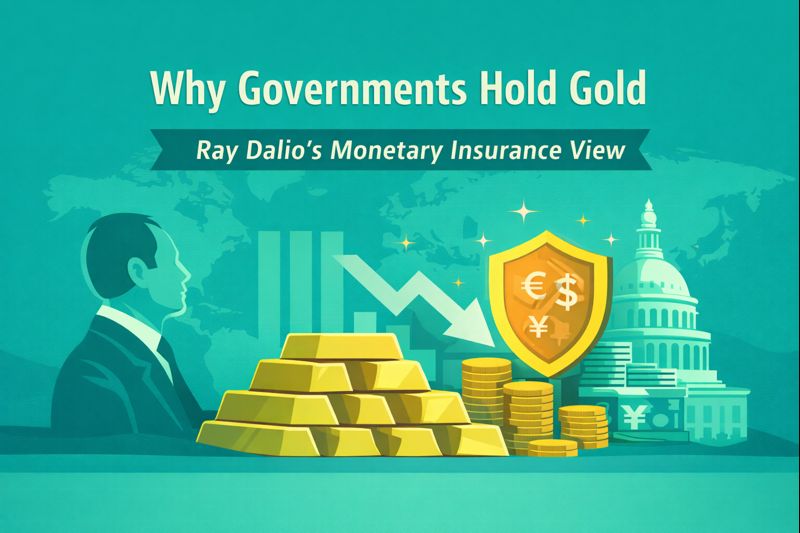
Ray Dalio’s View of Gold as the “Ultimate Insurance” in the Global Monetary System
I. Executive Summary: The Core Answer
Ray Dalio is explicit and consistent in his reasoning:
Gold is not a yield-generating asset.
Gold is the only asset that remains valuable
when currencies, governments, and financial systems fail.
Governments do not hold gold to optimize returns in normal times.
They hold gold to survive extreme monetary and geopolitical breakdowns.
II. The Primary Reason
Gold Is Not Anyone’s Liability
Dalio repeatedly emphasizes this point as fundamental.
- Government bonds depend on the issuer’s creditworthiness
- Currencies depend on central banks and political systems
- Bank deposits depend on the stability of the financial system
Gold, by contrast:
- Is not a debt instrument
- Has no issuer
- Cannot default
In Dalio’s framework:
When trust between states, institutions, and monetary authorities breaks down,
gold retains value because it does not rely on trust at all.
For governments planning for war, sanctions, or systemic crises, this property is decisive.
III. Reason Two
Gold as Insurance Against Reserve-Currency Risk
Dalio does not predict the imminent collapse of the U.S. dollar.
However, he consistently argues that all reserve currencies eventually lose purchasing power over long debt cycles.
The problem for central banks is structural:
- Foreign reserves are claims on other governments
- Those claims are exposed to
- monetary debasement
- political decisions
- geopolitical conflict
Gold is:
- Not dollars
- Not euros
- Not renminbi
It is a politically neutral reserve asset.
Thus, holding gold reduces dependence on any single reserve-currency regime.
IV. Reason Three
Protection Against Sanctions and Asset Freezes
Dalio places significant weight on the weaponization of financial systems in recent years.
- Freezing of foreign exchange reserves
- Exclusion from payment systems
- Confiscation risk of foreign-held assets
These actions have changed how states view reserve assets.
The implicit question governments now ask is:
Are my reserves truly mine in a geopolitical conflict?
Gold differs from financial claims because:
- It can be physically held domestically
- It exists outside foreign legal systems
- It is extremely difficult to freeze or seize
For this reason, gold is increasingly viewed as a sanctions-resistant reserve asset.
V. Reason Four
Gold’s Role in the Late Phase of the Long-Term Debt Cycle
In Dalio’s Long-Term Debt Cycle, the final phase is characterized by:
- Debt not being repaid in real terms
- Currency value being diluted through inflation
- Financial repression becoming the dominant adjustment tool
In such environments:
- Bonds lose real value
- Fiat currencies lose purchasing power
Historically, Dalio notes:
Gold has preserved value during periods of
currency resets, monetary restructurings, and debt monetization.
Gold is therefore not a growth asset, but a store of value across regime changes.
VI. A Critical Misunderstanding Dalio Explicitly Rejects
Dalio is careful to correct common misconceptions.
❌ Gold is not guaranteed to rise with inflation in the short term
❌ Gold is not a tactical trading asset
❌ Gold is not a productivity-driven investment
✔ Gold is:
Insurance against the failure of monetary trust itself
Governments hold gold for the same reason individuals buy insurance:
not because they expect disaster, but because disaster is survivable only if they do.
VII. Why Governments Are Increasing Gold Holdings Now
Dalio observes that current global conditions closely resemble historical periods when gold accumulation accelerated:
- Elevated global debt levels
- Fragmentation of geopolitical blocs
- Normalization of sanctions
- Gradual erosion of reserve-currency dominance
This combination historically signals:
Rising demand for assets that lie outside the credit-based system
Gold fits that role uniquely.
VIII. Dalio’s View in One Sentence
Gold is not an investment.
Gold is money when confidence is gone.
IX. Final Conclusion
Ray Dalio’s focus is not on short-term gold prices.
He is analyzing:
- The durability of monetary systems
- The sustainability of sovereign debt
- The fragility of trust between nations
From that perspective, the reason governments hold gold is unambiguous:
Gold is the ultimate reserve for a world in which
no currency, no government, and no institution
can be trusted with absolute certainty.
That—not speculation—is why central banks continue to hold it.
ure.