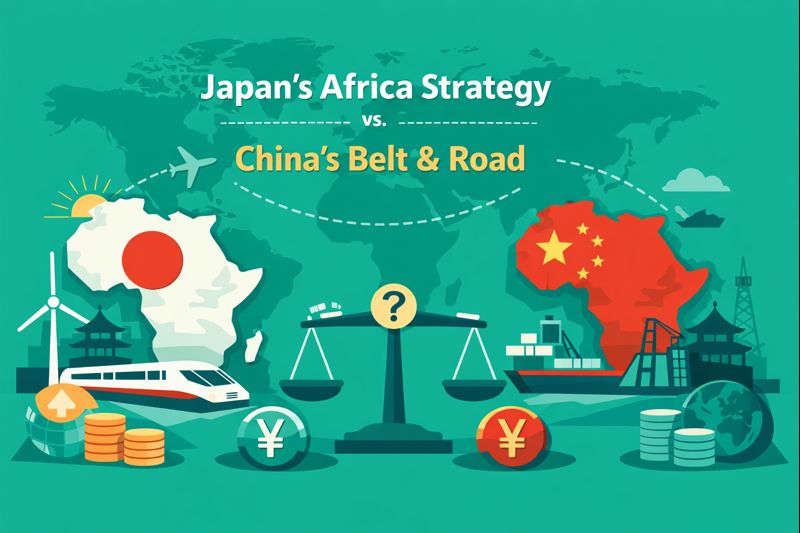
— The Trade-Off Between “Correctness” and “Influence” in the Era of the Belt and Road Initiative —
Executive Summary
For decades, Japan has pursued an Africa policy centered on high-quality investment, institutional development, and human-capital formation. This approach has been principled and economically sound. However, China’s Belt and Road Initiative (BRI) has fundamentally reshaped Africa’s policy environment by emphasizing speed, visibility, and the overt projection of state power.
The central conclusion of this report is clear:
Japan’s primary strategic risk in Africa is not the weakness of its model, but the growing mismatch between its long-term rationality and Africa’s short-term political time horizon.
Chapter 1: A Structural Shift in Africa’s Decision-Making Environment
African governments today operate under three binding constraints:
- Rapid population growth and acute infrastructure deficits
- Short political cycles and fragile regime legitimacy
- Severe fiscal and foreign-exchange limitations
Within this context, infrastructure projects that deliver visible results within a single political term are far more attractive than reforms whose benefits materialize over a decade. China has aligned its BRI precisely with this reality, mobilizing state-owned enterprises and policy banks to deliver fast, tangible outcomes.
Japan’s cooperation model, while economically sound, increasingly risks falling out of sync with Africa’s political reality.
Chapter 2: Structural Concern I
When “Correctness” Erodes Bargaining Power
Japan places strong emphasis on:
- Debt sustainability analysis
- Environmental and social safeguards
- Governance and transparency standards
These principles are indispensable in the long run. Yet in practice, African partners often face the following sequence:
- Years of feasibility studies
- Protracted institutional coordination
- Political turnover before results become visible
As a result, Japan is at risk of being perceived as reliable but not immediately responsive. In diplomacy, credibility without speed gradually loses influence.
Chapter 3: Structural Concern II
The Limits of Public–Private Partnerships in High-Risk Environments
Japan’s Africa strategy relies heavily on public–private partnerships (PPPs). However, African infrastructure projects typically involve:
- Elevated political risk
- Currency volatility
- Uncertain cash-flow recovery
Private firms, constrained by profitability and shareholder accountability, are often reluctant to proceed at scale. China, by contrast, operates through an integrated state-capital model that allows projects to proceed even when commercial returns are uncertain.
This asymmetry means Japan consistently underperforms China in project scale, symbolic impact, and strategic visibility.
Chapter 4: Structural Concern III
The Invisibility of Japan’s Value Proposition
Japan’s strengths are substantive:
- Human resource development
- Technology transfer
- High-quality infrastructure
- Institutional capacity building
Yet these contributions rarely produce compelling visuals or political symbolism. Ports and railways built by China become stages for political speeches; Japanese reforms tend to manifest in statistics, systems, and skills.
For domestic African audiences, Japan’s contributions are often less visible, and therefore less politically rewarding for incumbent leaders.
Chapter 5: Geopolitical Risk
Africa’s Shrinking Strategic Neutrality
Africa’s geopolitical importance is rising due to:
- Resource and food security concerns
- Growing diplomatic weight in multilateral institutions
- Its role within the Global South
In this environment, Japan is often perceived as part of the broader Western bloc. China, emphasizing non-interference and political neutrality, offers African states a way to avoid explicit alignment.
This creates a structural risk that Japan’s diplomatic space in Africa could narrow, regardless of intent.
Chapter 6: Financial and Institutional Risk
Losing the Battle to Shape the Rules
China’s Africa engagement increasingly establishes:
- China-centric contractual practices
- Renminbi-denominated financing
- Legal frameworks aligned with Chinese norms
Japan, by adhering to international standards, risks becoming a rule-taker rather than a rule-shaper. Over time, this could translate into higher barriers for Japanese firms operating in African markets.
Conclusion: Japan’s Core Strategic Challenge
Japan’s Africa strategy faces one overarching question:
Can long-term economic rationality be reconciled with Africa’s short-term political imperatives?
Japan need not replicate China’s model. However, it must:
- Communicate at comparable speed
- Demonstrate results within comparable timeframes
- Signal state commitment with comparable clarity
Ultimately, Japan’s influence in Africa will depend on its ability to translate “correctness” into visible power. This is not merely a development-policy issue—it is a test of Japan’s strategic resolve in a rapidly transforming global order.