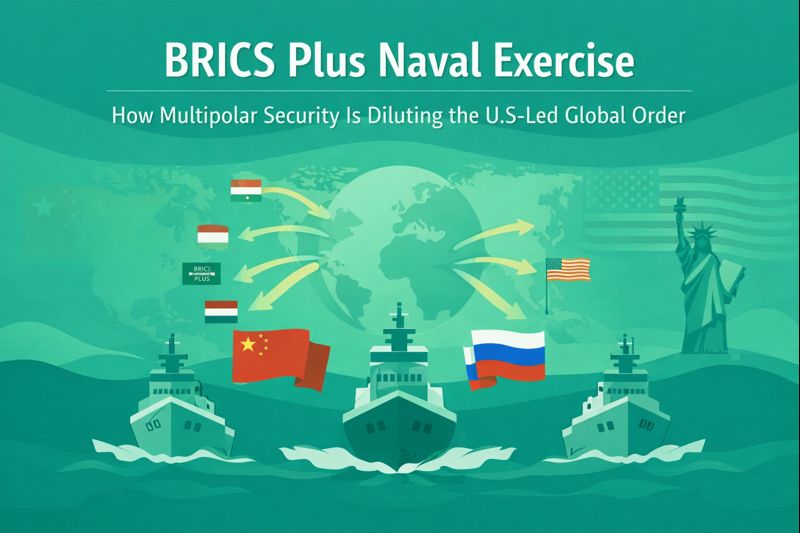
ーStructural Dilution of U.S.-Led Order Rather Than Military Confrontationー
1. Introduction: Why This Naval Exercise Matters
In January 2026, a BRICS Plus naval exercise led by China, Russia, and Iran was conducted in waters off South Africa.
This event should not be interpreted as a routine military drill. Rather, it represents a symbolic inflection point in the evolution of the global order, illustrating how alternative centers of coordination are emerging outside the traditional U.S.-led framework.
Crucially, the exercise does not signal an imminent military challenge to the United States. Its significance lies elsewhere: it raises the question of whether security cooperation must necessarily be anchored to U.S. leadership, or whether parallel, non-Western configurations can increasingly coexist.
2. The Qualitative Shift of BRICS Plus
The original BRICS framework was centered on:
- Economic cooperation
- Development finance (notably the New Development Bank)
- Enhancing the collective voice of emerging economies
BRICS Plus, however, marks a qualitative evolution. By engaging countries such as Egypt, Indonesia, and Saudi Arabia—states that are strategically pivotal yet not formally aligned with Western military blocs—the grouping has expanded into the security domain, where political signaling costs are highest.
This does not constitute a NATO-style alliance. Instead, it suggests the emergence of a flexible, non-ideological coordination model, where shared opposition to Western dominance is not required for cooperation.
3. Strategic Intent of the Core Participants
China
China’s participation reflects an effort to:
- Dilute U.S.-led maritime norms, particularly those underpinning the Indo-Pacific strategy
- Internationalize regional disputes (e.g., Taiwan, the South China Sea) by embedding them within a broader Global South narrative
- Demonstrate that emerging economies possess viable alternatives to U.S.-centric security structures
Russia
For Russia, the exercise serves to:
- Mitigate post-Ukraine-war isolation
- Signal that sanctions do not preclude meaningful military cooperation
- Reassert great-power status beyond the Euro-Atlantic sphere
Iran
Iran’s involvement underscores:
- Its ability to operate internationally despite sanctions
- A strengthening of leverage across the Indian Ocean and Middle Eastern theaters
- The normalization of its role within non-Western security networks
Collectively, these actors pursue a common objective: reducing reliance on U.S.-led systems without directly confronting them.
4. Implications for the U.S.-Led Order
From the perspective of the United States, the core risk is not military inferiority. Instead, it lies in the gradual erosion of preference.
As more emerging economies perceive that:
- Strategic autonomy is feasible without explicit alignment with Washington, and
- Security cooperation can be diversified across multiple poles,
the effectiveness of U.S. tools—sanctions, alliance leverage, and diplomatic pressure—diminishes incrementally rather than abruptly.
This represents a structural, not cyclical, challenge.
5. Multipolarity Without Bipolar Division
The global order implied by the BRICS Plus exercise is not a revival of Cold War-style bipolarity. The world is not dividing neatly into pro- and anti-U.S. camps.
Instead, it is evolving toward:
- A dominant U.S.-led system that remains central but no longer exclusive
- A set of overlapping, issue-specific alternative frameworks
- Fragmentation across military, economic, and financial domains
In such an environment, alignment becomes conditional and situational rather than absolute.
6. Financial and Investment Implications
From an economic and financial standpoint, the immediate market impact is limited. However, medium- to long-term implications are material:
- A structurally higher geopolitical risk premium
- Greater importance of political alignment in sovereign and project risk assessment
- Increased volatility in maritime logistics, energy transport, and insurance pricing
- A reassessment of assumptions underpinning emerging-market project finance
For international financial institutions, this necessitates moving beyond the assumption that U.S.-led order automatically functions as the global stabilizer.
7. Conclusion: The Core Message of the Exercise
The BRICS Plus naval exercise does not indicate imminent global instability. Instead, it signals a redistribution of systemic weight.
The world is not becoming disorderly; it is becoming less singularly ordered.
U.S. influence will not disappear, nor will it collapse suddenly. But it will increasingly coexist with alternative coordination mechanisms that reduce its exclusivity. For policymakers, investors, and financial institutions, the challenge is no longer how to manage shocks within a stable order—but how to operate in a world where stability itself is decentralized.
That structural shift, more than any military maneuver, is the lasting significance of this exercise.