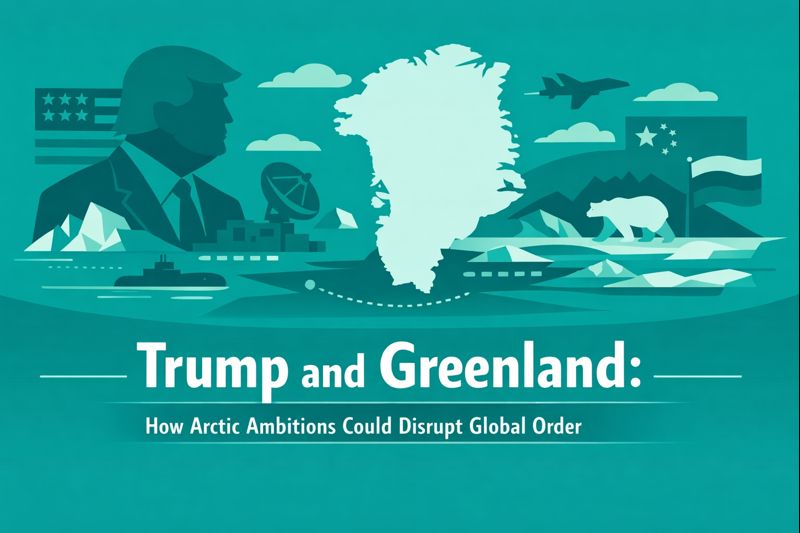
Renewed signals from Donald Trump suggesting that the United States should acquire or exert decisive influence over Greenland are not merely provocative rhetoric. They risk triggering systemic consequences across alliance politics, Arctic security, international law, and great-power competition.
Executive Summary
This is not a territorial dispute in isolation. It is a stress test of the Arctic order, simultaneously affecting alliance cohesion, military stability, resource governance, and global norms. The most serious danger is not whether Greenland changes hands, but whether trust within the Western alliance erodes and Arctic militarization accelerates.
1. Alliance Cohesion at Risk
- Tensions with Denmark: Greenland is part of the Danish Realm. Any acquisition rhetoric is interpreted as a direct challenge to sovereignty, even if framed economically.
- NATO Credibility: Pressuring an ally undermines confidence in collective defense. It weakens unity at a time when deterrence against Russia is central.
- Precedent Effect: If alliance territory becomes negotiable, the entire post-war security architecture faces normative erosion.
2. Accelerated Militarization of the Arctic
- Russian and Chinese Responses:
- Russia gains justification to expand Arctic deployments.
- China reinforces its “near-Arctic state” narrative and economic-strategic presence.
- U.S. Forward Posture: Missile defense, early warning systems, and basing pressures intensify, raising the risk of miscalculation.
- Crisis Management Degradation: Search-and-rescue, environmental response, and civilian cooperation are subordinated to military priorities.
3. Damage to International Law and Norms
- Instrumentalization of Self-Determination: Invoking local consent under pressure risks distorting a core legal principle.
- Erosion of Non-Expansion Norms: Even non-military coercion to acquire territory weakens the post-1945 rule set.
- Small-State Anxiety: If sovereignty becomes transactional, smaller states hedge harder, accelerating bloc formation.
4. Resource and Economic Distortions
- Critical Minerals (e.g., rare earths): Politicized extraction could rush development, heightening environmental damage and supply volatility.
- Arctic Shipping Routes: Competition for governance of emerging sea lanes intensifies regulatory friction.
- Investment Politicization: Infrastructure and mining capital becomes securitized, crowding out market logic.
5. Domestic U.S. Political Spillovers
- Symbolic Mobilization: Greenland becomes a rallying slogan, reducing policy predictability.
- Bureaucratic Fatigue: Allies and U.S. agencies expend resources on damage control rather than strategy.
- Strategic Discontinuity: Repeated reversals across administrations erode America’s credibility premium.
6. Implications for Japan and Other Allies
- Alliance Reliability Assessment: Bilateral commitments may hold, but U.S. consistency in multilateral settings is questioned.
- Arctic Governance Role: Japan and like-minded partners can step forward as institutional stabilizers—shipping rules, environment, science.
- Global Precedent Risk: Norm erosion in the Arctic invites imitation in East Asia and elsewhere.
Scenario Outlook
- Managed Friction (Most Likely): Rhetoric persists; alliance mechanisms quietly contain escalation.
- Institutional Degradation: Arctic governance weakens; military signaling rises.
- Cascade of Precedents (Worst Case): Territorial or influence claims proliferate across regions.
Conclusion
The Greenland issue is less about geography than about order. The gravest risk is not acquisition, but the moment when allies begin to ask, “Are we next?”
Deterrence and stability rest not only on power, but on continuity of trust. Once that trust is damaged, the cost of repair is exceptionally high.