By: Senior Global Economist / International Macroeconomic Analyst
■ Executive Summary
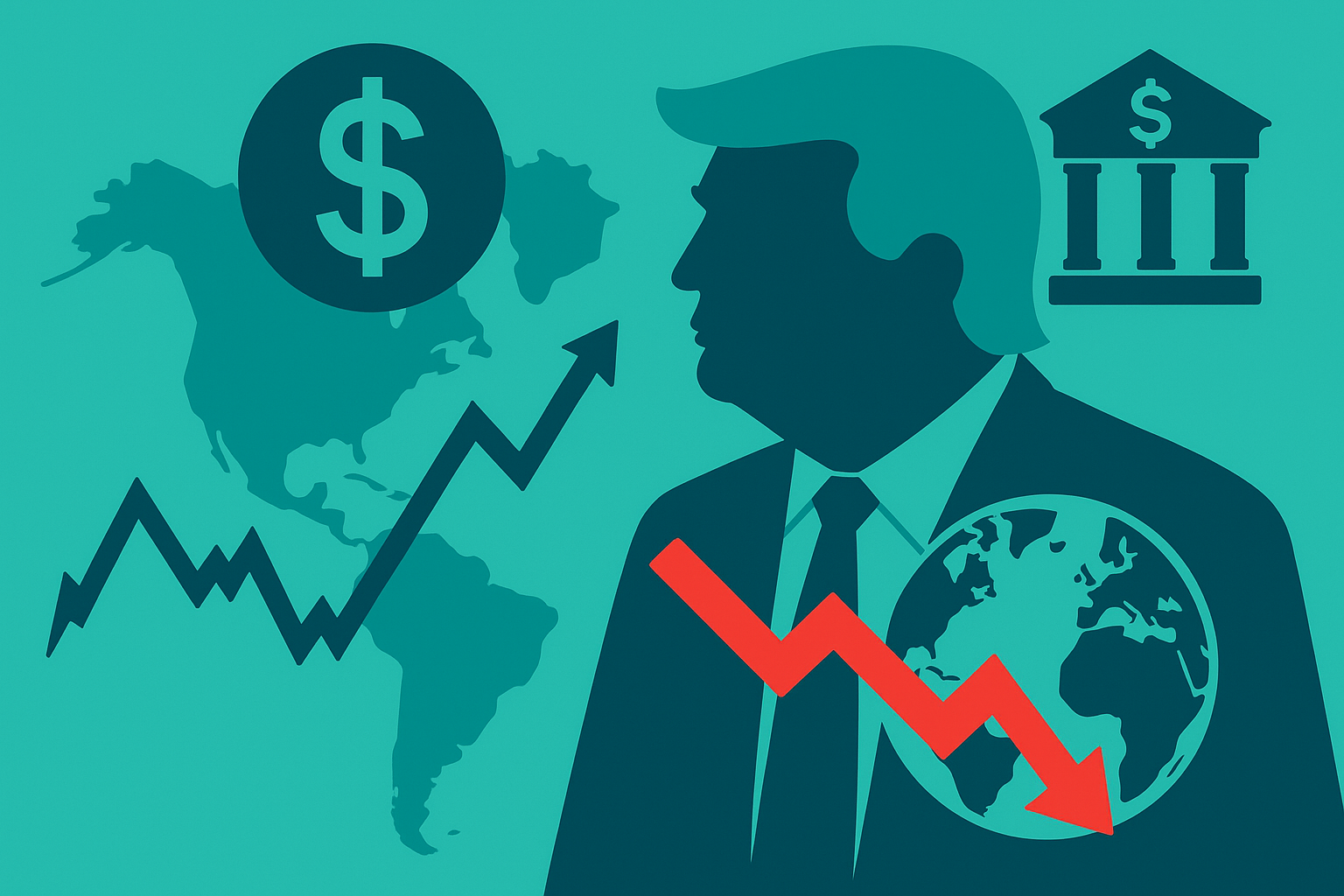
As former President Donald Trump’s return to the White House in 2025 becomes increasingly likely, concerns are mounting about the potential global financial instability triggered by his economic agenda. His flagship proposals — the One Big Beautiful Bill (OBBB) for massive tax cuts, aggressive protectionist tariffs, political interference in the Federal Reserve, and the weaponization of the U.S. dollar — may stimulate the U.S. economy in the short term but pose serious medium- to long-term risks of a global financial crisis.
This report analyzes how these policies, when combined, could threaten the very core of the global financial order, making the case that “the next global crisis could start from the White House.”
■ Policy Breakdown and Risk Assessment
Massive Tax Cuts (OBBB) and Fiscal Expansion
- Trump’s OBBB tax plan includes major corporate tax cuts, investment incentives, and high-income tax breaks.
- Without matching spending cuts, U.S. deficits could exceed $2 trillion annually, pushing debt-to-GDP past 150%.
- Result: U.S. Treasury downgrade, bond market instability, and rising interest rates.
- Dollar-denominated debt repayment becomes unsustainable for emerging markets.
📉 Risk Indicators:
- Rising U.S. CDS spreads (default insurance)
- 10-year Treasury yield stabilizing above 4.5%
2. 70% Tariffs and the Return of Protectionism
- Trump proposes up to 70% tariffs on imports from China, Mexico, Japan, and others.
- Breakdown of global supply chains → Input cost spikes → Global stagflation (stagnation + inflation).
- Unilateral trade actions may spark retaliation and WTO fragmentation.
📉 Risk Indicators:
- Falling Baltic Dry Index (global trade volume)
- Sharp decline in manufacturing PMI in Europe, Japan
Federal Reserve Interference and Policy Distortion
- Trump has openly criticized and threatened to remove Fed Chair Jerome Powell.
- Political pressure may lead to artificially low interest rates, undermining monetary credibility.
- Risks of a second inflation wave, particularly in housing and energy sectors.
📉 Risk Indicators:
- Divergence between Fed Funds Futures and actual Fed guidance
- Sudden drop in U.S. Dollar Index (DXY)
Dollar Weaponization and the Breakdown of Financial Order
- Under Trump, financial sanctions, SWIFT exclusions, and U.S. asset freezes were heavily used.
- In response, China, Russia, and other BRICS nations accelerate de-dollarization.
- This challenges the dollar’s reserve currency status and undermines the Bretton Woods framework.
📉 Risk Indicators:
- Decline in USD share of SDR basket
- Increase in gold and yuan reserves by central banks
■ Global Ripple Effect: A Three-Phase Shockwave
| Phase | Key Impact | Affected Regions |
|---|---|---|
| Phase 1 | U.S. debt crisis, interest rate shock, stock sell-offs | U.S. and major economies |
| Phase 2 | Capital flight, currency crises | Emerging markets |
| Phase 3 | Global tightening, credit freeze | Europe, Japan, global economy |
■ Conclusion and Recommendations
Trump’s “America First” economic policy paradoxically risks creating a “Global Risk First” environment.
The combination of fiscal irresponsibility, monetary distortion, and trade conflict sets the stage for a global crisis of confidence, particularly in the U.S. dollar and Treasury markets — the foundation of modern finance.
Policy Recommendations (for global central banks and governments):
- Diversify away from U.S. assets (reduce dollar dependency)
- Strengthen regional trade alliances and local currency settlement frameworks
- Reinforce IMF/BIS-led global financial monitoring systems
■ References
- IMF World Economic Outlook (2024, 2025)
- U.S. Congressional Budget Office (CBO)
- Peterson Institute for International Economics
- Bloomberg, Reuters, Wall Street Journal
- BIS Annual Economic Report