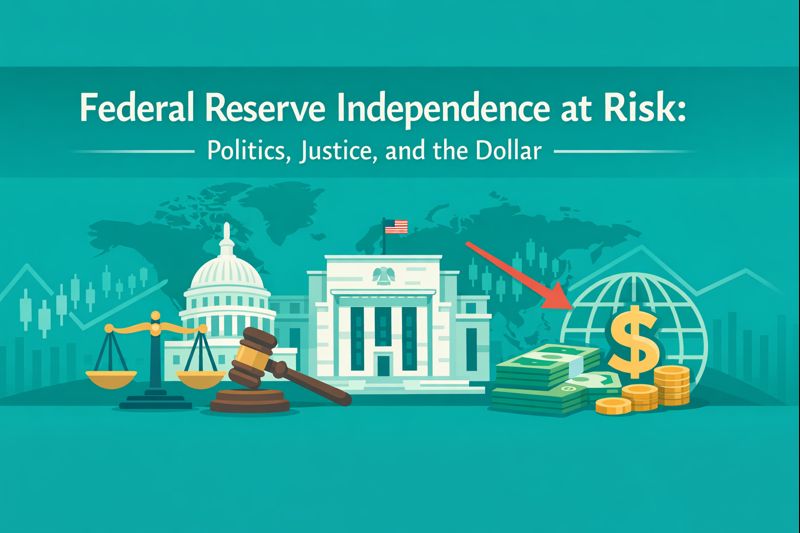
ーInstitutional Risk Revealed by the Confrontation Between the FRB and the Administrationー
Executive Summary
Tensions between the U.S. administration and the Federal Reserve Board (FRB) have entered an unprecedented phase. The decision by Chair Jerome Powell to publicly denounce an ongoing criminal investigation as “intimidation” marks a decisive departure from the Federal Reserve’s long-standing political restraint. This episode should not be interpreted as a personal or partisan conflict. Rather, it exposes a structural vulnerability in the U.S. institutional framework, where central bank independence can be eroded through formally legal, yet politically charged, mechanisms.
This report analyzes the issue as a systemic risk—spanning governance design, judicial credibility, market confidence, and the international monetary order.
1. The Core Issue: Institutions, Not Individuals
The fundamental problem is neither Powell’s rhetoric nor the intentions of President Donald Trump. The real issue lies in the design of the Federal Reserve’s governance system, under which political power can lawfully accumulate influence over monetary authorities.
Under the current framework:
- Members of the FRB Board are appointed by the president and confirmed by the Senate.
- The Chair and Vice Chair are selected by the president from among sitting governors.
- Staggered but overlapping terms allow a single administration, within one presidential term, to appoint a majority of the Board.
This structure is legal, but it places central bank independence at risk of becoming personality-dependent rather than institutionally guaranteed. The present confrontation merely reveals a weakness that has long existed beneath the surface.
2. Judicial Pressure as a Red Line
Political pressure on central banks is not new. What makes this episode qualitatively different is the perceived linkage between monetary policy disputes and judicial action.
Even if no direct political interference occurred, the concurrence of:
- Monetary policy resistance,
- Electoral incentives tied to interest-rate outcomes, and
- Criminal investigation procedures,
creates a damaging institutional perception. Central bank independence does not collapse when interference is proven; it collapses when reasonable doubt about independence becomes plausible.
Notably, dissent within the ruling party—particularly concerns voiced about the independence and credibility of the Department of Justice—indicates that the issue has transcended partisan politics and entered the realm of constitutional governance.
3. Market Implications: Legitimacy Over Levels
Financial markets do not simply react to interest-rate levels; they react to the legitimacy of the decision-making process.
The risks emerging from this confrontation include:
- Expectations that future rate decisions may align with electoral timelines rather than macroeconomic indicators,
- A credibility discount applied to future Federal Reserve leadership perceived as politically aligned,
- Erosion of confidence in forward guidance and rule-based policy frameworks.
This dynamic introduces an implicit institutional risk premium into U.S. financial markets. Over time, markets may demand compensation not for inflation risk alone, but for politicization risk.
4. International Spillovers: The Quiet Erosion of Dollar Credibility
The independence of the Federal Reserve underpins not only U.S. monetary policy, but also:
- The credibility of U.S. Treasury securities,
- The global role of the U.S. dollar as the dominant reserve currency,
- The assumption that U.S. institutions operate under stable, rules-based governance.
A perceived weakening of central bank independence does not trigger an immediate dollar crisis. Instead, it encourages gradual behavioral shifts:
- Incremental diversification by foreign central banks and sovereign investors,
- Increased allocations to gold and alternative currencies,
- A slow erosion of the United States’ institutional premium.
Reserve currencies rarely collapse suddenly; they decline when confidence ceases to be replenished.
5. Policy Implications: Strengthening Structure, Not Personalities
The central lesson of this episode is clear:
- Central bank independence cannot rely on individual integrity alone.
- Judicial, political, and monetary domains require clearer institutional boundaries.
- Market confidence depends on procedural transparency and structural safeguards.
If reform of the Federal Reserve’s governance is pursued, it should focus not on greater political oversight, but on reinforcing institutional distance from executive power. Independence must be engineered, not assumed.
Conclusion
This is not a transient political controversy. It is a stress test of American institutional resilience.
If the episode is reduced to a clash between personalities, the underlying vulnerability will remain unresolved. The true risk is not the replacement of a single chair, but the normalization of the idea that monetary policy is negotiable within the political arena.
Strong institutions are designed for imperfect actors.
The current moment will determine whether the United States still adheres to that principle—or quietly abandons it.