— Political and Economic Dynamics under a Dual Pressure from the United States and Russia —
- Executive Summary
- Chapter 1. Framing the Question: Is the EU Truly Divided?
- Chapter 2. Relations with the United States: Alliance Dependence vs. Strategic Autonomy
- Chapter 3. Relations with Russia: Unified Deterrence, Divergent Exit Strategies
- Chapter 4. Dual-Front Pressure and the Rise of Policy Multi-Tracking
- Chapter 5. Economic Implications: Structural Transformation of the EU Model
- Conclusion: Adaptation, Not Disintegration
Executive Summary
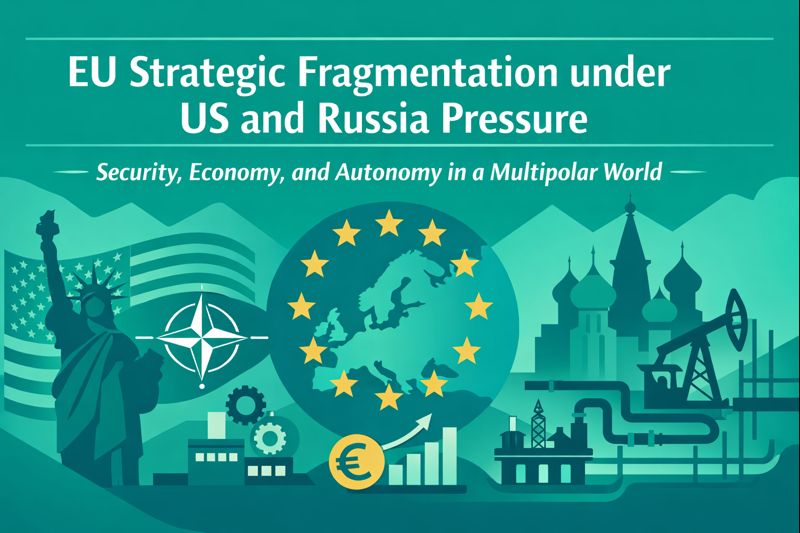
The European Union is broadly aligned on two fundamentals: the need to maintain close security cooperation with the United States and to deter Russia. Beneath this surface consensus, however, lies a clear divergence in policy preferences shaped by security exposure, industrial competitiveness, and energy transition costs.
This report argues that current EU “divisions” are not signs of disintegration, but rather evidence of a strategic multi-track adaptation to a more fragmented global order.
Chapter 1. Framing the Question: Is the EU Truly Divided?
At first glance, EU responses to the United States and Russia appear inconsistent and slow. Yet the underlying issue is not a breakdown in values, but a divergence in risk allocation.
- Toward the United States: acceptance of U.S. security leadership combined with caution over economic and industrial dependence.
- Toward Russia: consensus on deterrence, but disagreement on escalation management and end-state strategies.
This duality creates the perception of disunity, while in reality reflecting differentiated national constraints.
Chapter 2. Relations with the United States: Alliance Dependence vs. Strategic Autonomy
2.1 Asymmetric Security Dependence
European security remains heavily reliant on NATO. For Eastern European and Baltic states, the U.S. security guarantee is existential and largely irreplaceable.
Conversely, France and Germany increasingly emphasize Strategic Autonomy, driven by:
- concerns over structural dependency on U.S. military power,
- heightened awareness of U.S. domestic political volatility.
As a result, EU strategic discourse has shifted from unconditional Atlanticism to conditional alignment.
2.2 Industrial and Regulatory Frictions
U.S. subsidy-driven industrial policy has intensified competitive pressure on European firms. This has reinforced a dual approach within the EU:
- cooperation with the U.S. in security and geopolitics,
- defensive distance in industrial, technological, and regulatory domains.
Chapter 3. Relations with Russia: Unified Deterrence, Divergent Exit Strategies
3.1 Asymmetric Threat Perception
While all EU members recognize Russia as a strategic threat, proximity matters.
- Eastern Europe and the Baltics perceive an existential risk.
- Core Western European states view Russia as a long-term but manageable challenge.
This divergence shapes preferences over sanctions intensity, diplomatic channels, and escalation control.
3.2 Energy Dependency as a Path-Dependent Constraint
Past reliance on Russian energy continues to influence policy choices. Countries that bore higher adjustment costs during the energy decoupling phase now place greater emphasis on future crisis management rather than purely punitive approaches.
3.3 Concentrated Decision-Making Risk in Russia
Russia’s policy direction remains highly centralized under Vladimir Putin, significantly reducing predictability for European policymakers. This uncertainty widens the gap between hard-line deterrence advocates and proponents of controlled engagement.
Chapter 4. Dual-Front Pressure and the Rise of Policy Multi-Tracking
The EU faces two simultaneous constraints:
- Security cooperation with the United States remains indispensable.
- Excessive dependence on the United States undermines European industrial competitiveness and strategic agency.
To manage this contradiction, the EU is increasingly adopting a multi-track strategy:
- Security: sustained Atlantic cooperation.
- Industry and technology: European-centric capacity building.
- Diplomacy: deterrence of Russia combined with selective engagement for escalation control.
Chapter 5. Economic Implications: Structural Transformation of the EU Model
This strategic adjustment is reshaping the EU’s economic paradigm:
- From free-trade primacy → selective economic security
- From regulation-only governance → revival of industrial policy
- From single-market universalism → strategic sector protection
These shifts should be understood not as temporary deviations, but as structural adaptations to geopolitical fragmentation.
Conclusion: Adaptation, Not Disintegration
The EU’s differentiated approaches toward the United States and Russia do not signal fragmentation or decline. Rather, they reflect a pragmatic recalibration under conditions of multipolar competition.
Decision-making will remain complex and slower, yet systemic rupture is unlikely.
The EU is evolving into a political-economic entity that is neither monolithic nor brittle—capable of absorbing internal diversity while maintaining external coherence.
This imperfect equilibrium is not elegant, but it is durable and realistic in today’s international environment.