What Danish Pension Funds and China’s U.S. Treasury Rebalancing Really Signal
Executive Summary
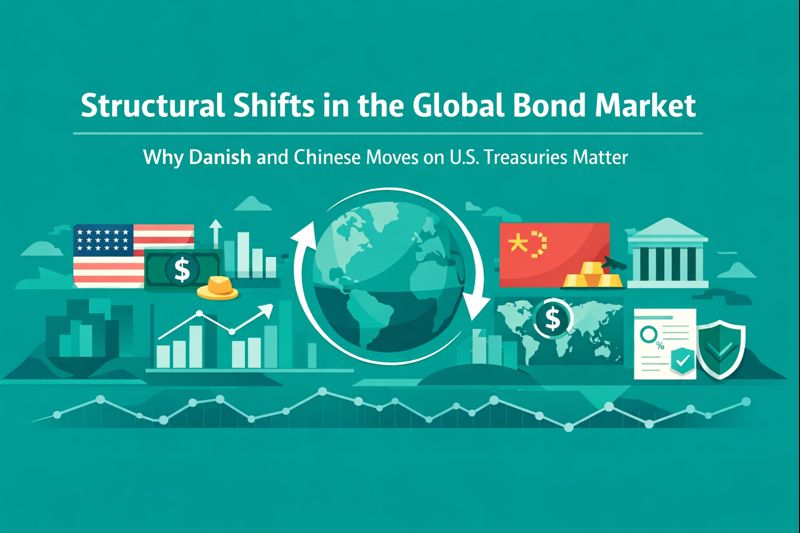
Recent developments—most notably the decision by a Danish pension fund to divest from U.S. Treasuries and the continued decline in China’s Treasury holdings—should not be interpreted as isolated portfolio adjustments. Rather, they reflect a gradual but meaningful structural transition in the global bond market.
U.S. Treasuries remain the world’s deepest and most liquid safe-asset market. However, they are increasingly moving from a position of default, unconditional safety toward one of conditional, purpose-specific utility.
The core implication is not an imminent collapse in demand, but a higher sensitivity of long-term yields to fiscal, political, and geopolitical shocks, primarily through changes in the term premium rather than outright yield levels.
1. Why Small Sales Matter: Framing the Issue
In global fixed-income markets, signals often matter more than flows.
The Danish pension fund’s divestment is quantitatively negligible relative to the size of the U.S. Treasury market. Yet it has attracted disproportionate attention because it articulates a replicable decision framework:
- Fiscal sustainability concerns
- Long-term political and geopolitical risk
- Fiduciary duty to beneficiaries
Markets correctly infer that other institutions operating under similar constraints could reach the same conclusion, even if they have not yet acted.
2. Denmark: Exporting a Decision Model, Not a Shock
2.1 Key Characteristics
- The divestment was justified on risk-management and fiscal grounds, not ideological opposition.
- The fund explicitly maintained exposure to U.S. dollar assets, underscoring that this is not a rejection of the dollar system.
2.2 Market Implications
This represents a shift from viewing Treasuries as a universal safe asset toward evaluating them as one option among several within a risk-budget framework.
For long-horizon investors such as pensions and insurers, institutional risk (fiscal credibility, governance stability) is now entering the same decision space as duration risk and inflation risk—particularly at the long end of the curve.
3. China: Selling Less, Transforming More
3.1 Observed Facts
- China’s Treasury holdings have declined steadily, reaching levels last seen in the late 2000s.
- Simultaneously, total foreign holdings of U.S. Treasuries have reached record highs.
3.2 Interpretation
This is not a disorderly exit. Structural constraints prevent China from rapidly liquidating Treasuries without destabilizing both markets and its own reserve management framework.
What is occurring instead is portfolio morphing:
- From Treasuries toward other dollar-denominated instruments
- Gradual reallocation toward gold and shorter-duration assets
The effect is persistent marginal pressure, not episodic selling.
4. Near-Term Market Effects: Where the Stress Appears
4.1 Term Premium, Not Yield Levels
Demand for Treasuries does not disappear—but it becomes conditional.
As a result:
- Long-dated Treasuries exhibit higher sensitivity to fiscal and political headlines
- Shocks manifest more in term premium volatility than in sustained yield repricing
4.2 Spillovers to Substitute Assets
When Treasuries are reduced, capital tends to migrate toward:
- Agency/GSE securities
- Supranational and SSA bonds
- Treasury bills rather than long bonds
Hence, distortions often appear in spread behavior, not outright Treasury yields.
5. Medium- to Long-Term Structural Trends
5.1 Dollar Dominance Without Re-Concentration
The U.S. dollar remains the dominant reserve currency.
However, incremental reserve accumulation increasingly favors diversification rather than concentration.
This is not de-dollarization by rupture, but erosion by marginal choice.
5.2 From Universal Safe Asset to Functional Asset
The future of Treasuries is segmented by use case:
| Function | Preferred Assets |
|---|---|
| Settlement & collateral | U.S. Treasuries (still dominant) |
| Reserves | Diversified currencies, gold, shorter duration |
| ALM optimization | Hedged-return-efficient instruments |
Treuries remain essential—but no longer exclusive.
5.3 Volatility as the New Normal
The structural consequence is clear:
- Yield levels may remain contained
- Volatility rises structurally
Markets with price-sensitive buyers and fewer unconditional holders respond more sharply to shocks.
6. Policy and Investment Implications
For Policymakers
Fiscal credibility is no longer abstract. It directly affects the stability premium embedded in sovereign debt.
For Institutional Investors
The central question is no longer how much Treasury exposure to hold, but for what purpose.
Hedged returns, political risk, and portfolio function must be assessed simultaneously.
For Markets
The risk is not a Treasury collapse.
The risk is thin tolerance during stress, leading to outsized moves when confidence is tested.
Conclusion
The actions of Danish pension funds and China do not herald the end of the U.S. Treasury market.
They do, however, mark the end of its status as an unquestioned, all-purpose safe asset.
The international bond market is entering a phase where:
- Structure outweighs scale
- Volatility matters more than levels
- Decision logic matters more than headlines
Understanding this transition is essential for effective macroeconomic policy, risk management, and long-horizon investment strategy.