ー Insights from Ray Dalio’s Davos Intervention ー
- Executive Summary
- 1. Capital Is No Longer Neutral
- 2. The Functional End of the Rules-Based Order
- 3. U.S. Treasuries and the Dollar: From Absolutes to Conditionals
- 4. Gold and Non-Liability Assets as Systemic Insurance
- 5. Investment Behavior in a Capital-War Environment
- 6. Implications for Key Actors
- Conclusion: Dalio’s Core Warning
Executive Summary
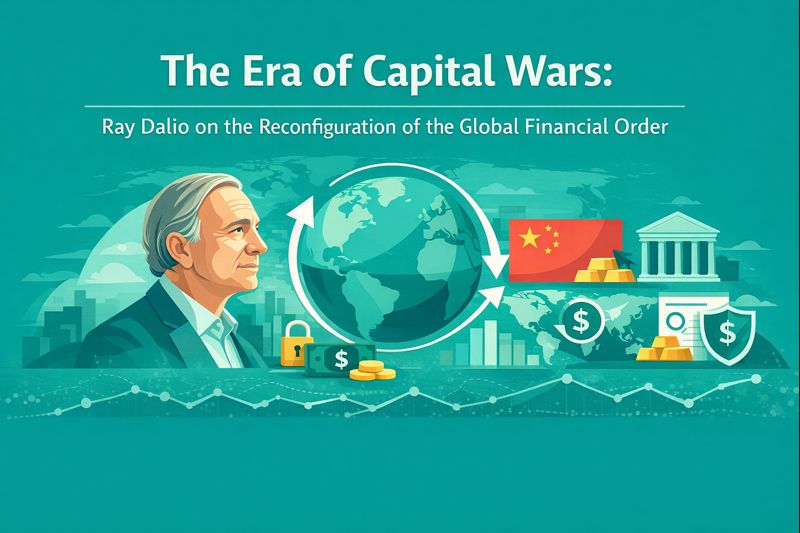
At the World Economic Forum in Davos, Ray Dalio articulated a stark but coherent diagnosis of the current global environment:
the world is no longer merely experiencing trade conflicts or geopolitical frictions, but is entering a phase he describes as “capital wars.”
This shift marks a structural transformation in the international financial system. Capital—sovereign debt, currencies, reserve assets, and cross-border investments—is increasingly politicized, weaponized, and conditioned by geopolitical alignment.
The implication is not the collapse of markets or the dollar system, but the end of unconditional trust in the institutions and assumptions that underpinned global finance for decades.
This report examines Dalio’s core arguments and situates them within a broader macro-economic framework, addressing:
- Why the rules-based international order is functionally weakening
- How U.S. Treasuries and the dollar are being structurally re-priced
- What this implies for investors, asset managers, and policymakers
1. Capital Is No Longer Neutral
1.1 The Meaning of “Capital Wars”
Dalio’s concept of capital wars refers to a stage of conflict in which:
- Capital flows themselves become strategic tools
- Holding another country’s assets entails political and legal risk, not merely credit risk
- Financial interdependence is no longer assumed to be stabilizing
In this environment, owning a foreign asset can be perceived as exposure to another country’s policy discretion, including sanctions, freezes, or forced repricing.
This represents a decisive break from the post-Cold War assumption that capital markets are politically neutral arenas.
2. The Functional End of the Rules-Based Order
2.1 Rules Exist, but They Are No Longer Binding
Dalio does not claim that international rules have disappeared.
Rather, his warning is more subtle—and more serious:
- Rules remain on paper
- But in moments of stress, they are selectively enforced or ignored
- Markets are increasingly aware of this asymmetry
As a result, international law and multilateral frameworks are no longer treated as firm constraints, but as inputs into negotiation and power dynamics.
For economic actors, relying on rules alone has become naïve.
3. U.S. Treasuries and the Dollar: From Absolutes to Conditionals
3.1 Relative, Not Absolute, Decline
Dalio is explicit that the U.S. dollar and Treasury market are not on the verge of collapse.
However, they are undergoing a process of relative repricing.
Three forces drive this shift:
- Persistent and expanding U.S. fiscal deficits
- The routine use of sanctions, asset freezes, and financial coercion
- Rising domestic political polarization and policy unpredictability
The consequence is that U.S. sovereign assets are increasingly viewed as political instruments, not purely financial ones.
Trust has not vanished—but it has become conditional.
4. Gold and Non-Liability Assets as Systemic Insurance
4.1 Why Gold Matters in Dalio’s Framework
Dalio’s endorsement of gold is often misunderstood as a return to commodity investing.
In reality, his logic is institutional:
- Gold has no issuer
- It cannot be printed, sanctioned, or frozen by another state
- It exists outside any single legal jurisdiction
Gold therefore functions as insurance against systemic and political failure, not as a speculative return generator.
In this context, moderate allocations to non-liability assets represent risk management, not macro bets.
5. Investment Behavior in a Capital-War Environment
5.1 The Limits of the Past 40-Year Model
The investment frameworks developed over the past four decades assumed:
- Stable globalization
- Disinflationary growth
- A broadly trusted dollar-centric system
Dalio’s warning is that these assumptions can no longer be extrapolated forward.
5.2 The New Rationality
In a capital-war environment, rational portfolio construction prioritizes:
- Survivability over optimization
- Jurisdictional and legal diversification, not just asset-class diversification
- Liquidity and reversibility as first-order considerations
Returns matter—but resilience matters more.
6. Implications for Key Actors
6.1 Governments
Fiscal discipline and political cohesion are no longer domestic issues alone; they directly affect currency credibility and sovereign funding costs.
6.2 Institutional Investors and Wealth Managers
The largest risks increasingly lie outside standard risk models:
- Legal intervention
- Capital controls
- Regime and rule changes
Asset management is becoming inseparable from geopolitical and legal risk management.
Conclusion: Dalio’s Core Warning
Ray Dalio’s message at Davos can be distilled into a single proposition:
The global order is not collapsing,
but it can no longer be safely assumed.
In such a world:
- Capital becomes cautious
- Markets become more volatile
- Trust becomes conditional and reversible
Dalio is not advocating pessimism.
He is advocating intellectual realism.
Those who fail to update their assumptions will not necessarily lose immediately—but over time, they will lose options, flexibility, and freedom.
In an era defined by capital wars, the ultimate measure of success is not maximal return, but the ability to remain solvent, liquid, and free across regimes.
That is the economic reality Dalio brought to Davos—and the one global decision-makers can no longer afford to ignore.