- Is the Petrodollar Crumbling—or Quietly Eroding?
- Conclusion: Not Collapse, but Erosion
- What the Petrodollar Really Is
- Why This Still Matters: Pressure from the Periphery
- Yuan vs. Crypto: Two Very Different Tools
- The Real Shift: Financialization of Geography
- Three Possible Scenarios
- What Actually Matters: Not Price, but Flow
- Final Take: A Quiet but Structural Shift
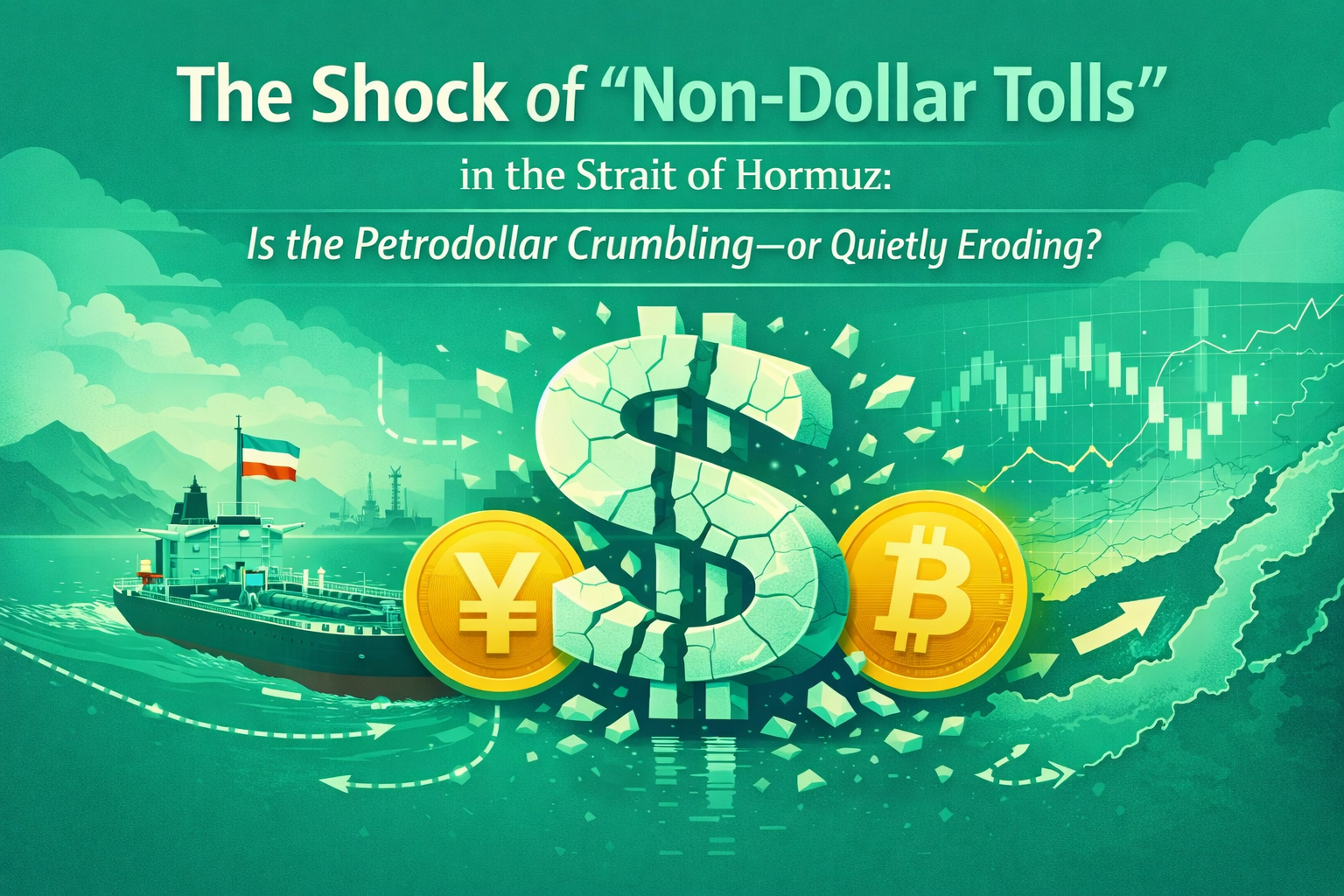
Is the Petrodollar Crumbling—or Quietly Eroding?
Amid escalating tensions in the Middle East, reports that Iran is considering charging transit fees in the Strait of Hormuz in Chinese yuan or cryptocurrencies have triggered a familiar question:
Is this the beginning of the end for the petrodollar system?
The short answer: No—but something important is changing.
Conclusion: Not Collapse, but Erosion
This development will not dismantle the petrodollar system overnight.
However, it does mark a meaningful shift:
- The dollar remains dominant
- But it is no longer the only viable channel
In other words:
This is not the end of dollar dominance—
but the beginning of the end of its exclusivity.
What the Petrodollar Really Is
The petrodollar system is often misunderstood as simply “oil priced in dollars.”
In reality, it is a much broader ecosystem:
- Oil benchmarks (Brent, WTI) are dollar-denominated
- Global trade is largely settled in dollars
- Shipping, insurance, and trade finance operate in dollars
- Oil exporters recycle revenues into dollar assets
- Central banks hold dollar reserves
As long as this system remains intact,
a partial shift in payment methods does not overturn the system.
Why This Still Matters: Pressure from the Periphery
The significance of Iran’s move lies here:
It targets the edges of the system, not its core.
Historically:
- Oil → USD
- Shipping → USD
- Insurance → USD
Now:
- Oil pricing → still USD
- Transit fees → yuan / crypto
- Ancillary services → increasingly flexible
This creates a new structure:
“Dollar core, non-dollar friction layer.”
This may seem minor—but it is structurally meaningful.
Yuan vs. Crypto: Two Very Different Tools
Yuan: A Competing Economic Circuit
The strength of the yuan lies in its usability:
- Can be used for exports to China
- Can fund imports from China
- Can be reinvested in Chinese financial assets
This enables:
A closed-loop economic system outside the dollar
It directly challenges one pillar of the petrodollar system:
the recycling of energy revenues into dollar assets.
Crypto: A Sanctions Evasion Tool
Cryptocurrencies serve a different purpose:
- Resistant to seizure
- Independent of banking systems
- Enables rapid transfers
This is not a challenge to dollar dominance per se.
It is an escape route from the dollar system—not a replacement.
The Real Shift: Financialization of Geography
Focusing only on currencies misses the bigger picture.
What is actually happening is this:
A physical chokepoint is becoming a financial toll system.
Traditionally:
- Oil producers controlled pricing power
Now:
- Strategic geography (like Hormuz) controls flow and payment conditions
This represents a deeper transformation:
From “resource dominance” to “logistics dominance.”
Three Possible Scenarios
1. Short-Term Stabilization (Most Benign)
- Traffic normalizes
- Non-dollar payments remain temporary
→ Minimal long-term impact
2. Partial Fragmentation (Base Case)
- Non-dollar channels expand within China-aligned and sanctioned economies
- Shipping and insurance begin to fragment
→ Emergence of a “petro-yuan zone”
3. Structural Shift (Low Probability, High Impact)
- Yuan-denominated oil benchmarks gain traction
- Yuan financial markets deepen significantly
→ Genuine challenge to dollar dominance
What Actually Matters: Not Price, but Flow
Most observers focus on oil prices.
But the real risk lies elsewhere.
Key indicators to watch:
- Volume of traffic through Hormuz (vs. normal levels)
- Currency used in maritime insurance
- Settlement currency for China-bound oil
- Share of non-dollar energy transactions
- LNG shipping delays
Ultimately:
Markets do not break when prices rise—
they break when flows stop.
Final Take: A Quiet but Structural Shift
This is not a dramatic collapse.
It is a subtle but important transition.
The petrodollar system remains intact.
But its monopoly is weakening.
The most important shift is this:
For the first time, energy is demonstrably able to move—at least partially—outside the dollar system.
This change will not dominate headlines every day.
But over time, it will reshape how global energy—and money—flows.
Quiet, but consequential.