The Dutch Government’s Takeover of Nexperia: A Turning Point in Global Tech Sovereignty
— The New Frontline in the U.S.–China–EU Technology Rivalry —
1. Overview
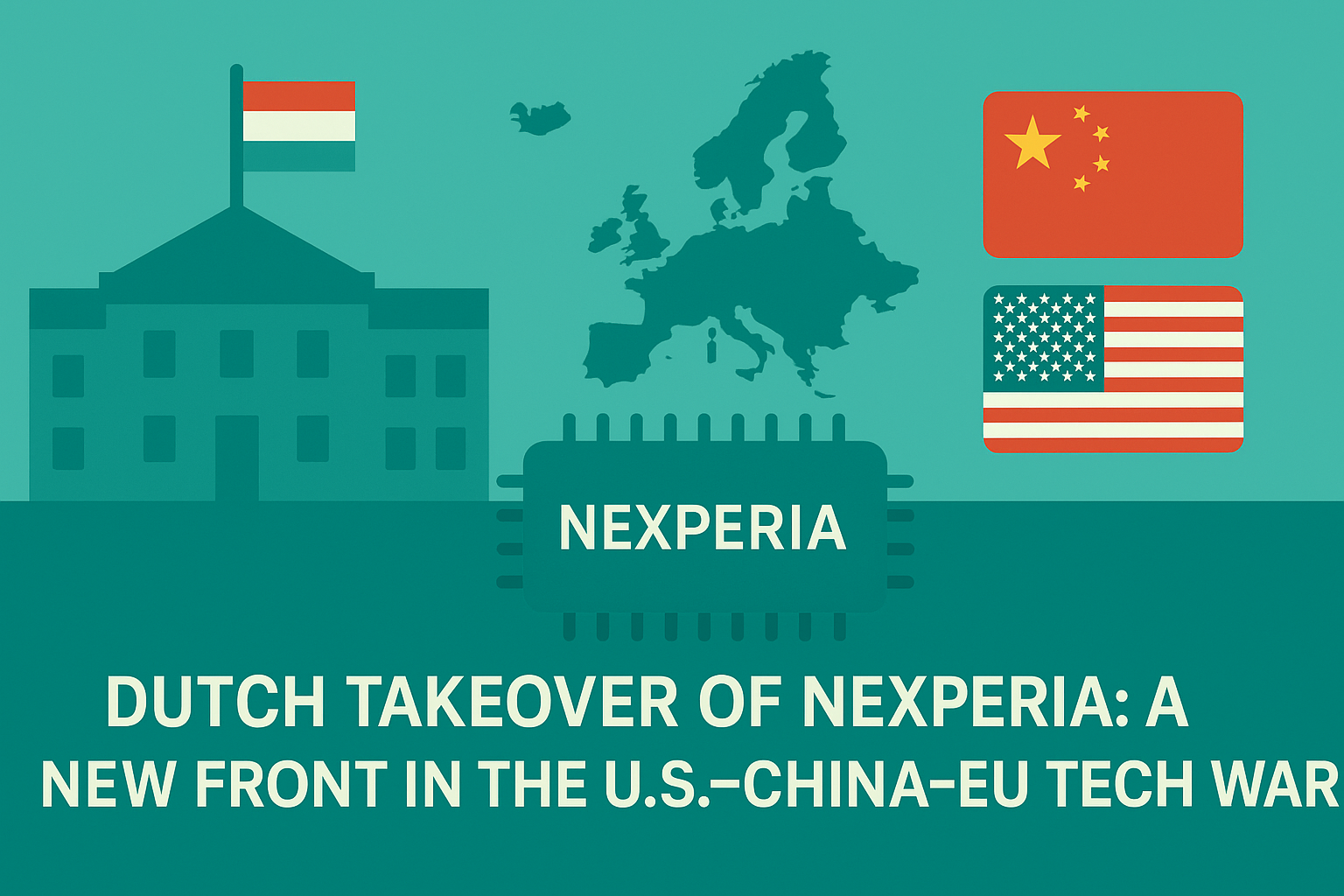
In October 2025, the Dutch government effectively took control of Nexperia, a semiconductor manufacturer owned by China’s Wingtech Technology, invoking the Goods Availability Act—a wartime-era law rarely used in peacetime. The move, justified on the grounds of national and supply-chain security, represents an unprecedented state intervention within the European technology sector. While Washington expressed support, Beijing condemned the measure as an “act of economic coercion.” This marks a defining escalation in the global struggle for technological sovereignty.
2. Background: Nexperia and the Europe–China Tech Divide
Nexperia, headquartered in Nijmegen, the Netherlands, originated from Philips’ semiconductor division (later NXP). In 2018, it was acquired for roughly USD 3.6 billion by Wingtech Technology of China. Since then, Nexperia has become a key supplier of automotive and industrial semiconductors across Europe.
By mid-2025, growing U.S. pressure on European allies to tighten scrutiny of Chinese ownership in strategic industries had intensified. Washington privately raised alarms over potential data transfers, intellectual property exposure, and export-control evasion via Nexperia’s global network.
In late September 2025, the Dutch Ministry of Economic Affairs determined that Nexperia’s governance exhibited “serious shortcomings,” citing:
(1) data and production shifts from EU sites to China,
(2) circumvention of U.S. export-control mechanisms through third-party intermediaries, and
(3) internal discussions to consolidate European production under Chinese management.
The Dutch government concluded that such actions endangered Europe’s technological continuity and placed Nexperia under state supervision.
3. China’s Reaction and Diplomatic Escalation
Beijing’s Ministry of Commerce denounced the Dutch decision on October 13, declaring that it “undermines international economic order and discriminates against Chinese investors.” In retaliation, China imposed export restrictions on Nexperia-related components and finished products, disrupting shipments to Europe.
The Chinese Foreign Ministry summoned the Dutch ambassador in Beijing, demanding reversal of the takeover. The Dutch foreign minister responded firmly that the intervention was “a national-security necessity, not an act of protectionism.” Chinese media, meanwhile, labeled the Netherlands “a technology pirate of the West.”
Reports from industry insiders suggest that Beijing is considering expanding export controls on rare materials such as germanium and gallium, essential for Nexperia’s manufacturing lines—potentially triggering another supply crunch for European automakers.
4. The U.S. and EU Response
The U.S. Department of Commerce welcomed the Dutch decision, emphasizing that “trusted allies have the right to protect critical technologies.” Washington argued that Nexperia operated as part of Beijing’s Made in China 2025 industrial policy and that its takeover was a prudent defense of Europe’s tech base.
Simultaneously, the U.S. and Netherlands expanded coordination on semiconductor controls, integrating ASML, NXP, and Infineon into a broader “Chip 4 + EU” alliance framework.
Within the EU, Germany’s Economy Ministry announced plans to strengthen foreign-investment screening. France, Italy, and Spain also called for a new European mechanism for “strategic industry protection,” signaling a shift toward state-centric technology governance.
5. Industrial and Market Implications
Nexperia is a vital supplier of low-cost analog and power semiconductors used by European automakers such as Volkswagen and Stellantis. The Dutch intervention has triggered immediate supply concerns. Manufacturers are now seeking alternative suppliers in Japan, South Korea, and Taiwan.
In the short term, the industry faces price increases, delivery delays, and Chinese export restrictions on subcomponents. To mitigate the shock, the Dutch government has pledged to stabilize Nexperia’s operations via a state-backed fund, ensuring continued employment and local production. Wingtech, however, is expected to file for international arbitration, raising the likelihood of a prolonged legal dispute.
6. Strategic Significance
This case represents a watershed in Europe’s transition from open-market pragmatism to strategic autonomy. The Dutch action underscores that economic security has become inseparable from national security.
For China, the move epitomizes Western containment in technology. For the United States, it is evidence of alliance alignment against Beijing’s industrial ambitions. As a result, the global semiconductor ecosystem is now divided along geopolitical fault lines: supply-chain sovereignty versus market integration.
7. Implications for Japan and JBIC-Linked Projects
- Supply-chain restructuring: Japanese companies must review foreign ownership and joint-venture transparency, especially where Chinese capital is involved in advanced manufacturing.
- Risk assessment in financing: JBIC and NEXI should classify “state intervention in foreign-owned tech assets” as a new category of political risk when underwriting European or Asian projects.
- Policy alignment: Japan’s METI, MOFA, and financial institutions should harmonize export-control and security-review standards with the U.S.–EU framework to avoid regulatory asymmetry.
8. Conclusion
The Dutch government’s seizure of Nexperia is not merely an industrial decision—it symbolizes Europe’s assertion of technological sovereignty amid global polarization. The U.S. has endorsed this stance, while China prepares counter-measures that could escalate into resource and trade retaliation. The episode crystallizes a new geopolitical reality: the fusion of industrial policy and national defense, where technology firms have become instruments—and victims—of statecraft.
For global investors and policymakers, Nexperia’s fate will be remembered as the moment Europe crossed the Rubicon in the tech sovereignty era.