China’s Rare Earth Export Controls Shake Global Supply Chains — Impacts on Semiconductors, EVs, and Defense Industries
Wrote By : Global Economist 2025
Introduction: The New Era of Resource Power
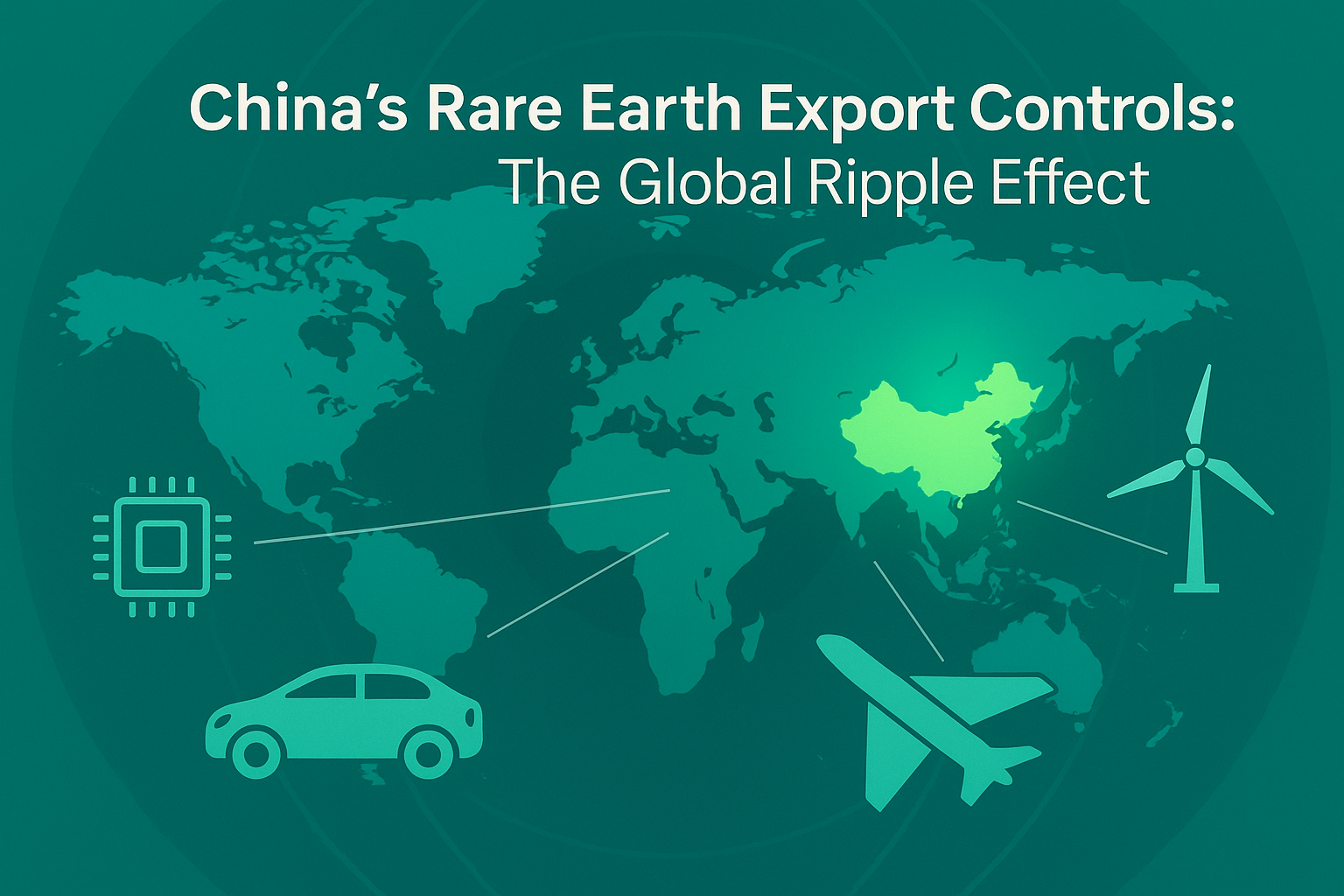
In October 2025, the Chinese government officially launched a new export control regime for rare earths — a move that has sent shockwaves across global industries. These strategic materials, critical to semiconductors, electric vehicles (EVs), renewable energy, and defense systems, are now under tighter export supervision.
China produces over 70% of the world’s rare earth supply, and its new measures go far beyond trade policy. They represent a geoeconomic maneuver: Beijing is now weaponizing its control over critical minerals in response to mounting technological and trade restrictions from the West.
The Details and Strategic Intent
1. Scope of the New Controls
Under the October 2025 regulations, the following categories now require export licenses:
- Rare earth ores, oxides, alloys, and magnetic materials
- Refining and processing equipment
- Intermediate products containing > 10% rare earth content
A key change is the introduction of a composition-based licensing threshold, meaning even non-Chinese finished products containing Chinese rare earth inputs above a certain ratio must obtain approval before re-exporting.
2. Beijing’s Strategic Objectives
Although the Ministry of Commerce cites “national security and resource protection,” analysts identify three deeper objectives:
- Apply pressure on U.S. semiconductor and defense supply chains
- Reassert dominance over global manufacturing networks
- Preserve domestic industrial advantage for Chinese EV and magnet producers
State outlets such as People’s Daily and Global Times framed the move as a reciprocal measure: “If the West uses technology as a weapon, China will respond with resources.”
Global Economic and Industrial Impacts
1. Semiconductor and Electronics
Rare earths like neodymium and dysprosium are vital for high-precision optics and lithography systems. The new restrictions expose Japanese, Korean, and Taiwanese chipmakers to price volatility and delivery delays. Alternative sources — such as Australia or the U.S. Mountain Pass mine — exist but lack refining capacity, which remains overwhelmingly in China.
2. Electric Vehicles and Clean Energy
Roughly 80% of EV motors rely on rare earth magnets. Supply disruptions will push up costs and lengthen production cycles for automakers in Japan and Europe. Meanwhile, Chinese producers such as BYD and CATL are strengthening in-house material sourcing, widening their competitive moat.
3. Defense and Aerospace
A single F-35 fighter jet contains an estimated 417 kilograms of rare earth components. U.S. and NATO defense contractors now face potential material shortages, linking resource security directly to national security.
International Responses
- United States: The Department of Commerce launched emergency financing for Australian and Canadian mining ventures to diversify supply.
- European Union: The Critical Raw Materials Act (CRMA) aims to double refining capacity within the bloc by 2028.
- Japan: Through JBIC and JOGMEC, Tokyo has accelerated joint exploration with Vietnam, Kazakhstan, and Madagascar to secure alternative sources.
Implications for Japanese Companies and Financial Institutions
- Immediate Procurement Review
Manufacturers — especially in automotive and electronics — must quantify Chinese content exposure and pre-emptively secure secondary suppliers. - Price Stabilization Measures
Rare earth prices have risen 38% year-on-year (S&P Global, Oct 2025). Long-term fixed-price contracts or futures hedging are advisable. - Leverage Policy Finance Tools
JBIC and NEXI can provide guarantees and co-financing for overseas resource development and processing infrastructure.
The Broader Picture: A “Second Cold War” of Resources
This is not merely an export regulation; it is a declaration of resource-based geopolitical realignment.
As the U.S. and its allies weaponize technology controls, China is countering with resource leverage — transforming global trade into a dual contest between “the West of technology” and “the East of resources.”
For Japan, a manufacturing powerhouse heavily dependent on imported materials, this marks a turning point. Ensuring resource security, processing autonomy, and multilateral coordination must become central pillars of economic strategy.
Conclusion
China’s rare earth export restrictions underscore a profound shift: commodities are no longer passive inputs but active instruments of statecraft.
The global economy is entering an era where strategic minerals define geopolitical power, and nations that secure diversified supply lines will hold the upper hand.
For Japan and allied economies, the imperative is clear — treat critical materials not as market goods, but as national infrastructure.
Sources
- Reuters (Oct 16 2025) “China expands rare earth export controls, raising global supply concerns”
- Global Times (Oct 17 2025) “China’s export restrictions aim to ensure national security and industrial advantage”
- S&P Global Commodity Insights (Oct 15 2025)
- Financial Times / Bloomberg / Nikkei Asia reports