Institutional Design Behind Growth Without Becoming an Immigration State
- Executive Summary
- 1. Structural Preconditions of UAE’s Economic Development
- 2. The Economic Essence of the Kafala System
- 3. A Growth Accelerator During Rapid Expansion
- 4. Alignment with Indian and African Labor Inflows
- 5. Institutional Fatigue and Modern Reconfiguration
- 6. Why Full Abolition Is Economically Irrational
- 7. Conclusion: An Economic-Historical Assessment
Executive Summary
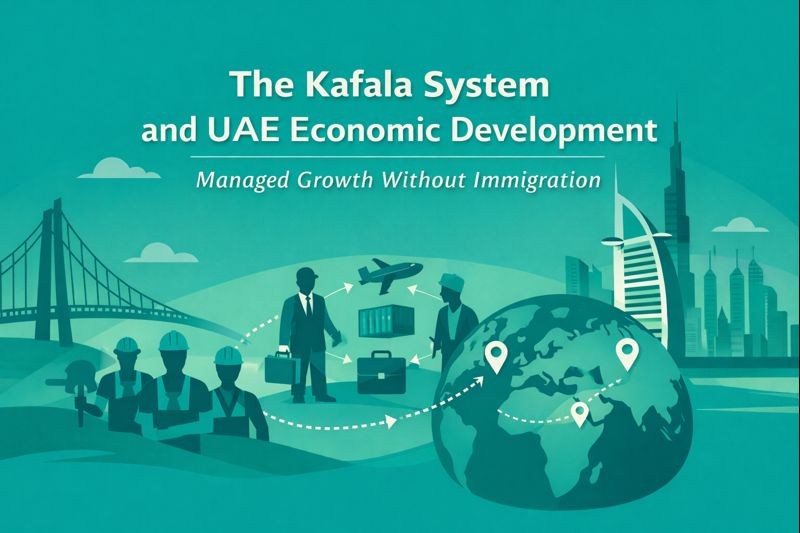
The economic development of the United Arab Emirates (UAE) should not be understood as a passive outcome of globalization. Rather, it is the result of active institutional engineering that transformed globalization into a manageable, state-controlled process.
At the center of this architecture lies the Kafala system.
This report argues that the Kafala system functioned not merely as a labor sponsorship mechanism, but as a core economic institution that enabled the UAE to mobilize labor, capital, and human resources at scale without transitioning into an immigration or welfare state.
In economic terms, Kafala operated as a mechanism for externalizing social and fiscal risks, while accelerating growth and preserving macro-stability.
1. Structural Preconditions of UAE’s Economic Development
The UAE began its development trajectory under conditions fundamentally different from those of advanced economies:
- A very small national population
- Limited administrative capacity during the early growth phase
- The need to convert oil wealth rapidly into non-resource sectors
- A political imperative to avoid permanent demographic transformation
Under these constraints, Western-style models based on:
- Permanent immigration
- Expanding labor rights and welfare systems
- Long-term social integration
were economically and institutionally infeasible.
The UAE therefore adopted an alternative strategy:
Admit labor and capital, but not permanent settlement.
2. The Economic Essence of the Kafala System
From an economist’s perspective, the essence of the Kafala system lies in risk allocation, not culture or ideology.
- Employment risk is borne by workers, not the state
- Residency is tied to contractual economic activity
- Social welfare obligations remain minimal at the sovereign level
This design allowed the UAE to:
- Prevent long-term unemployment from accumulating domestically
- Concentrate fiscal resources on infrastructure and urban development
- Maintain social and political stability despite extreme demographic imbalance
In macroeconomic terms, Kafala functioned as a system that externalized labor-market adjustment costs beyond national borders.
3. A Growth Accelerator During Rapid Expansion
3.1 Eliminating Labor Supply Constraints
Most fast-growing economies eventually face labor bottlenecks that slow expansion. The UAE largely avoided this constraint.
Under Kafala:
- Labor supply could scale rapidly with investment cycles
- Workforce levels could contract during downturns without domestic social fallout
- Wage pressures were moderated through international labor arbitrage
This made it possible to sustain continuous investment in:
- Ports and airports
- Transport networks
- Mega-projects and high-density urban development
- Tourism and hospitality infrastructure
Capital investment could be converted into physical output with exceptional speed.
4. Alignment with Indian and African Labor Inflows
4.1 Indian Workers: Quantitative Compatibility
Indian workers fit the Kafala model with high efficiency due to:
- Established overseas employment culture
- Strong remittance incentives
- Willingness for temporary, contract-based residence
They formed the invisible backbone of construction, logistics, services, and urban maintenance—effectively functioning as non-citizen infrastructure within the UAE economy.
4.2 African Workers: Commercial Integration Rather Than Pure Labor
African inflows should not be interpreted solely through a labor lens.
Many African nationals participate in:
- Trade intermediation and re-exports
- Logistics and aviation-linked services
- Small-scale entrepreneurship connected to African markets
Dubai, in this sense, operates as an external commercial port for Africa.
Here, Kafala served as a filter—allowing economic participation without permanent demographic absorption.
5. Institutional Fatigue and Modern Reconfiguration
As the UAE economy matured and shifted toward finance, technology, and knowledge-based sectors, the original Kafala framework began to show limitations:
- Reduced mobility for high-skill professionals
- Weak incentives for long-term human capital accumulation
- Friction with global ESG and governance expectations
The policy response was not abolition, but institutional differentiation:
- Labor-intensive sectors remain under managed sponsorship
- Skilled professionals gain mobility and family stability
- Entrepreneurs, investors, and specialists access self-sponsored and long-term residency
This created a multi-tier system aligned with economic value rather than nationality.
6. Why Full Abolition Is Economically Irrational
A complete dismantling of Kafala would likely produce outcomes the UAE has consistently sought to avoid:
- Permanent unemployment within national borders
- Expanding welfare obligations
- Political and social claims associated with long-term residency
From a cost-benefit standpoint, abolition would undermine the very stability that enabled growth.
Instead, the UAE has adopted:
Selective liberalization within a managed framework
This represents a deliberate model of controlled globalization, not deregulation.
7. Conclusion: An Economic-Historical Assessment
Across different stages of development, the Kafala system functioned as:
- A growth accelerator during early expansion
- A stabilization mechanism during consolidation
- A platform for institutional differentiation in maturity
It should therefore be evaluated not as a moral artifact, but as a development-stage-specific governance technology.
The UAE’s most important lesson is not about labor control per se, but about institutional design:
Globalization is not something a state merely accepts—it is something a state can engineer.
In this sense, the Kafala system embodies the UAE’s economic model itself: adaptive, selective, and strategically managed.