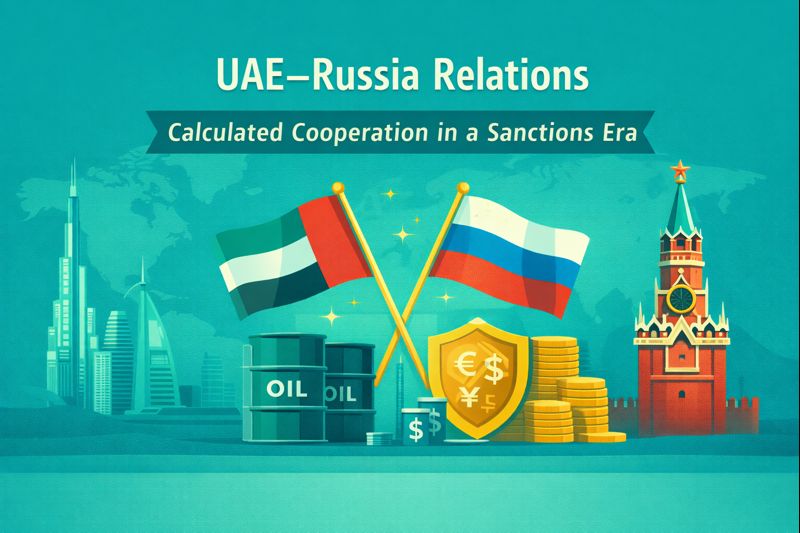
Calculated Cooperation and State Rationality in the Age of Sanctions
- I. Introduction: Why the UAE–Russia Relationship Is Often Misread
- II. Analytical Framework: The UAE’s Optimization Problem
- III. Energy Cooperation: The Most Rational Area of Alignment
- IV. Finance and Capital Flows: Sovereign Discretion, Not Defiance
- V. Diplomacy and Security: Cooperation With Clear Limits
- VI. Russia’s Perspective: No Illusions
- VII. A Microcosm of the Multipolar World
- VIII. Implications for Japan
- IX. Conclusion
I. Introduction: Why the UAE–Russia Relationship Is Often Misread
The relationship between the United Arab Emirates (UAE) and Russia is frequently portrayed in simplistic terms:
either as a sanctions-evasion partnership or as part of an anti-Western bloc.
Both interpretations are analytically weak.
In reality, the UAE–Russia relationship is:
- Not an alliance
- Not value-based
- Yet cooperative where interests clearly align
It is best understood as a textbook case of realist state behavior, optimized under constraints rather than ideology.
II. Analytical Framework: The UAE’s Optimization Problem
The UAE’s foreign policy is shaped by a clear set of structural constraints:
- Limited population and military scale
- High exposure to regional geopolitical risk
- A strategic imperative to monetize energy resources over the long term
Under these conditions, the rational solution is:
Avoid full dependence on any single great power,
while maintaining functional relationships with all of them.
Within this optimization framework, Russia is not an adversary to be excluded,
but a variable to be incorporated.
III. Energy Cooperation: The Most Rational Area of Alignment
1. OPEC+ as a Market-Management Mechanism
The most substantive point of contact between the UAE and Russia lies in
OPEC+.
- Russia: the largest non-OPEC oil producer
- UAE: a rising power within OPEC with increasing spare capacity
Their shared objective is not political alignment but:
- Preventing oil-price collapses
- Preserving revenue stability through coordinated supply management
This cooperation is cartel-like economic rationality, not ideology.
2. Complementarity Under Sanctions
Following Western sanctions, Russia faced restricted access to:
- European markets
- Western financial systems
In this environment, the UAE emerged as:
- A neutral trade hub
- A stable financial center
- A non-hostile jurisdiction
Crucially, the UAE is not rescuing Russia.
Rather:
Russia is using the UAE as one of the remaining viable market platforms.
This distinction matters.
IV. Finance and Capital Flows: Sovereign Discretion, Not Defiance
The UAE—particularly Dubai—has absorbed:
- Russian capital
- Russian high-net-worth individuals
- Russia-linked corporate entities
This reflects neither sanction-breaking nor ideological alignment.
It reflects sovereign discretion.
The UAE:
- Understands Western sanction logic
- But does not fully subordinate its national interest to it
Sanctions, in the UAE’s view, are foreign-policy tools, not binding doctrine.
V. Diplomacy and Security: Cooperation With Clear Limits
1. Position on the Ukraine War
The UAE has consistently chosen:
- Not to endorse Russia
- Not to condemn Russia outright
In the United Nations, this has translated into:
- Abstentions
- Carefully neutral language
This is not ambiguity. It is:
Deliberate neutrality designed to preserve future diplomatic optionality.
2. A Hard Ceiling in Security Relations
The UAE draws a clear red line:
- Its security architecture remains anchored to the United States
- No military alliance with Russia
- Defense procurement is deliberately diversified
Russia’s role is therefore explicitly capped so as not to undermine the UAE–US relationship.
VI. Russia’s Perspective: No Illusions
From Russia’s standpoint, the UAE is:
- A critical sanctions-era hub
- One of the few pragmatic partners in the Middle East
At the same time, Russia fully recognizes that the UAE is:
- Not an ally
- Not a long-term security guarantor
- Not a country on which Russia can become dependent
The relationship functions precisely because:
Neither side harbors illusions about the other.
VII. A Microcosm of the Multipolar World
The UAE–Russia relationship does not fit:
- Cold War bloc logic
- Post-Cold War unipolar assumptions
Instead, it reflects a multipolar operating system, in which:
- States prioritize flexibility over loyalty
- Interests outweigh values
- Strategic autonomy is maximized
In this sense, the relationship is symbolic of the new global order.
VIII. Implications for Japan
Japan operates under a fundamentally different constraint set:
- Clear alliance commitments
- Full participation in sanctions regimes
- Limited diplomatic flexibility
The UAE’s approach is not a model to be copied wholesale.
However, it does offer lessons:
- The value of preserving economic channels
- The importance of separating security alignment from economic pragmatism
- The strategic benefit of maintaining optionality where possible
IX. Conclusion
The UAE–Russia relationship is not a value-based alliance.
It is:
A carefully calibrated form of cooperation,
designed to maximize national autonomy
in a world where sanctions, fragmentation, and rivalry are permanent features.
The UAE does not treat Russia as a “friend.”
Russia does not treat the UAE as an “ally.”
Yet the relationship persists for one simple reason:
For both sides, engagement is more rational than disengagement.
This is the essence of state behavior in a multipolar world—
and the clearest lens through which the UAE–Russia relationship should be understood.