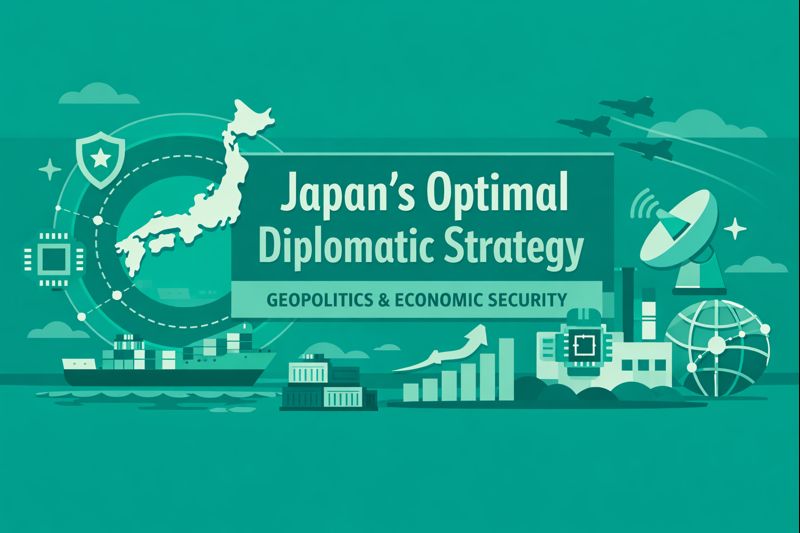
Maximizing Asymmetric Advantage in the Age of Geopolitics and Economic Security
A Strategic Report by a Professional Economist
- Executive Summary
- Chapter 1: Reframing the Premise — Japan Is Not a “Frontline State”
- Chapter 2: The Strategic Core — Economizing FOIP
- Chapter 3: Deterrence Revisited — Denying Success, Not Signaling Force
- Chapter 4: Economic Security as the Primary Diplomatic Arena
- Chapter 5: Middle-Power Network Strategy — Escaping Binary Rivalry
- Chapter 6: De-Risking as a Governing Principle
- Conclusion: Japan’s Winning Strategy
Executive Summary
Japan’s comparative diplomatic advantage does not lie in confronting great-power rivalry head-on, but in shaping the environment in which other states must act. By leveraging geography, alliances, economic indispensability, and institutional credibility, Japan can construct an asymmetric advantage that constrains adversaries’ choices while preserving cooperation where beneficial.
This report argues that Japan’s optimal diplomatic strategy is to function not as a frontline state, but as a systemic stabilizer—designing order, supply chains, and rules in a way that makes destabilizing behavior costly and unattractive.
Chapter 1: Reframing the Premise — Japan Is Not a “Frontline State”
Japan is often described as being on the front line of great-power confrontation in East Asia. This framing is analytically misleading.
Japan’s true geopolitical characteristics are:
- An island nation with no land borders
- Located on the outer rim, not the core, of regional flashpoints
- A critical hub for sea lanes and supply chains
This positioning makes Japan structurally suited to act as a buffer and stabilizer, not a shock absorber. The central objective of diplomacy, therefore, is not confrontation, but the design of conditions in which conflict becomes irrational.
Chapter 2: The Strategic Core — Economizing FOIP
Japan’s diplomatic backbone is the concept of the Free and Open Indo-Pacific (FOIP). Its strength lies not in rhetoric, but in its ability to be embedded into economic structures.
Normative Pillars
- Rule of law
- Freedom of navigation
- Open and transparent markets
Material Incentives
- Infrastructure investment
- Supply-chain resilience
- Technology and human-capital cooperation
By decoupling values from material benefits while delivering both simultaneously, Japan enables partner countries to cooperate without facing excessive domestic or geopolitical backlash. This dual-track approach is a distinctive Japanese strength.
Chapter 3: Deterrence Revisited — Denying Success, Not Signaling Force
Effective deterrence does not rely solely on military power; it relies on reducing the probability that coercion will succeed.
For Japan, deterrence is best achieved through the interaction of three factors:
- Alliance Credibility
The cornerstone remains the alliance with the United States, ensuring strategic predictability and extended deterrence. - Diversification of Dependencies
Energy, food, critical minerals, and semiconductor inputs must be diversified to reduce strategic vulnerability. - Institutionalized Readiness
Joint exercises, intelligence sharing, and interoperability conducted in peacetime lower response costs during crises.
The goal is not escalation dominance, but success denial—making aggressive action yield poor returns.
Chapter 4: Economic Security as the Primary Diplomatic Arena
Modern geopolitical competition increasingly unfolds through control over supply, rather than through direct military confrontation.
Japan holds a structural advantage in:
- Semiconductor manufacturing equipment and materials
- Precision machinery and advanced chemicals
- Infrastructure finance and regulatory design
These capabilities are difficult to substitute and deeply embedded in allied economies. As a result, Japan occupies a position of quiet but decisive influence: a country that cannot easily be bypassed.
Diplomacy, in this context, is less about negotiation tables and more about architecting supply networks.
Chapter 5: Middle-Power Network Strategy — Escaping Binary Rivalry
Japan’s most significant strategic risk is being locked into a rigid great-power binary.
The counterstrategy is to cultivate a network of middle powers—ASEAN states, India, the Middle East, and parts of Africa—through the following principles:
- Japan avoids over-visibility as the “leader”
- Partner regions retain ownership and agency
- Cooperation is delivered as integrated packages: logistics, finance, technology, and human capital
This approach positions Japan as a provider of options, not a demander of allegiance.
Chapter 6: De-Risking as a Governing Principle
Complete decoupling is economically unrealistic, while over-dependence is strategically dangerous. The practical solution is de-risking.
- Protected domains: critical technologies, core infrastructure, data, and standards
- Cooperative domains: climate change, public health, disaster response, and humanitarian assistance
The ability to clearly distinguish between these domains is a hallmark of mature statecraft.
Conclusion: Japan’s Winning Strategy
Japan’s optimal diplomatic posture can be summarized succinctly:
Do not fight on the front line; design the order behind it.
This strategy lacks spectacle, but it maximizes durability, minimizes risk, and generates outsized influence. In an era defined by geopolitical uncertainty, Japan’s comparative advantage lies not in the display of power, but in shaping how power can be used.
Japan already possesses most of the necessary assets. The remaining challenge is not capacity, but strategic consistency and self-awareness in deploying them.