Executive Summary
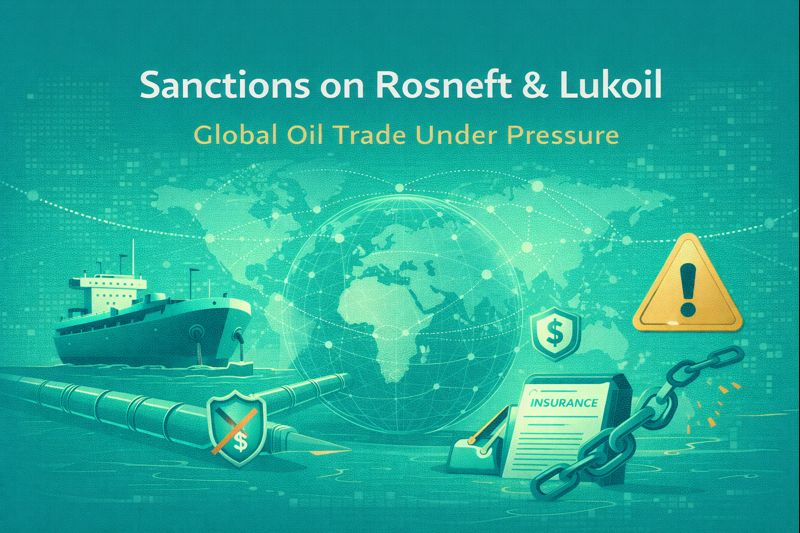
Recent sanctions developments have shifted from incremental pressure to operational disruption—targeting the plumbing that enables Russian oil majors to function globally: payments, trade finance, insurance/reinsurance, shipping, and services. The most consequential recent step is the U.S. designation of Rosneft and Lukoil under E.O. 14024, which triggers broad blocking effects and forces counterparties worldwide to reassess exposure.
In parallel, the EU’s 19th sanctions package tightens constraints on Russia’s energy revenues and the “shadow fleet” that sustains exports under restrictions.
A key near-term theme is downstream spillover in Europe—where refineries, fuel supply, and national energy security become directly implicated, as seen in Romania and Bulgaria.
1) What Changed Most Recently (High-Impact Policy Moves)
1.1 United States: Blocking Designations of Rosneft and Lukoil
On October 22, 2025, the U.S. Treasury (OFAC) designated Rosneft and Lukoil pursuant to E.O. 14024 (energy sector basis), alongside multiple subsidiaries, and reaffirmed the 50 Percent Rule (majority-owned entities are also blocked even if not listed).
This is qualitatively different from sectoral restrictions: it materially raises legal and reputational risk for global banks, insurers, traders, and service providers touching the two groups.
1.2 United States: Time-Bound “Wind-Down / Divestment” Pathways
Following the designations, OFAC issued general licenses and FAQs to allow limited, time-bound activity (e.g., divestment/transfer of pre-existing debt or equity positions) to reduce disorderly market impacts.
Operationally, these windows tend to pull forward de-risking by counterparties (banks and compliance teams typically tighten far earlier than the legal deadline).
1.3 European Union: 19th Package—Energy and Shadow Fleet Pressure
On October 23, 2025, the EU adopted its 19th package, which explicitly targets Russian energy revenue channels and strengthens tools against circumvention—most notably by tightening constraints around the “shadow fleet,” including measures affecting insurance/reinsurance and access to services.
1.4 United Kingdom: Exemptions Managed Through General Licences
The UK continues to manage energy-security exceptions via general licences for specific exempt projects (e.g., Russian oil “exempt projects” structures), reflecting an approach of controlled exceptions rather than blanket permissiveness.
2) How Sanctions Transmit Into Real-World Disruption
Channel A — Payments and Financial Intermediation (“Banks Step Away”)
Blocking sanctions drive a sharp increase in compliance risk. Even where a transaction is not explicitly prohibited under a local regime, major banks often decline involvement due to exposure to U.S. secondary effects and reputational risk. The result is higher friction in:
- USD/EUR clearing and correspondent banking
- Trade finance and letters of credit
- Supplier/customer onboarding (KYC/AML)
Channel B — Services and Maintenance (“Capability Erodes Over Time”)
Restrictions on services—especially those supporting exploration, production, refining, and logistics—matter less on day one and more over quarters and years. Constraints compound through:
- harder access to specialized parts and technical support
- delayed turnarounds and maintenance cycles
- reduced capacity expansion and reliability
Channel C — Shipping, Insurance, and Reinsurance (“Move the Barrel, Not Just Sell It”)
EU measures aimed at the shadow fleet tighten the bottleneck that often matters most: insurable, financeable transport. As traditional maritime insurance/reinsurance becomes harder to access, trade migrates to less transparent channels, usually at the cost of:
- deeper discounts on Russian crude/products
- longer routes and more transshipment
- higher incident and compliance risk
Channel D — Downstream Stability in Europe (“Refineries, Fuels, Politics”)
When sanctioned entities touch refineries and retail networks, sanctions quickly become an inflation and energy-security issue for host states. Governments then respond with administrative controls, supervision, or forced-sale pathways.
3) Observed Spillovers: Europe’s Downstream Becomes a Front Line
3.1 Romania: Legal Mechanism to Take Control of Sanction-Exposed Assets
Romania approved a decree enabling the state to assume control/special administration of assets belonging to internationally sanctioned companies if sanctions threaten market stability or energy security. Reuters specifically noted Lukoil’s footprint (retail stations and refinery relevance to national supply).
This is notable because it transforms sanctions from “external policy” into “domestic asset governance,” accelerating forced divestment or supervision outcomes.
3.2 Bulgaria: Restrictions on Fuel Exports Following Lukoil/Rosneft Sanctions
Bulgaria temporarily restricted exports of certain fuels (including diesel and aviation fuel) to stabilize domestic supply after the U.S. sanctions shock, reflecting immediate downstream sensitivity and the political salience of fuel availability.
4) Rosneft vs. Lukoil: Same Direction, Different Exposure Profiles
Rosneft
- Perceived as more tightly connected to Russian state objectives and geopolitics
- Typically faces higher “headline risk” for Western counterparties
- Exposure often concentrates in upstream and export flows, where shipping/insurance and payments are critical
Lukoil
- Frequently has (or had) more visible downstream footprints and commercial interfaces in adjacent markets
- As a result, host states may face direct trade-offs between sanctions compliance and fuel-market stability—raising the probability of supervision, forced sale, or operational constraints (Romania/Bulgaria dynamics illustrate this).
5) Near-Term Watch List (Next 3–6 Months)
- Expiry / renewal terms of wind-down and divestment authorizations—these can sharply tighten practical compliance posture even without new headline designations.
- Enforcement intensity around shadow fleet insurance/reinsurance and service bans—this is where circumvention capacity is most vulnerable.
- Forced-sale / special administration outcomes in European downstream assets—likely to become more common as governments prioritize price stability and supply security.
Bottom Line
The latest sanctions phase is best characterized as systems warfare against the enabling infrastructure of oil trade, not simply a symbolic widening of restricted lists. The immediate economic effects are most visible in finance and downstream stability, while the most durable effects accumulate through services, maintenance, and logistics constraints.