— The Breaking Point of a Sanctions-Era Credit Model —
- Executive Summary
- 1. Why the Arrest Is a Structural Shock
- 2. Implications for Chinese Policy Banks: Credit Risk Dominates
- 3. Implications for State-Owned Oil Companies: Assets or Political Liabilities?
- 4. Implications for Independent Refineries: The End of Arbitrage
- 5. China at the National Level: The Risk Absorber of Last Resort
- Conclusion: The Collapse of a Sanctions-Era Credit Model
- Broader Implication
Executive Summary
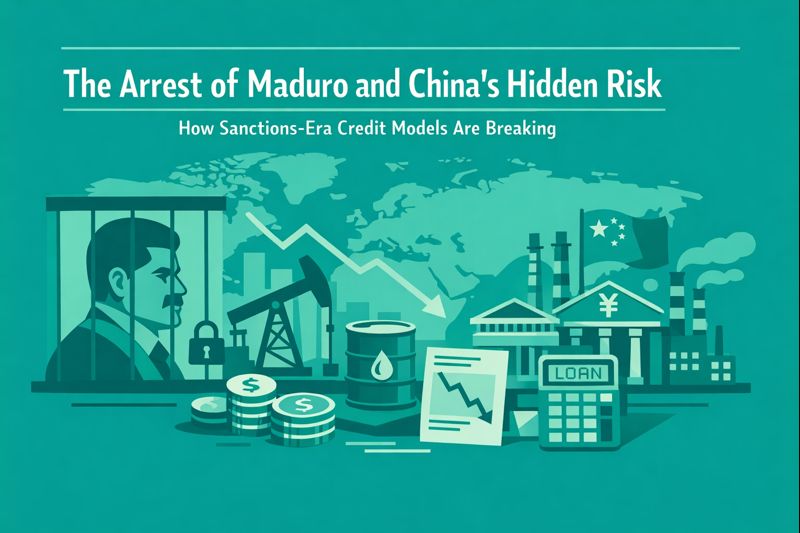
The arrest of Donald Trump of Nicolás Maduro should not be interpreted by China as a geopolitical setback or victory.
For China, this is fundamentally a credit event, not a diplomatic one.
China’s long-standing engagement with Venezuela—built on a hybrid structure of oil, policy lending, refining capacity, and market absorption—has relied critically on the political continuity of the Maduro regime.
With that continuity abruptly severed, credit claims, upstream oil assets, and arbitrage-based trade structures are all simultaneously repriced.
1. Why the Arrest Is a Structural Shock
Unlike incremental sanctions or diplomatic pressure, the arrest of a sitting leader represents a discontinuity of legal and political authority.
China’s Venezuela exposure was not anchored primarily in robust institutions, but in executive-level political agreements. Once the individual serving as the counterparty disappears:
- The legal validity of state contracts becomes contestable
- The identity of the legitimate debtor is questioned
- Asset ownership and production rights are reopened for review
From a financial perspective, this is equivalent to a counterparty collapse rather than a policy change.
2. Implications for Chinese Policy Banks: Credit Risk Dominates
Core Issue: Can the debt still be enforced?
For Chinese policy banks, oil flows are secondary. The dominant concern is recoverability.
- Venezuela’s oil-for-loans framework was politically negotiated under Maduro.
- A successor government—especially one recognized by the United States—has strong incentives to challenge the legitimacy of those obligations, framing them as corrupt, non-transparent, or regime-specific.
The most damaging scenario is not outright default, but prolonged legal and political contestation, which creates:
- Assets that remain on balance sheets but are practically unrecoverable
- Pressure from Chinese financial regulators regarding provisioning and disclosure
- Political exposure for having backed a collapsed regime
In short, credit risk becomes institutional risk.
3. Implications for State-Owned Oil Companies: Assets or Political Liabilities?
Venezuela as a Long-Dated Option—Now Volatile
For Chinese state oil companies, Venezuela has never been about near-term profitability. It has been about option value: access to vast reserves under favorable terms.
The arrest forces a binary reassessment:
Scenario A: US-Backed Political Transition
- US majors return
- Existing contracts are renegotiated
- Chinese upstream positions are diluted or subordinated
Scenario B: Prolonged Instability
- Legal ownership may persist
- Operational viability collapses
- Assets become stranded
In both cases, Chinese SOEs face a dilemma:
- Exit crystallizes losses
- Stay converts economic exposure into diplomatic bargaining chips
Asset valuation now depends as much on future recognition by Western powers as on geology.
4. Implications for Independent Refineries: The End of Arbitrage
Independent “teapot” refineries thrived on three assumptions:
- Sanctions-driven discounts
- Anonymized logistics
- Limited enforcement tolerance
The arrest disrupts all three.
- Supply chains become more visible
- Enforcement risk rises sharply
- Discounts compress as alternative buyers emerge or trade freezes
For these actors, the response is mechanical: pause, withdraw, or exit.
They are the fastest to adapt—and the fastest to abandon the trade.
Their retreat also weakens China’s ability to absorb Venezuelan oil indirectly.
5. China at the National Level: The Risk Absorber of Last Resort
Strategically, China has acted as:
- The buyer of last resort
- The lender of last resort
This episode reveals the cost of that role.
China is not “losing” Venezuela—but it is being forced to recognize accumulated, underpriced risk:
- Credit concentration
- Political dependency
- Regulatory spillover into domestic finance
As a result, future engagement with sanctioned states will carry a higher internal risk premium.
Conclusion: The Collapse of a Sanctions-Era Credit Model
The arrest of Maduro is best understood as:
Not a geopolitical defeat for China,
but a stress test that exposed the limits of its sanctions-era credit model.
- Policy banks must now manage politicized debt
- State oil firms must reassess asset durability
- Independent refiners lose their arbitrage foundation
Collectively, these forces push China toward retrenchment and redesign, rather than expansion, of its role as the stabilizing hub for sanctioned economies.
Broader Implication
This case is not unique to Venezuela.
It offers a transferable lesson for China’s exposure to other politically isolated producers:
Political risk cannot be indefinitely transformed into economic opportunity without eventually becoming balance-sheet risk.
If required, this framework can be extended to:
- Comparative analysis with Iran and Russia
- Quantitative stress testing of Chinese overseas credit exposure
- Scenario modeling under partial sanctions relief
These would further clarify how China prices—and limits—political risk going forward.