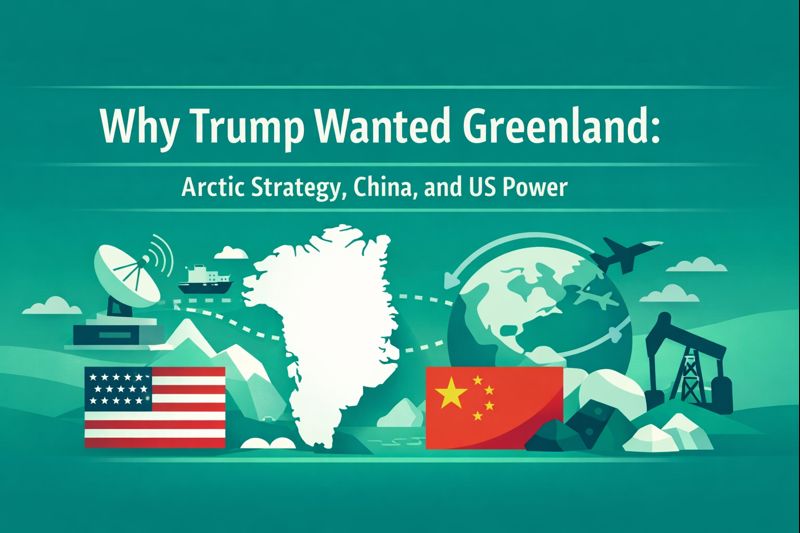
— Repricing National Balance Sheets in the Age of the Arctic —
- Executive Summary
- 1. Problem Definition: Why Greenland, and Why Now?
- 2. Arctic Shipping Routes and Structural Change in Global Trade
- 3. Military and Security Economics: The Invisible Yield
- 4. Resource Economics and the China Factor
- 5. Russia, Alliances, and the Repricing of Allies’ Assets
- 6. Greenland as Economic Thought: The State as a Balance Sheet
- Conclusion
Executive Summary
President Trump’s proposal to acquire Greenland was widely dismissed as eccentric or diplomatically naive. However, when examined through the lens of economics, geopolitics, and long-term strategic competition, the proposal reveals a highly rational—if unconventional—strategic logic.
At its core, the Greenland initiative reflects an attempt by the United States to reposition itself amid four structural shifts:
- The emergence of the Arctic as a viable economic and military corridor
- The strategic revaluation of critical resources, particularly rare earth elements
- Preventive containment of Chinese and Russian influence in peripheral regions
- A re-pricing of allied territories and geopolitical assets under great-power competition
This was not a land-grab in the classical sense, but a declaration of intent: the Arctic is becoming a primary theater of 21st-century power, and the United States intends to anchor itself decisively within it.
1. Problem Definition: Why Greenland, and Why Now?
From a conventional macroeconomic perspective, Greenland appears insignificant. Its population is small, its GDP negligible, and its immediate fiscal contribution limited.
Yet this assessment collapses once the analytical frame shifts from static valuation to dynamic option value.
Climate change is transforming the Arctic from a frozen buffer zone into:
- A navigable trade corridor
- A military transit space
- A reservoir of strategic resources
Greenland occupies a unique position where geography, security, and resource optionality converge. In financial terms, it is a deeply out-of-the-money option rapidly moving into the money.
2. Arctic Shipping Routes and Structural Change in Global Trade
The normalization of Arctic sea routes would materially shorten transit times between Europe and East Asia, reducing reliance on traditional chokepoints such as:
- The Suez Canal
- The Strait of Malacca
This shift does more than improve logistics efficiency. It erodes the geopolitical rent embedded in existing maritime bottlenecks and redistributes strategic leverage.
For the United States, the central objective is not merely access, but agenda-setting power:
- Rule-making authority
- Security oversight
- Crisis response capability
In this context, Greenland functions as a strategic anchor asset in a newly forming global trade topology.
3. Military and Security Economics: The Invisible Yield
Greenland sits along the shortest ballistic trajectory between Russia and North America, making it indispensable for:
- Early-warning radar systems
- Missile defense architecture
- Space and Arctic force projection
The crucial analytical move is to treat defense not as a sunk cost, but as an insured asset with asymmetric payoff.
Trump’s strategic intuition mirrors corporate risk management logic:
High upfront cost is acceptable if it materially reduces the probability of catastrophic loss.
From this perspective, sovereign control over Greenland would dramatically lower geopolitical tail risk.
4. Resource Economics and the China Factor
Greenland holds substantial deposits of:
- Rare earth elements
- Uranium
- Iron ore
In particular, rare earths are central to advanced manufacturing, defense systems, and clean energy—areas where China maintains structural dominance over global supply chains.
The Greenland proposal was not driven by near-term profitability, but by strategic expected value:
- Reducing dependence on Chinese supply
- Preventing Beijing from establishing upstream influence
- Preserving optionality in future industrial policy
This is less about competition within markets, and more about preventing monopoly power from forming at the geopolitical level.
5. Russia, Alliances, and the Repricing of Allies’ Assets
Russia has rapidly militarized its Arctic frontier and expanded energy exploration across the region. Greenland, meanwhile, remains an autonomous territory of Denmark, placing it squarely within NATO’s strategic perimeter.
Trump’s approach challenges a post-war assumption:
- Alliances are permanent and unconditional
Instead, his framework implicitly asserts:
- Alliances are stable
- But strategic assets within alliances are subject to renegotiation
This represents a shift from values-based alliance management toward portfolio optimization of geopolitical assets.
6. Greenland as Economic Thought: The State as a Balance Sheet
The intellectual core of the Greenland proposal lies not in territorial expansion, but in reframing the state as a consolidated balance sheet:
- Territory as fixed assets
- Military bases as insured infrastructure
- Alliances as equity stakes
- Diplomacy as merger and acquisition negotiation
Under this framework, Greenland appears as an underpriced asset with rising strategic beta.
In this sense, the proposal can be understood as an experiment in 21st-century geopolitical corporate finance.
Conclusion
President Trump’s Greenland acquisition proposal was easy to caricature and dismiss. Yet beneath its unconventional presentation lay a coherent strategic thesis:
- The Arctic is transitioning into a primary arena of global competition
- Strategic assets must be secured before scarcity becomes explicit
- Influence is cheaper to acquire early than to contest later
The acquisition itself did not occur.
But as a signaling mechanism—to allies, rivals, and markets alike—the proposal succeeded.
Its greatest achievement was not ownership, but reframing Greenland as a first-order strategic asset.
That revaluation has already been absorbed into the strategic calculus of the United States and other great powers.
In that sense, the proposal failed tactically—but succeeded strategically.