A Strategic Corridor at the Intersection of Power Competition, Sanctions, and Infrastructure Reordering
— An Economist’s Structural Assessment —
- Executive Summary
- Chapter 1. Why the Balkans Matter
- Chapter 2. Russia’s Approach: Influence via Pipes and Ownership
- Chapter 3. The EU Counter-Strategy: De-Risking Through Institutions
- Chapter 4. The United States: Sanctions as Market Architecture
- Chapter 5. China and Middle Eastern Capital: A Third Path?
- Chapter 6. National Pathways and Divergence
- Chapter 7. Economic Implications: Capital Costs over Commodity Prices
- Conclusion: The Balkans as Europe’s Energy Stress Test
Executive Summary
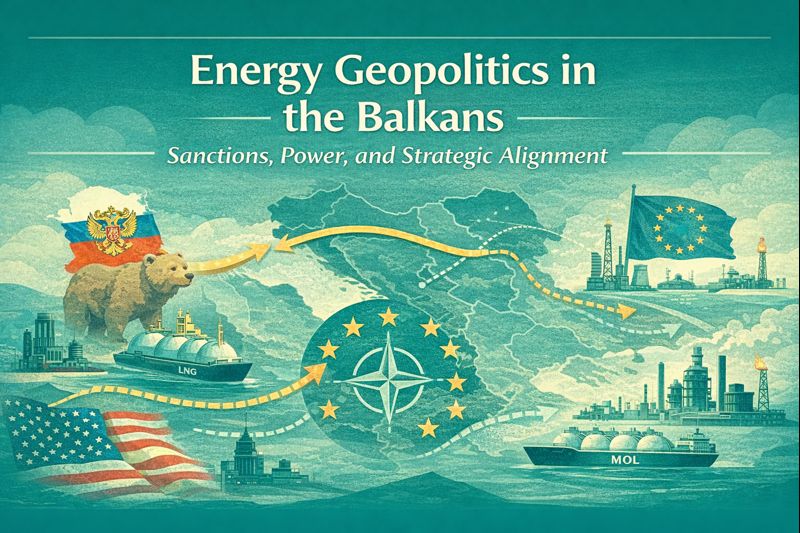
The Balkans are no longer a peripheral energy market. They constitute a strategic transit and decision corridor where Russian export strategy, EU de-risking, U.S. sanctions diplomacy, and alternative capital from China and the Middle East collide.
The central finding of this report is clear: energy outcomes in the Balkans are now determined less by prices or volumes than by alignment, institutions, and capital access. Over the next decade, the region will be among Europe’s most politically risk-priced energy spaces.
Chapter 1. Why the Balkans Matter
The Balkans combine four features that magnify geopolitical leverage:
- A transit position linking Russia, the EU, and the Eastern Mediterranean
- A mix of EU members and non-members, fragmenting rules and enforcement
- Aging infrastructure with urgent reinvestment needs
- Historically high dependence on Russian supply
This makes the region strategically indispensable yet structurally vulnerable to sanctions, supply interruptions, and capital withdrawal.
Chapter 2. Russia’s Approach: Influence via Pipes and Ownership
2.1 Pipeline geopolitics
Russia’s leverage has relied less on territory than on control of supply chokepoints:
- Gas flows via TurkStream into Southeast Europe
- Overland distribution through Serbia and Hungary
- Embedded stakes in refining, storage, and retail networks
This is a strategy of controlling the valve rather than the land.
2.2 State-owned enterprises as instruments
Key firms—Rosneft, Lukoil, and Gazprom Neft—have historically anchored Russia’s presence.
Their role reflects a model where corporate control and state power are intertwined, extending geopolitical reach through commercial assets.
Chapter 3. The EU Counter-Strategy: De-Risking Through Institutions
3.1 Not decoupling, but de-risking
The EU’s stated objective is not full disengagement, but structural dependence reduction. This has translated into:
- LNG entry points (e.g., Croatia’s Krk terminal)
- North–south gas interconnectors
- Grid integration, renewables, and storage
3.2 Conditional integration
For Balkan states, energy has become the frontline of institutional alignment. Access to EU funds, infrastructure finance, and accession momentum is increasingly conditioned on energy governance and ownership choices.
Chapter 4. The United States: Sanctions as Market Architecture
The U.S. is not a primary supplier, but it is the principal arbiter of financial permissibility:
- Primary and secondary sanctions
- Licensing and waivers administered by OFAC
- Enforcement that reshapes ownership and trade routes
Serbia’s NIS case illustrates a broader rule: third countries are not exempt when Russian control persists.
Chapter 5. China and Middle Eastern Capital: A Third Path?
5.1 China
Chinese capital has targeted power generation and grids, but growing sanctions exposure and political scrutiny have tempered expansion, especially where EU alignment is at stake.
5.2 Middle Eastern investors
Capital from the Gulf—particularly the UAE—offers:
- Rapid deployment capacity
- Lower geopolitical signaling than Russian or Chinese investment
As a result, Middle Eastern investors are emerging as plausible substitutes for sanctioned Russian ownership.
Chapter 6. National Pathways and Divergence
| Country | Strategic Posture | Key Risk |
|---|---|---|
| Serbia | Strategic neutrality | Sanctions exposure |
| Hungary | Exception-seeking | EU frictions |
| Croatia | EU-aligned | Investment burden |
| Bulgaria | Politically fluid | Policy volatility |
| Romania | EU-anchored | Infrastructure delays |
Across cases, a common pattern holds: energy choices now equal foreign-policy choices.
Chapter 7. Economic Implications: Capital Costs over Commodity Prices
Future outcomes will hinge less on oil or gas prices than on:
- Cost of capital
- Sanctions risk premia
- Insurance, shipping, and compliance costs
Where Russian ownership remains, financing costs rise sharply and logistics thin—a structural drag on long-term growth.
Conclusion: The Balkans as Europe’s Energy Stress Test
The Balkans are not Europe’s energy periphery; they are its stress test.
Here, three questions are being answered in real time:
- Can Russia’s resource-based influence endure under sanctions?
- Can the EU extend institutional order through energy integration?
- Do sanctions stabilize or fragment regional markets?
The answers will reverberate far beyond the region.
Final Assessment
What is unfolding is not a contest over molecules, but over membership in competing economic orders.
For the next decade, the Balkans will remain Europe’s most politicized energy market—where alignment, not abundance, determines outcomes.