By an Economic Analyst — Strategic Perspective Report
I. Introduction: When Resources Become Weapons
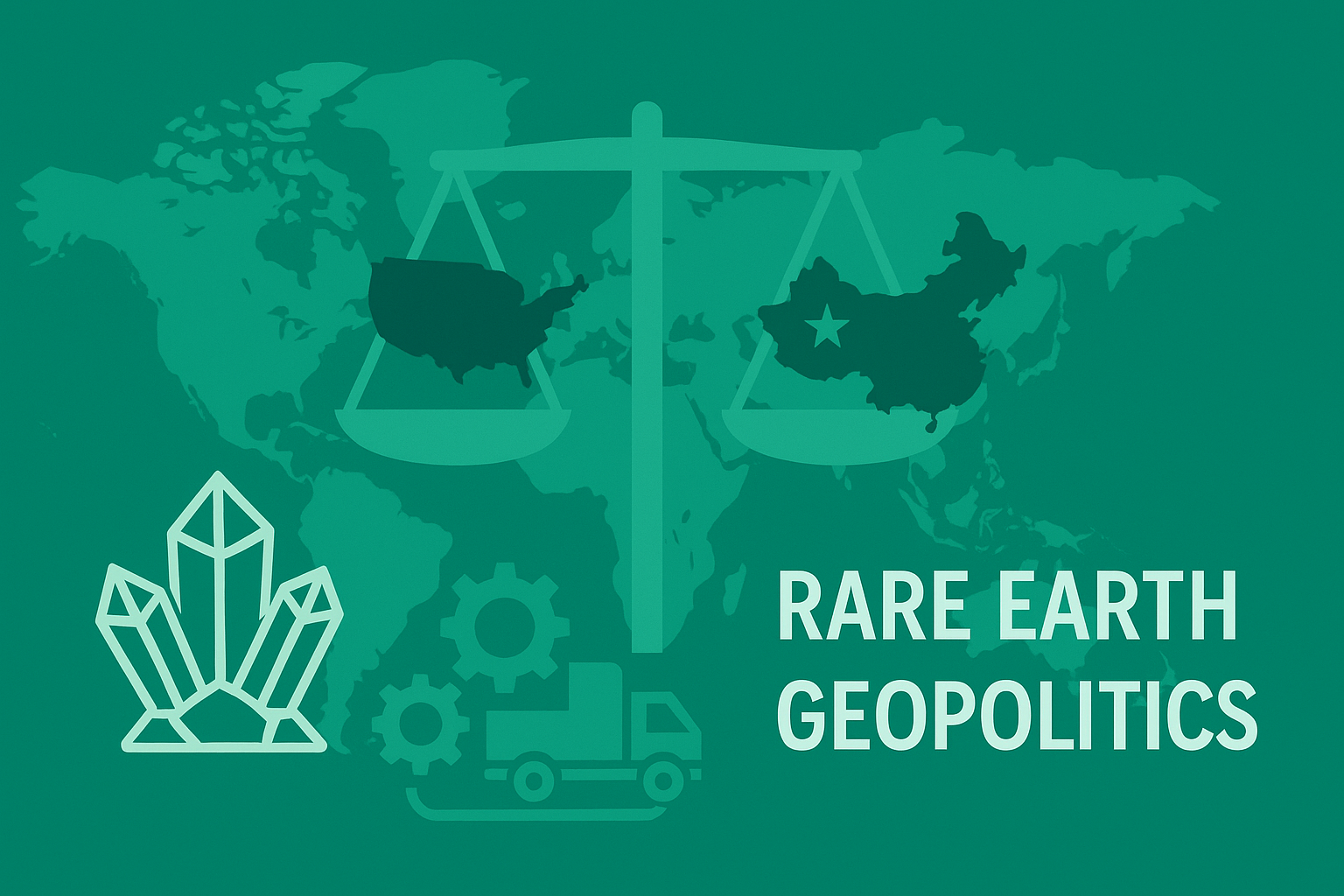
In the 21st century, geopolitical conflict is no longer confined to armies or finance — the supply chain itself has become a battlefield.
Among all strategic materials, rare earth elements form the silent backbone of energy, technology, and defense industries.
China’s dominance — controlling roughly 70–80% of global refining and processing capacity — grants it an unparalleled leverage: the ability to weaponize critical materials without firing a shot.
If that supply tap is turned off, even temporarily, the impact on global manufacturing, defense systems, and green energy transitions would be immediate and profound.
II. The U.S.–China Friction Scenario: Non-Military Deterrence Through Materials
Should Washington intensify its technology blockade on Beijing (AI, semiconductors, quantum, etc.), China would likely retaliate through export delays and selective restrictions on rare earths.
| Phase | Mechanism | Economic Impact |
|---|---|---|
| ① Military Bottlenecks | Delays in high-performance magnets and guidance systems | Procurement issues for Lockheed, Northrop, and defense contractors |
| ② Industrial Supply Choke | Disruption in semiconductor and EV motor chains | Reduced output for Tesla, GM, and chipmakers |
| ③ Retaliatory Spiral | U.S. sanctions escalation → Chinese counter-restrictions | Higher input costs, tech stagnation, market uncertainty |
This would mark the rise of a “Silent Blockade Strategy” — a non-military deterrence mechanism where materials, not missiles, paralyze industrial capacity.
Consequently, the U.S. would accelerate onshoring and ally-based supply networks, deepening economic bloc formation.
III. Multilateral Supply Chain Alliances: The “Tech NATO” Emerges
In response, the United States, Japan, the EU, Australia, and India are collectively building a post-China resource ecosystem.
Key initiatives include:
- Mining diversification in Australia, Greenland, and Vietnam
- Japan’s refining consortia via JOGMEC, Sumitomo Metal Mining, and Lynas
- EU Critical Raw Materials Act (2025) mandating diversified sourcing ratios
- India’s National Rare Earth Strategy Bureau (2025) to secure processing autonomy
These moves transcend resource security; they represent the embryonic form of a “Strategic Supply Chain Alliance” — effectively an economic NATO.
However, this structure carries the undertone of a China containment network, transforming resource diplomacy into a polarized, Cold War-like competition.
IV. The Rise of Resource Nationalism: The Global South Strikes Back
Beyond China, the wave of resource nationalism is spreading rapidly.
Indonesia’s nickel export ban and Chile/Bolivia’s lithium nationalization exemplify how resource-rich nations are reclaiming sovereignty over extraction and profits.
This evolution creates a triple tension:
- Producers vs. Processors – redistributing industrial margins
- National Sovereignty vs. Global Capital – redefining who owns the value chain
- Environmental Ethics vs. Supply Stability – balancing green and growth
As a result, resources are shifting from commodities to strategic levers of statecraft.
Countries now measure national power not just by GDP or military capacity, but by supply autonomy, recycling efficiency, and diplomatic leverage in materials.
V. Technological Decoupling: The New “Iron Curtain of Technology”
China has begun restricting the export of refining equipment and separation technologies, effectively stalling the growth of foreign midstream processing capabilities.
This move signals the onset of technological decoupling within the resource infrastructure itself.
- The U.S. bloc seeks “Clean Technology Networks” — trusted-ally supply systems.
- China, in turn, expands its influence through BRICS+ and South-South cooperation.
If this bifurcation solidifies, the world could face dual technological regimes, fragmenting standards, R&D ecosystems, and cost structures across two competing spheres.
VI. Sanctions and Counter-Sanctions: Toward a Multi-Layered Economic Cold War
Rare earth restrictions will likely spill over to other strategic resources — gallium, germanium, graphite — forming a cascading web of mutual embargoes.
| Sector | Immediate Effect | Broader Consequence |
|---|---|---|
| EV & Battery | Metal price surges and delivery delays | Decarbonization slowdown |
| Semiconductors & ICT | Shortages in materials and components | Inflationary pressures, slower innovation |
| Defense & Aerospace | Delays in component procurement | Setbacks in weapons and satellite programs |
| Financial Markets | Volatility in commodity ETFs and equities | Geopolitical capital flight and risk repricing |
Resources are thus morphing from “traded goods” into “ammunition of sanctions.”
This marks the evolution of “Stable Fragmentation” — a geopolitical order defined not by globalization, but by controlled, competing interdependencies.
VII. Conclusion: The Birth of a New Geoeconomic Order
At its core, the rare earth conflict is a battle over who controls the technological heart of the modern economy.
While China leverages resource dominance and midstream mastery, the U.S.–Japan–EU coalition advocates “Technological Democracy”, built on transparency and allied trust.
This rivalry will shape the next decade through three enduring trends:
- Allied Resource Diplomacy
- Bipolar Technology Standards
- Security-centric Globalization
Ultimately, the rare earth struggle is not about mining — it is about redefining global power in three dimensions:
(1) Geopolitical balance of power
(2) Governance of capitalism
(3) The irreversible shift toward a multipolar world
VIII. Policy Recommendations
| Strategic Area | Recommended Direction |
|---|---|
| 1. Friend-shoring of Supply Chains | Long-term extraction partnerships with Australia, India, and ASEAN nations |
| 2. Domestic Refining Investment | Tax incentives, R&D subsidies, and technology-transfer treaties |
| 3. Recycling & Substitution Innovation | National initiatives for rare metal recovery and alternative materials |
| 4. Global Resource Fund | Joint JBIC–World Bank–EIB financing for critical mineral projects |
| 5. Economic Security Architecture | Integrated ministries overseeing resources, technology, and finance |
Epilogue: From Efficiency to Security
The rare earth contest marks the symbolic end of the post-Cold War globalization era.
A new paradigm is emerging — one where trust outweighs efficiency, and security eclipses price.
To decode this transformation and anticipate its trajectories is, indeed, the defining mission of economists in the new geoeconomic age.