Why Major Financial Crises Emerge Through Converging Forces
Date:2025/10
- Executive Summary
- 1. Dalio’s Core Insight: Crises Are Cyclical, Not Accidental
- 2. The Three Pillars of the “Big Cycle”
- 3. Why Dalio Believes the Current Era Is Uniquely Fragile
- 4. How the Next Crisis Will Differ from Lehman
- 5. Convergence with Modern Central Bank Supervision
- 6. Practical Implications for Investors and Institutions
- Conclusion
Executive Summary
Ray Dalio does not forecast crises in the conventional sense.
Rather, he identifies the structural conditions under which crises become inevitable.
His central thesis is consistent and unambiguous:
Systemic crises do not arise from financial imbalances alone.
They occur when debt constraints, political fragmentation, and geopolitical conflict converge—
at precisely the moment central banks lose their freedom of action.
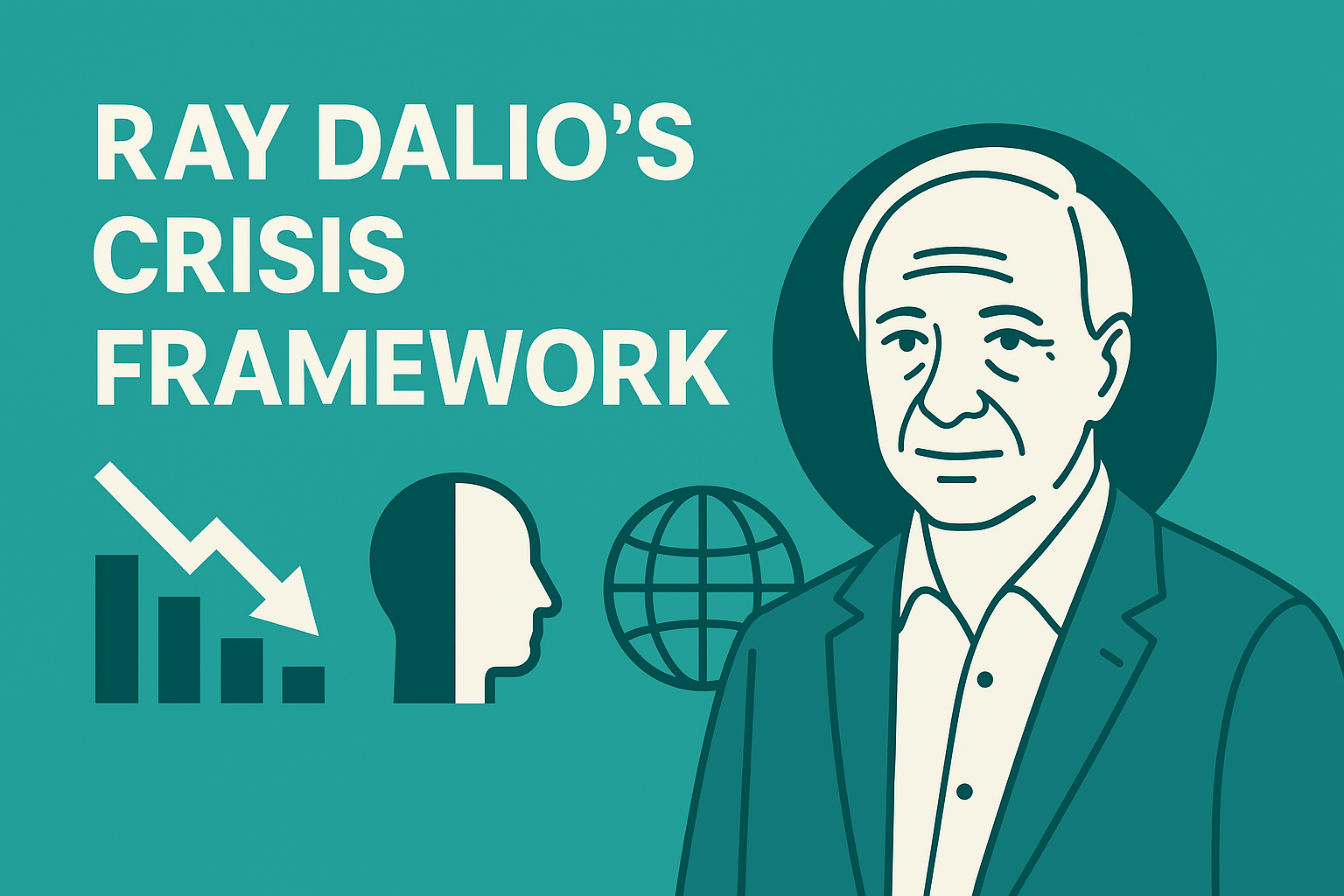
This report reconstructs Dalio’s crisis framework and explains why the current global environment closely resembles the late stage of what he terms the “Big Cycle.”
1. Dalio’s Core Insight: Crises Are Cyclical, Not Accidental
Dalio’s crisis theory begins with a rejection of the “shock” narrative.
Financial crises are not black swans.
They are endogenous outcomes of long-term cycles.
Across centuries, Dalio observes a recurring pattern:
- Expansion of debt and credit
- Prolonged financial stability and risk-taking
- Suppression of volatility and risk premia
- Policy constraints emerge
- Non-linear systemic breakdown
Crises occur not because events are unpredictable, but because systems eventually exceed their capacity to absorb stress.
2. The Three Pillars of the “Big Cycle”
Dalio argues that severe crises require the simultaneous activation of three forces.
2.1 Debt and Monetary Limits
At the late stage of the debt cycle:
- Debt levels are structurally high
- Interest-rate sensitivity increases
- Monetary easing becomes inflationary
- Tightening becomes destabilizing
Policy trade-offs become acute.
When monetary tools lose effectiveness, financial stress escalates rapidly.
This is not a recessionary condition—it is a policy paralysis condition.
2.2 Internal Conflict and Political Fragmentation
Dalio consistently emphasizes that financial instability is amplified by political dysfunction.
Key indicators include:
- Widening inequality
- Political polarization
- Declining institutional trust
- Pressure on central bank independence
Markets do not merely assess policy intent.
They assess whether policy can be executed at all.
When governance credibility erodes, risk premiums rise discontinuously.
2.3 External Conflict and the Breakdown of Global Order
The third pillar is geopolitical.
Dalio highlights:
- Strategic rivalry between major powers
- Weaponization of trade, finance, and sanctions
- Fragmentation of payment and settlement systems
- Politicization of reserve currencies
His warning is explicit:
When money becomes a political weapon rather than a neutral store of value,
the global financial system becomes inherently unstable.
3. Why Dalio Believes the Current Era Is Uniquely Fragile
Dalio avoids precise timing.
Instead, he evaluates condition alignment.
Today’s environment exhibits:
- High global debt alongside restrictive financial conditions
- Persistent political polarization across advanced economies
- Rising geopolitical confrontation and economic bloc formation
- Expansion of leveraged non-bank financial intermediaries
- Increasing political constraints on central bank responses
In Dalio’s framework, this constellation signals late-cycle vulnerability.
4. How the Next Crisis Will Differ from Lehman
Dalio is explicit that the next crisis will not resemble 2008 in form.
Key distinctions:
| Lehman Crisis | Next Systemic Crisis |
|---|---|
| Financial sector leverage | Financial + political + geopolitical |
| Central banks unconstrained | Central banks politically constrained |
| Market-based liquidity shock | Institutional and structural liquidity shock |
| Clear safe assets | Simultaneous stress in “safe” assets |
The defining feature will not be asset price collapse, but institutional dysfunction.
5. Convergence with Modern Central Bank Supervision
Dalio’s framework aligns closely with the current evolution of financial supervision.
Central banks—particularly the ECB—now emphasize:
- Reverse stress testing
- Liquidity survivability horizons
- Funding and settlement continuity
- Geopolitical and sanctions risk
The shared insight is simple:
The most dangerous risk is not volatility,
but the disappearance of market functionality itself.
6. Practical Implications for Investors and Institutions
Dalio’s crisis framework implies a shift in risk management priorities:
- Leverage must be assessed under non-continuous liquidity conditions
- “Safe assets” must be diversified across jurisdictions and functions
- Liquidity should be measured by access, not balance-sheet size
- Scenario analysis must include political and institutional failure modes
This is not a call for pessimism—it is a call for resilience.
Conclusion
Ray Dalio’s crisis analysis is not a prediction.
It is a diagnostic framework.
He does not ask when the next crisis will occur.
He asks:
What must simultaneously break for a crisis to become unavoidable?
The current global environment increasingly satisfies those conditions.
Crises are not defined by what fails first,
but by what fails together.
Understanding this convergence is the most valuable risk management insight Dalio offers to investors, policymakers, and financial institutions today.