— Expansionary Hegemony vs. Selective Hegemony —
Executive Summary
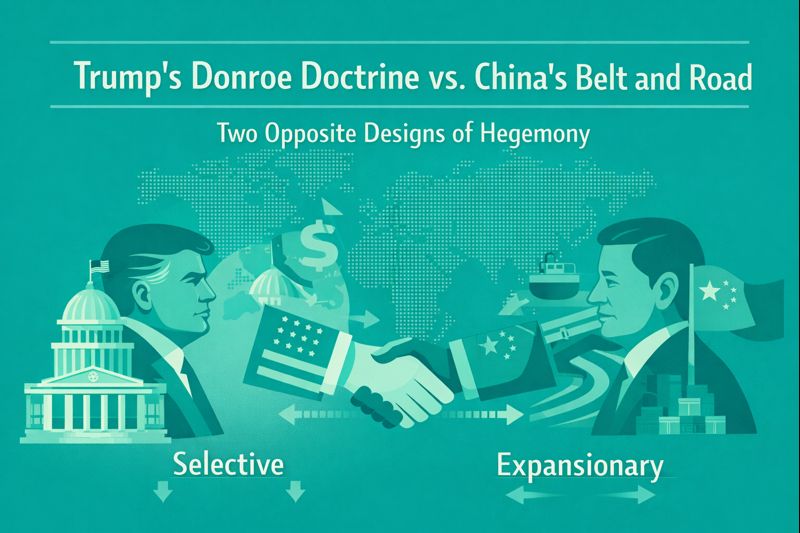
Trump’s modernized Monroe Doctrine (“Donroe Doctrine”) and China’s Belt and Road Initiative are often framed as competing strategies.
This framing is misleading.
They do not compete on the same axis. Instead, they represent opposite solutions to the same structural problem:
how a major power manages global influence under rising economic, financial, and political constraints.
The Belt and Road Initiative expands the world by absorbing risk.
The Donroe Doctrine narrows the world by rejecting risk.
This asymmetry—not direct confrontation—is what defines today’s unstable global order.
1. Two Strategies, Two Worldviews
China’s Belt and Road Initiative: Expansion Through Risk Absorption
From an economic perspective, the BRI is not merely an infrastructure program. It is a mechanism to:
- Export excess capital and industrial capacity
- Convert geopolitical uncertainty into credit relationships
- Expand influence through debtor dependence rather than formal alliances
China’s implicit assumption is:
“The world may be unstable, but expansion must continue.”
Risk is not avoided; it is internalized and postponed through long-dated loans, state-backed projects, and political relationships.
This is an accumulative, outward-looking hegemony model.
Trump’s Donroe Doctrine: Power Through Selectivity
By contrast, Trump’s approach—associated with Donald Trump—starts from a different premise:
- Global order is expensive
- Unlimited engagement is fiscally and politically unsustainable
- Ambiguity creates hidden liabilities
Therefore, the Donroe Doctrine emphasizes:
- Explicit spheres of influence
- Alliances evaluated as contracts, not moral obligations
- Intervention justified by return on investment
The guiding logic is:
“The world must be reduced to what can be managed.”
This is a selective, inward-optimizing hegemony model.
2. Structural Comparison of the Two Models
| Dimension | Donroe Doctrine (U.S.) | Belt and Road Initiative (China) |
|---|---|---|
| Direction of Power | Selective, inward | Expansive, outward |
| View of the World | Costly and overextended | Opportunity-rich |
| Risk Management | Risk rejection | Risk absorption |
| Mode of Influence | Contracts and conditions | Credit and dependence |
| Fiscal Philosophy | Loss avoidance | Long-term recovery assumption |
| Failure Mode | Strategic vacuum | Debt and political entanglement |
3. Why These Strategies Do Not Collide Head-On
A critical insight is that Trump did not seek to “destroy” the Belt and Road Initiative.
The implicit message of the Donroe Doctrine to China is:
“You may expand—but the United States will not underwrite the consequences.”
In other words:
- The U.S. will not provide institutional guarantees
- The U.S. will not act as the stabilizer of last resort
- The U.S. will not absorb downstream political or financial losses
This is not opposition—it is disengaged accountability.
4. The Paradox: When the Belt and Road Suffers Most
Ironically, the Belt and Road Initiative is weakest in a Donroe-style world.
When the United States:
- Withdraws from implicit system guarantees
- Reduces diplomatic and security backstopping
- Treats instability as someone else’s problem
China is forced into the role of:
Lender of last resort, political guarantor, and crisis manager
This dynamic is already visible in cases such as:
- Venezuela
- Sri Lanka
- Several African and Central Asian economies
What began as expansion turns into risk concentration.
5. An Economist’s Assessment
Strengths of the Donroe Doctrine
- Controls hegemonic costs
- Aligns foreign policy with domestic fiscal and political constraints
- Limits cascading failures by exiting early
Strengths of the Belt and Road Initiative
- Rapid expansion of influence
- Strong appeal to developing economies
- Ability to fill governance vacuums left by the U.S.
Core Vulnerabilities
- Donroe Doctrine:
→ Creates strategic vacuums - Belt and Road Initiative:
→ Overaccumulates political and financial risk
Final Conclusion
The Donroe Doctrine does not aim to stop the Belt and Road Initiative.
Its real function is this:
To ensure that the full cost of global expansion is borne entirely by China.
In a world where both strategies coexist:
- The United States becomes a selective hegemon
- China becomes an absorptive hegemon
The result is not balance, but greater fragmentation and volatility in the international system.