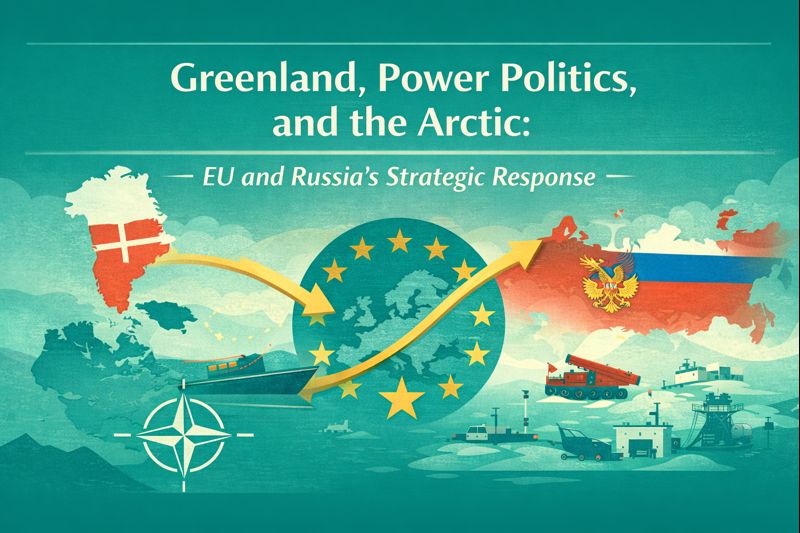
— An Economist’s Strategic Assessment of Order, Alliances, and Geopolitical Signaling —
- Executive Summary
- Chapter 1. Why the Greenland Episode Matters
- Chapter 2. The European Union: Institutional Defense of Sovereignty
- Chapter 3. NATO Context: A Silent Friction Within the Alliance
- Chapter 4. Russia: Strategic Opportunism Through Restraint
- Chapter 5. Comparative Analysis: Two Strategic Reflexes
- Chapter 6. Economic and Strategic Implications
- Conclusion: A Symbolic Turning Point, Not a Diplomatic Anomaly
Executive Summary
President Donald Trump’s expressed interest in acquiring Greenland was never a realistic transactional proposal. Its significance lies instead in the strategic signal it sent.
This report argues that the episode functioned as a stress test for the rule-based order in the Arctic. The European Union responded with firm institutional rejection rooted in sovereignty and legal norms, while Russia interpreted the event as confirmation that the Arctic has irreversibly entered a phase of explicit great-power competition. The asymmetry of reactions reveals how differently actors internalize risk, power, and legitimacy in a multipolar world.
Chapter 1. Why the Greenland Episode Matters
Greenland is not merely a territory. It is simultaneously:
- a Danish autonomous region,
- a strategic node in North Atlantic and Arctic security,
- a location of existing U.S. military presence,
- and a future resource and shipping hub.
Against this backdrop, a public suggestion of territorial acquisition by a leading alliance power was bound to resonate far beyond its practical feasibility. The episode became a revealing moment—not because it altered borders, but because it exposed underlying assumptions about who can bend rules, and when.
Chapter 2. The European Union: Institutional Defense of Sovereignty
2.1 Immediate reaction: non-negotiability of territory
EU governments, led by Denmark, rejected the idea unequivocally. The core message—Greenland is not for sale—was not rhetorical but doctrinal. For the EU, territorial sovereignty and self-determination are not bargaining variables, even among allies.
2.2 Structural concern: precedent, not personality
Privately, EU policymakers focused less on the individual leader and more on precedent:
- Could alliance leadership legitimize transactional territorial thinking?
- Would power trump legal order if interests escalated?
This concern strengthened the EU’s long-standing debate on Strategic Autonomy—not as a rejection of the United States, but as insurance against alliance volatility.
Chapter 3. NATO Context: A Silent Friction Within the Alliance
Greenland sits at the intersection of Danish sovereignty and NATO’s Arctic posture. The novelty was not Arctic competition, but the articulation of territorial acquisition within an alliance framework.
European NATO members avoided public escalation. Internally, however, the episode entered strategic planning as a low-probability, high-impact risk scenario—one that challenged implicit assumptions about alliance discourse and boundaries.
Chapter 4. Russia: Strategic Opportunism Through Restraint
4.1 Official posture: restraint over confrontation
Russia refrained from sharp criticism. Statements were measured, occasionally ironic. This was a calculated choice:
- open condemnation would elevate tensions,
- silence allowed narrative flexibility.
4.2 Strategic interpretation: normalization of power politics
Substantively, Moscow read the episode as confirmation that the Arctic is no longer governed solely by norms. If even the United States framed Arctic geography in acquisition terms, Russia could argue that:
- competitive logic is universal,
- its own Arctic militarization is not exceptional but adaptive.
For the Kremlin under Vladimir Putin, this strengthened the legitimacy of:
- expanded military infrastructure,
- tighter control over Arctic sea routes,
- framing Arctic policy as strategic realism rather than revisionism.
Chapter 5. Comparative Analysis: Two Strategic Reflexes
| Dimension | European Union | Russia |
|---|---|---|
| Core interpretation | Threat to legal-institutional order | Validation of power competition |
| Primary response | Normative rejection | Strategic absorption |
| Policy instinct | Rules and multilateral governance | Presence and control |
| Long-term vision | Managed, cooperative Arctic | De facto sphere of influence |
The EU treats the Arctic as a governed space; Russia treats it as a contested space. The Greenland episode reinforced, rather than created, this divergence.
Chapter 6. Economic and Strategic Implications
From an economic perspective, the episode accelerated three trends:
- Risk pricing of Arctic governance: Investors and states increasingly factor geopolitical volatility into Arctic projects.
- Institutional hedging in Europe: EU initiatives on Arctic policy, defense coordination, and resource security gained momentum.
- Narrative leverage for Russia: Moscow gained rhetorical cover to portray Arctic competition as symmetrical rather than unilateral.
Importantly, none of these effects required policy execution—the signal alone was sufficient.
Conclusion: A Symbolic Turning Point, Not a Diplomatic Anomaly
The Greenland proposal was not a policy blueprint. It was a signal event that:
- reminded the EU that legal order cannot rely on goodwill alone,
- reassured Russia that power politics define Arctic realities.
In economic terms, it marked a shift from an Arctic risk environment priced on cooperation assumptions to one increasingly priced on strategic uncertainty.
Final Assessment
The episode did not redraw maps, but it redrew expectations.
It symbolized the Arctic’s transition from a peripheral zone of managed cooperation to a core theater of great-power politics, where norms still matter—but are increasingly tested by power.
For policymakers and economists alike, the lesson is clear: in the Arctic, credibility and governance will now be evaluated not only by rules written, but by power implied.