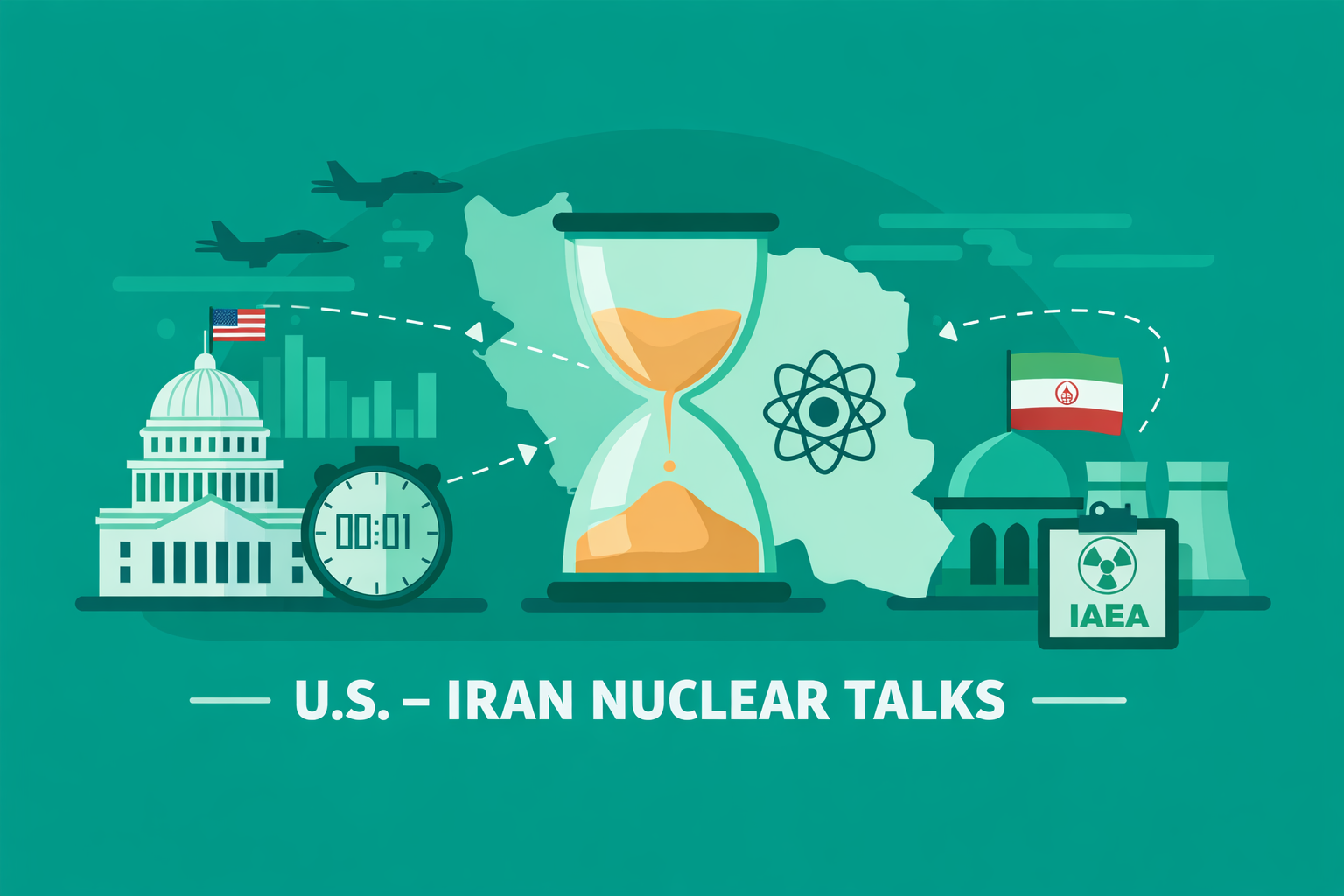
— A Form of Diplomacy Designed to Buy Time
When people hear about negotiations between the United States and Iran, they tend to frame the issue in binary terms: Will the nuclear deal be revived, or is war inevitable?
This framing is misleading. What is unfolding today is neither a peace process nor a prelude to war. It is, instead, a risk-management exercise designed to prevent an irreversible outcome.
At its core, the current U.S.–Iran dialogue is not about reaching a grand agreement. It is about buying time.
Choosing Not to Make a Deal
Today, United States and Iran are not sitting across from each other at the same table. Talks are conducted indirectly, typically through intermediaries such as Oman. This is not diplomatic courtesy; it is a deliberate design choice.
Direct talks produce images, symbolism, and political narratives. A single handshake can be portrayed domestically as capitulation. Indirect talks, by contrast, preserve ambiguity. They allow both sides to advance practical discussions while retaining political deniability at home.
In short, the structure of the talks is meant to preserve the option of walking away without political collapse. This is not weakness. It is structural resilience.
Managing Time, Not Eliminating Capability
Publicly, negotiations revolve around uranium enrichment levels, centrifuge counts, and inspection protocols. Privately, the U.S. focus is far more singular: breakout time—the amount of time Iran would need to produce enough fissile material for a nuclear weapon.
Washington does not realistically expect Iran’s nuclear capability to disappear. Instead, the objective is to slow progress and preserve decision-making space. Temporary freezes replace permanent bans. Operational constraints replace physical destruction.
This explains why diplomacy and military signaling proceed in parallel. The goal is not trust, but delay. Not disarmament, but control over timing.
The IAEA as Negotiating Infrastructure
The International Atomic Energy Agency (IAEA) is often portrayed as a neutral technical body. In practice, it functions as critical negotiating infrastructure.
For the U.S., IAEA reports provide legal and political justification for sanctions or escalation. For Iran, cooperation with inspectors becomes a calibrated signal—an adjustable lever rather than a binary commitment.
Expanded access signals restraint. Restricted access signals warning. The IAEA thus serves not only to verify facts, but also to translate political intent into measurable indicators. It is less a referee than a thermometer.
Sanctions Are Not Rewards — They Are Controls
One of the most persistent misunderstandings concerns sanctions relief. Sanctions are not lifted as rewards for good behavior. They are modulated.
Full removal carries heavy political costs and is difficult to reverse. Temporary waivers, selective enforcement, and narrowly defined exemptions are far more useful. They can be granted, withdrawn, and recalibrated quickly.
Sanctions, in this framework, function less like punishment and more like a remote control. Their value lies not in severity, but in reversibility.
Why Rhetoric Hardens as Talks Progress
Observers often misinterpret increasingly harsh rhetoric as a sign of failure. In reality, the opposite is often true. The primary audience for negotiating statements is not the other side, but domestic politics.
The U.S. must reassure allies and legislators that it is not appeasing Iran. Iranian leaders must reassure hardliners that they are not surrendering sovereignty. As substantive discussions deepen, verbal posturing intensifies.
This paradox—more progress, harsher language—is a hallmark of negotiations conducted under intense domestic constraints.
The Case Against a Grand Bargain
Why not pursue a comprehensive agreement? Because comprehensive agreements are fragile. They require ratification, long-term compliance, and political continuity across electoral cycles. Each of these is a potential failure point.
Modular, limited arrangements are less elegant, but more durable. By separating nuclear issues, sanctions management, and regional security, negotiators reduce the risk that failure in one domain collapses the entire structure.
This is not a lack of ambition. It is strategic realism.
Quiet Does Not Mean Success
The current talks are not quiet because they are successful. They are quiet because they have not yet collapsed. That distinction matters.
From an economic and strategic perspective, the key metric is not whether an agreement exists on paper, but whether the timeline to nuclear weaponization is being extended. As long as time is being bought, worst-case scenarios are deferred.
This is not inspiring diplomacy. It does not lend itself to dramatic announcements or historic ceremonies. But in a system where escalation is easy and reversal is not, time itself is the most valuable currency.
The U.S.–Iran negotiations are best understood not as a quest for peace, but as an ongoing effort to keep catastrophe at arm’s length—one extension at a time.