– The Deepening Financial Siege on Moscow’s Energy Revenues –
1. Overview
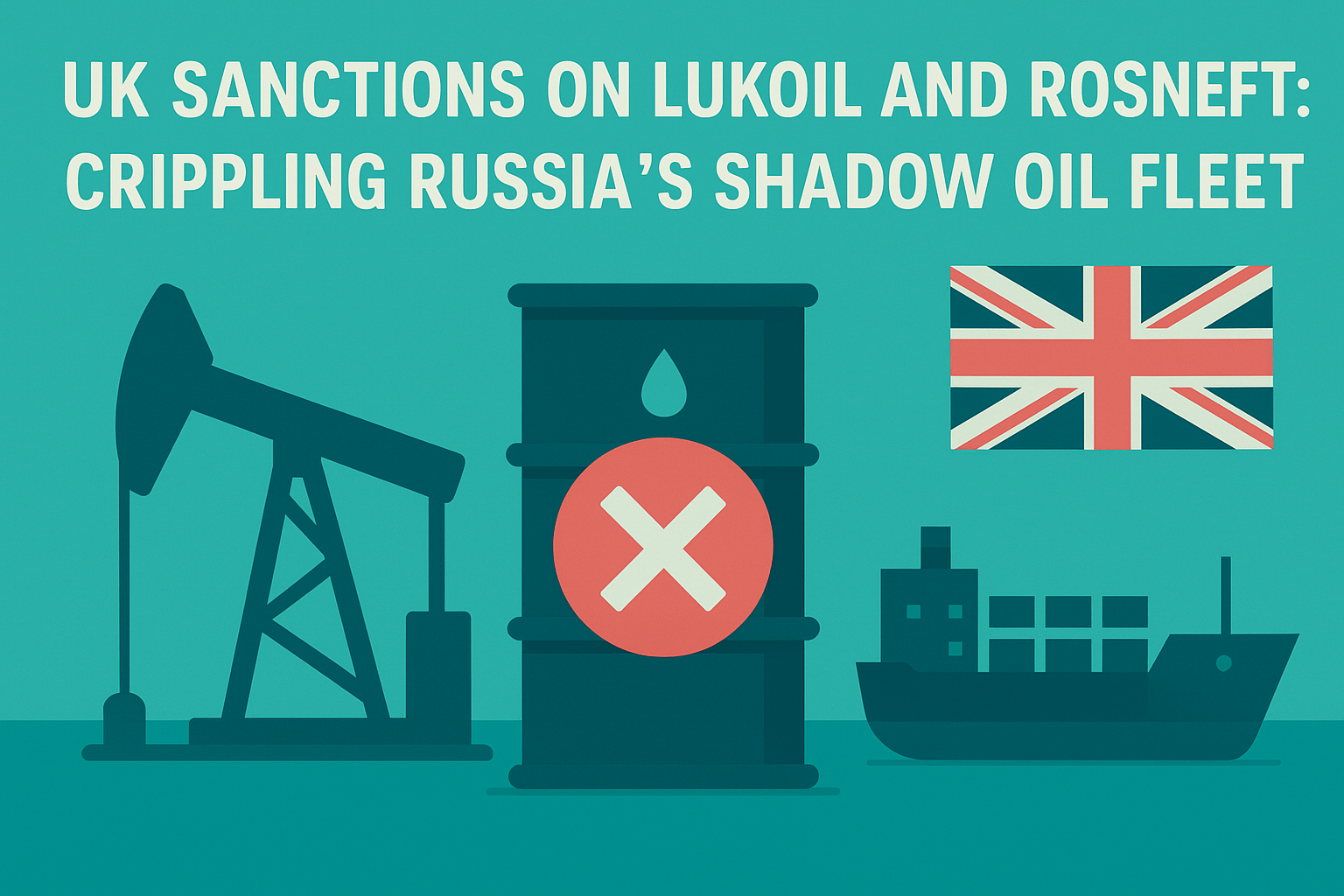
On October 15, 2025, the UK government announced sweeping new sanctions targeting Russia’s top oil producers, Rosneft and Lukoil, as well as their extensive “shadow fleet” of tankers used to bypass international restrictions. The package adds 90 new entities and individuals to the UK sanctions list, expanding asset freezes, prohibiting trust and management services, and restricting vessel operations linked to Russian crude exports.
(Sources: Reuters, GOV.UK, S&P Global, The Moscow Times)
2. Background and Strategic Context
Since Russia’s invasion of Ukraine in February 2022, Western powers have systematically targeted Moscow’s energy revenues — the Kremlin’s primary financial lifeline. The latest British measures go beyond targeting financial intermediaries: they strike directly at the core of Russia’s oil industry and the logistical infrastructure that sustains it.
Rosneft accounts for nearly 50% of Russia’s total oil production and roughly 6% of global output, while Lukoil represents the country’s largest privately held energy firm. Together, they anchor Russia’s crude exports to Asia and the Middle East, particularly through fleets of older, opaque vessels—known as the “shadow fleet”—used to circumvent the G7 oil price cap and insurance restrictions.
By adding between 44 and 51 of these tankers to its sanctions list, the UK aims to disrupt Russia’s covert maritime logistics, which have enabled Moscow to maintain oil exports despite Western embargoes. The measures follow growing intelligence that Russian entities have rerouted crude shipments via third-party operators, offshore jurisdictions, and reflagged vessels to evade detection.
This latest round of sanctions signals that London now seeks to eliminate Russia’s residual oil-trading ecosystem, thereby eroding the Kremlin’s fiscal base. In parallel, British officials have urged India, China, and other Asian importers to scale back purchases of discounted Russian oil, underscoring a coordinated Western campaign to close remaining loopholes.
(Sources: Reuters, GOV.UK, S&P Global)
3. Scope and Key Measures
The October 15 sanctions include:
- Asset freezes on Rosneft, Lukoil, and related subsidiaries.
- Prohibitions on UK-based trust and management services for sanctioned entities and their executives.
- Revocation of UK directorship qualifications for affiliated individuals.
- Designation of 44–51 vessels as sanctioned assets, effectively blocking their port access and maritime services.
According to the UK Foreign Office, these measures “strike at the heart of Russia’s ability to finance its illegal war of aggression” and “close the remaining pathways for Russian oil to reach global markets.”
(Sources: The Moscow Times, GOV.UK)
4. Implications and Global Reaction
Market Impact: The sanctions are expected to tighten shipping capacity for Russian crude, raise insurance premiums, and add friction to supply routes to Asia. Analysts anticipate modest upward pressure on Brent prices if enforcement proves effective.
Russian Response: Moscow condemned the UK’s move as an “economic act of hostility,” while Russian shipping brokers warned that the “shadow fleet” may expand further under non-Western flags. Lukoil and Rosneft have not publicly commented.
International Coordination: The United States and European Union are reportedly preparing parallel actions against the same maritime networks, highlighting an emerging pattern of synchronized enforcement across Western jurisdictions.
(Sources: Reuters, S&P Global)
5. Strategic Assessment
The UK’s sanctions mark a transition from financial containment to logistical interdiction—targeting not just oil producers but the physical means of distribution. This signals a broader shift in Western policy: dismantling Russia’s alternative trade networks that sustain its war economy.
However, enforcement challenges remain. Many “shadow fleet” vessels are nominally owned by companies in the UAE, India, and Greece, often shielded by layered ownership structures and offshore registration. Without coordinated maritime tracking and insurance denial from global insurers, the impact could be partial or delayed.
Nonetheless, the policy’s symbolism is potent: the UK is positioning itself as the spearhead of the anti-Russian energy sanctions regime post‑EU.
6. Implications for Japan and JBIC-linked Projects
For Japanese corporations and state-backed financiers such as JBIC (Japan Bank for International Cooperation), this development necessitates an urgent reassessment of all contracts or supply arrangements involving Rosneft, Lukoil, or Russian-origin crude.
- Energy & trading firms should verify that chartered tankers, intermediaries, and insurers are not among the sanctioned entities.
- Financial institutions must strengthen KYC protocols for energy-linked financing, particularly in regions (Middle East, India, Southeast Asia) where Russian oil rerouting occurs.
- Policy planning should incorporate new stress scenarios: rising crude prices, tighter shipping capacity, and extended delivery timelines for energy imports.
7. Conclusion
The UK’s decision to sanction Rosneft, Lukoil, and the shadow fleet represents a major escalation in the West’s economic war against Russia’s oil apparatus. By directly targeting the vessels and infrastructure enabling illicit exports, London aims to choke Moscow’s war funding at its source. The move also signals tighter transatlantic coordination and increased scrutiny of third-country intermediaries.
For global energy players—including Japan—this is a pivotal reminder that the geopolitical risk landscape surrounding Russian hydrocarbons remains volatile, and compliance, diversification, and due diligence will define resilience in the months ahead.
Reported: October 15, 2025
Sources: Reuters; GOV.UK; S&P Global; The Moscow Times