— A Nation Weak in Form, Strong in Institutions: Europe’s Structural Crossroads —
Introduction | Why Observe Belgium Now
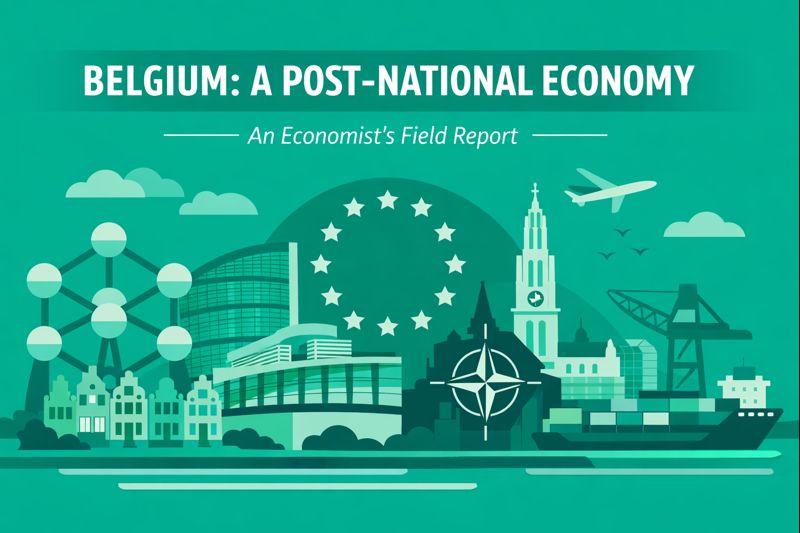
I selected Belgium as the next destination following the UAE for a clear reason.
Belgium is not an economically “flashy” country. However, it is one of the few places where the political, institutional, and economic contradictions of modern Europe are compressed into a single national framework.
If the UAE represents a designed state, Belgium represents a negotiated one.
This report does not judge Belgium as a success or failure; rather, it treats the country as a realistic endpoint of a mature society, where stability is maintained through institutional depth rather than national unity.
Chapter 1 | The First Quiet Dissonance
— Borders Exist, but the Nation Feels Abstract —
Upon arriving in Brussels, one immediately senses the weak presence of the nation-state.
- French and Dutch coexist visibly
- Political, educational, and cultural systems differ by region
- National symbols are subdued
Yet daily life is orderly and economically stable.
This gap is the key to understanding Belgium.
Belgium is not a strong nation bound by identity.
It is a society held together by institutions and continuous compromise.
Chapter 2 | Brussels as a Post-National Capital
— Concentration Born from Sovereign Neutrality —
Any serious economic analysis of Belgium must center on
Brussels.
Brussels hosts:
- Major institutions of the European Union
- NATO headquarters
- A dense ecosystem of diplomats, lobbyists, and policy professionals
Crucially, Belgium did not aspire to become Europe’s political center.
Rather, its internal divisions and limited assertion of sovereignty made Brussels acceptable to all parties.
The absence of strong national dominance created a neutral gravitational center.
Chapter 3 | Economic Structure of a Divided State
— Friction as a Tool for Stability —
Belgium is a deeply federalized country:
- Flanders (Dutch-speaking): export-driven manufacturing and logistics
- Wallonia (French-speaking): public sector, services, and redistribution
- Brussels: international governance and knowledge industries
Policy decisions are slow. Government formation can take months or even years.
Yet institutional collapse does not occur.
From an economist’s perspective, this is not inefficiency but
deliberate institutional friction designed to maximize social cohesion.
Chapter 4 | Belgium as a Logistics Power
— How Small States Remain Relevant —
4
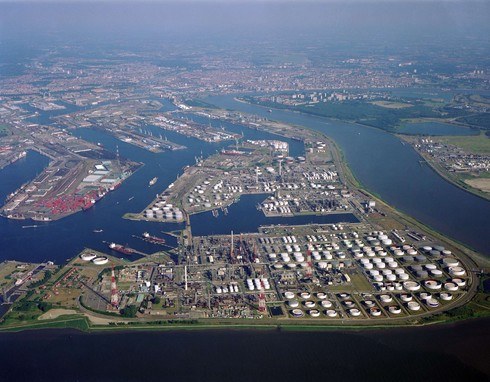
Belgium’s economic relevance is anchored by
Port of Antwerp.
- One of Europe’s largest ports
- Core hub for chemicals, energy, and intermediate goods
- Direct access to Germany, France, and inland Europe
Belgium abandoned the idea of competing through domestic scale early on.
Instead, it maximized value as a transit and adjustment node within global supply chains.
For small, open economies, this is a highly rational survival strategy.
Chapter 5 | The Cost Structure of a Mature Society
— Choosing Stability Over Growth —
Belgium is a high-welfare state:
- Universal healthcare
- High-quality education
- Institutional mitigation of inequality
At the same time, it faces:
- Heavy tax and social contribution burdens
- Low potential growth
- Limited fiscal flexibility
This combination represents not failure, but a conscious societal choice.
Belgium is close to the final form of a mature economy, where resilience outweighs expansion.
Chapter 6 | Implications for Japan
— Designing Systems for Division —
The key lessons Belgium offers are the following:
- National unity is not a prerequisite for stability
- Slow consensus is not equivalent to weakness
- Even small countries can retain relevance by becoming indispensable nodes
For Japan, the insight is not imitation, but translation:
how to redesign institutions under demographic decline and social fragmentation.
Conclusion | Belgium as Proof of Societal Durability
Belgium is neither a strong state nor a growth story.
Yet it has demonstrated, over decades,
how a fragmented, high-cost society can endure without systemic breakdown.
If the UAE represents an experiment in future-oriented state design,
Belgium stands as
a living proof of how far a mature society can be stabilized through institutions alone.
This contrast is essential for any serious discussion about the future of advanced economies.